
@being_on_line @bratton @NoemaMag 8/ The essay grants radical freedom to AI’s evolutionary future while denying the possibility of novelty beyond history itself: 'Process may surprise us indefinitely, but ontology may not.' That's a metaphysical prior, treated as ontological realism and presented as plain sense.
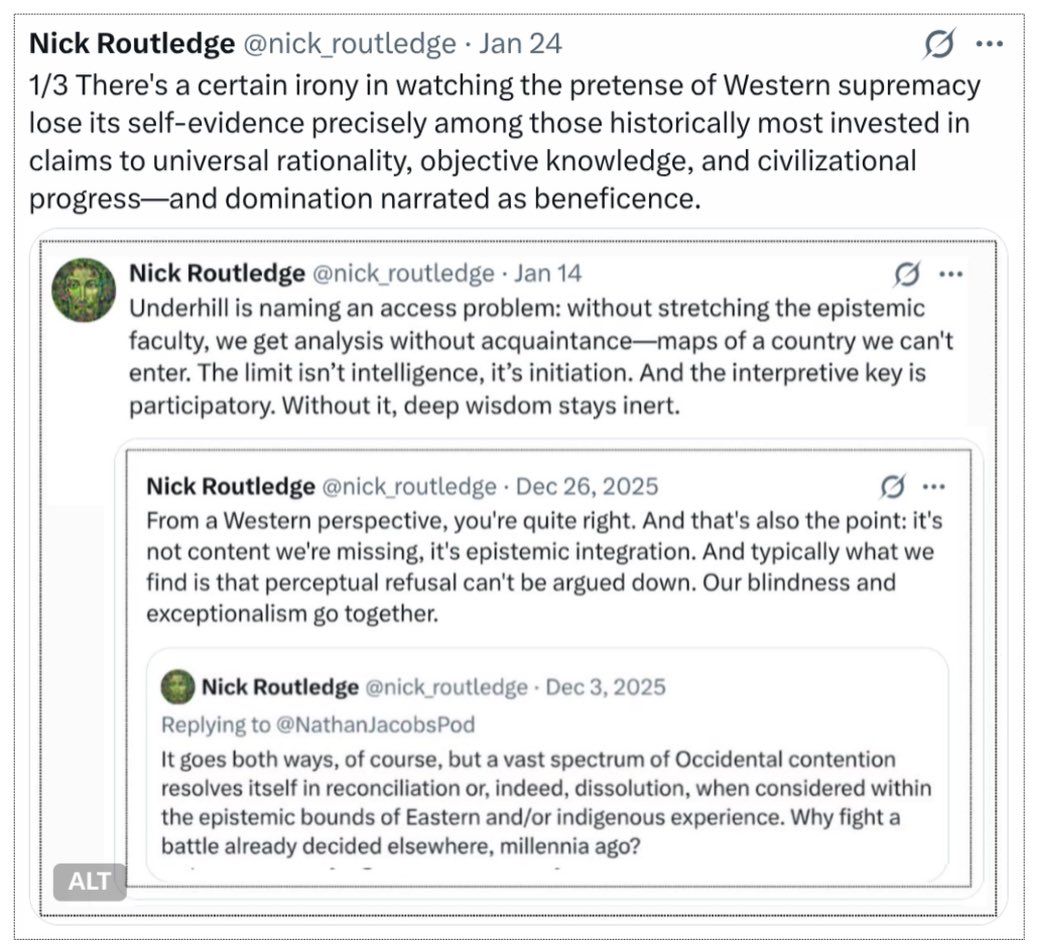
Image description
Extended description
1/3 There's a certain irony in watching the pretense of Western supremacy lose its self-evidence precisely among those historically most invested in claims to universal rationality, objective knowledge, and civilizational progress—and domination narrated as beneficence. Underhill is naming an access problem: without stretching the epistemic faculty, we get analysis without acquaintance—maps of a country we can't enter. The limit isn’t intelligence, it’s initiation. And the interpretive key is participatory. Without it, deep wisdom stays inert. From a Western perspective, you're quite right. And that's also the point: it's not content we're missing, it's epistemic integration. And typically what we find is that perceptual refusal can't be argued down. Our blindness and exceptionalism go together. It goes both ways, of course, but a vast spectrum of Occidental contention resolves itself in reconciliation or, indeed, dissolution, when considered within the epistemic bounds of Eastern and/or indigenous experience. Why fight a battle already decided elsewhere, millennia ago?
Open original document@sentantiq 2/ The very figures who positioned themselves as reality's arbiters now seem most unmoored, experiencing a more profound disorientation because the ground they stood on was always about a certain kind of epistemic authority, a particular structure of sovereignty—now in free fall.
View this post’s context →