
@PageauJonathan I once spent much time with a compass and ruler and John Michell's 'New Jerusalem' geometrical, visual claim that the eschaton harmonizes the 6 and 7 orders. Paradise gardening is its earthbound analog: creation care reconciling the distinctions between home, habitat, and God.
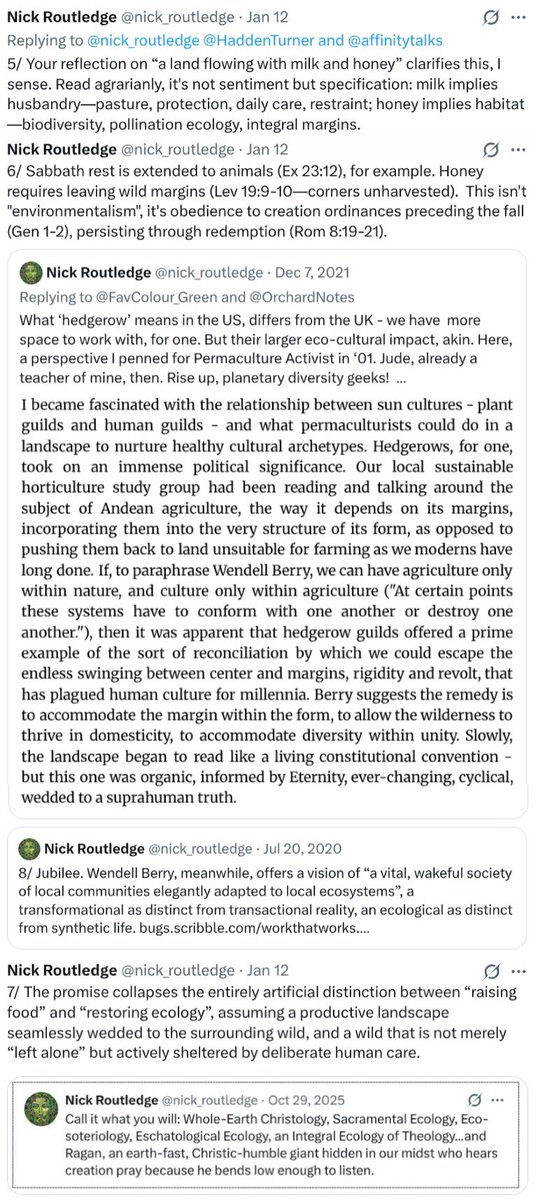
Image description
Extended description
5/ Your reflection on “a land flowing with milk and honey” clarifies this, I sense. Read agrarianly, it's not sentiment but specification: milk implies husbandry—pasture, protection, daily care, restraint; honey implies habitat—biodiversity, pollination ecology, integral margins. 6/ Sabbath rest is extended to animals (Ex 23:12), for example. Honey requires leaving wild margins (Lev 19:9-10—corners unharvested). This isn't "environmentalism", it's obedience to creation ordinances preceding the fall (Gen 1-2), persisting through redemption (Rom 8:19-21). Subtweet: What ‘hedgerow’ means in the US, differs from the UK - we have more space to work with, for one. But their larger eco-cultural impact, akin. Here, a perspective I penned for Permaculture Activist in ‘01. Jude, already a teacher of mine, then. Rise up, planetary diversity geeks! I became fascinated with the relationship between sun cultures - plant guilds and human guilds - and what permaculturists could do in a landscape to nurture healthy cultural archetypes. Hedgerows, for one, took on an immense political significance. Our local sustainable horticulture study group had been reading and talking around the subject of Andean agriculture, the way it depends on its margins, incorporating them into the very structure of it form, as opposed to pushing them back to land unsuitable for farming as we moderns have long done. If, to paraphrase Wendell Berry, we can have agriculture only within nature, and culture only within agriculture ("At certain points these systems have to conform with one another or destroy one another."), then it was apparent that hedgerow guilds offered a prime example of the sort of reconciliation by which we could escape the endless swinging between center and margins, rigidity and revolt, that has plagued human culture for millennia. Berry suggests the remedy is to accommodate the margin within the form, to allow the wilderness to thrive in domesticity, to accommodate diversity within unity. Slowly, the landscape began to read like a living constitutional convention - but this one was organic, informed by Eternity, ever-changing, cyclical, wedded to a suprahuman truth. 7/ The promise collapses the entirely artificial distinction between “raising food” and “restoring ecology”, assuming a productive landscape seamlessly wedded to the surrounding wild, and a wild that is not merely “left alone” but actively sheltered by deliberate human care. Call it what you will: Whole-Earth Christology, Sacramental Ecology, Eco-soteriology, Eschatological Ecology, an Integral Ecology of Theology...and Ragan, an earth-fast, Christic-humble giant hidden in our midst who hears creation pray because he bends low enough to listen. – []t
Open original document@HaddenTurner 1/24 Your final paragraph landed. With your @affinitytalks pieces on evangelical faith and environmental concerns in view, I wonder if a seeming tension—critiquing "environmentalism" yet insisting on responsible agrarian work—is actually the outline of a reconciliation to name.
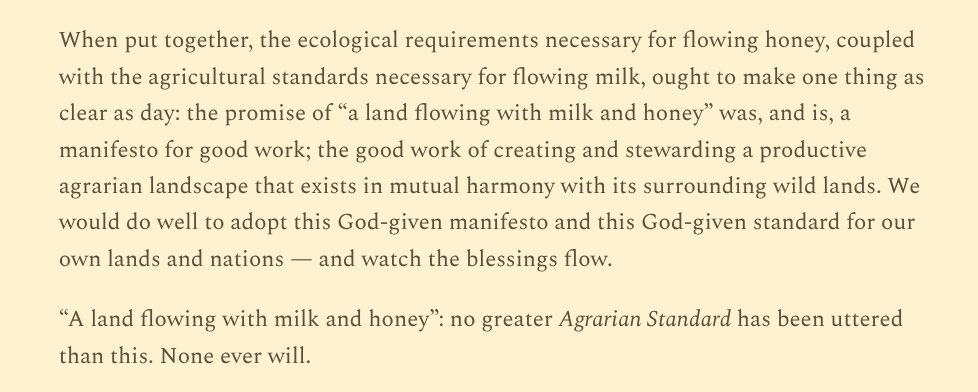
Image description
Original X alt text
Excerpt from: When put together, the ecological requirements necessary for flowing honey, coupled with the agricultural standards necessary for flowing milk, ought to make one thing as clear as day: the promise of “a land flowing with milk and honey” was, and is, a manifesto for good work; the good work of creating and stewarding a productive agrarian landscape that exists in mutual harmony with its surrounding wild lands. We would do well to adopt this God-given manifesto and this God-given standard for our own lands and nations — and watch the blessings flow. “A land flowing with milk and honey”: no greater Agrarian Standard has been uttered than this. None ever will.