
@kacey_gardner @Plough Oh, and here's a little more context: ?s=20
@Plough My experience, deepening, is that beauty is shaped by an artistry far beyond what I can hold. O'Donohue's own words showed me: beauty, not as decoration but disclosure; divine presence breaking through; "the climate of divine kindness"; grace as elegance. How apt he's remembered.
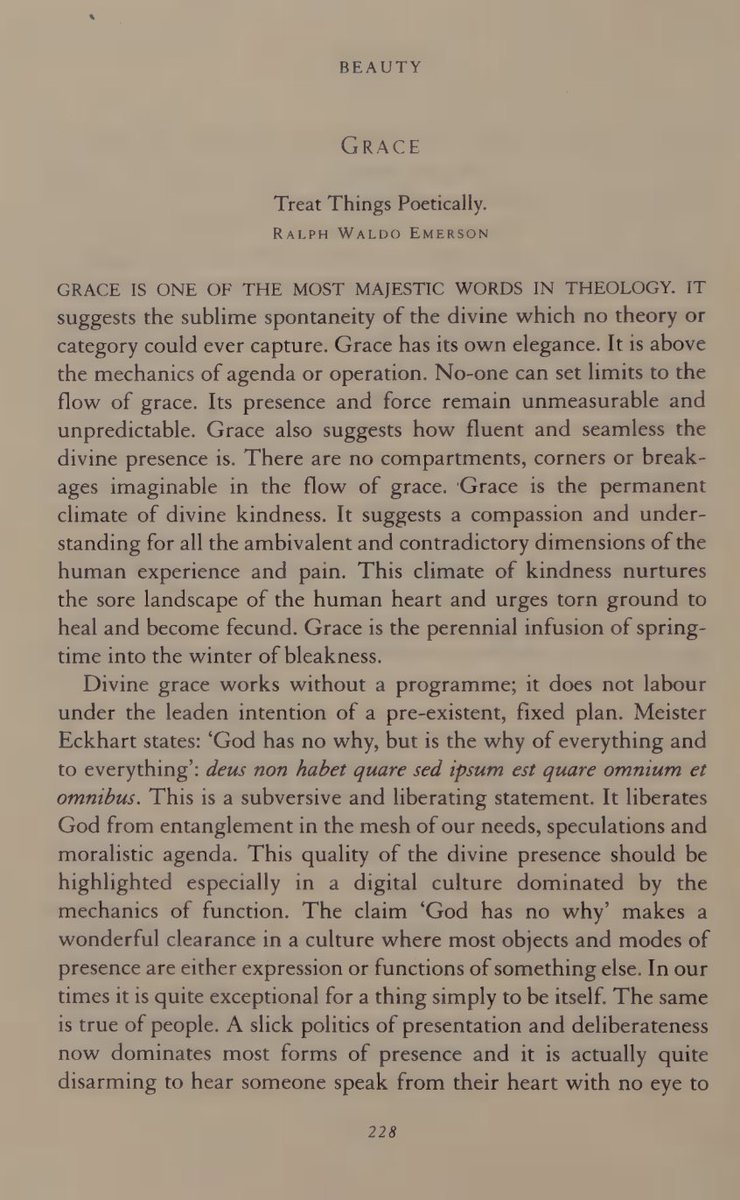
Image description
Extended description
[Pg. 228 of John O’Donohue’s ‘Beauty: The Invisible Embrace’] GRACE Treat Things Poetically. RALPH WALDO EMERSON GRACE IS ONE OF THE MOST MAJESTIC WORDS IN THEOLOGY. IT suggests the sublime spontaneity of the divine which no theory or category could ever capture. Grace has its own elegance. It is above the mechanics of agenda or operation. No-one can set limits to the flow of grace. Its presence and force remain unmeasurable and unpredictable. Grace also suggests how fluent and seamless the divine presence is. There are no compartments, corners or break- ages imaginable in the flow of grace. ‘Grace is the permanent climate of divine kindness. It suggests a compassion and under- standing for all the ambivalent and contradictory dimensions of the human experience and pain. This climate of kindness nurtures the sore landscape of the human heart and urges torn ground to heal and become fecund. Grace is the perennial infusion of spring- time into the winter of bleakness. Divine grace works without a programme; it does not labour under the leaden intention of a pre-existent, fixed plan. Meister Eckhart states: ‘God has no why, but is the why of everything and to everything’: deus non habet quare sed ipsum est quare omnium et omnibus. This is a subversive and liberating statement. It liberates God from entanglement in the mesh of our needs, speculations and moralistic agenda. This quality of the divine presence should be highlighted especially in a digital culture dominated by the mechanics of function. The claim ‘God has no why’ makes a wonderful clearance in a culture where most objects and modes of presence are either expression or functions of something else. In our times it is quite exceptional for a thing simply to be itself. The same is true of people. A slick politics of presentation and deliberateness now dominates most forms of presence and it is actually quite disarming to hear someone speak from their heart with no eye to
Open original document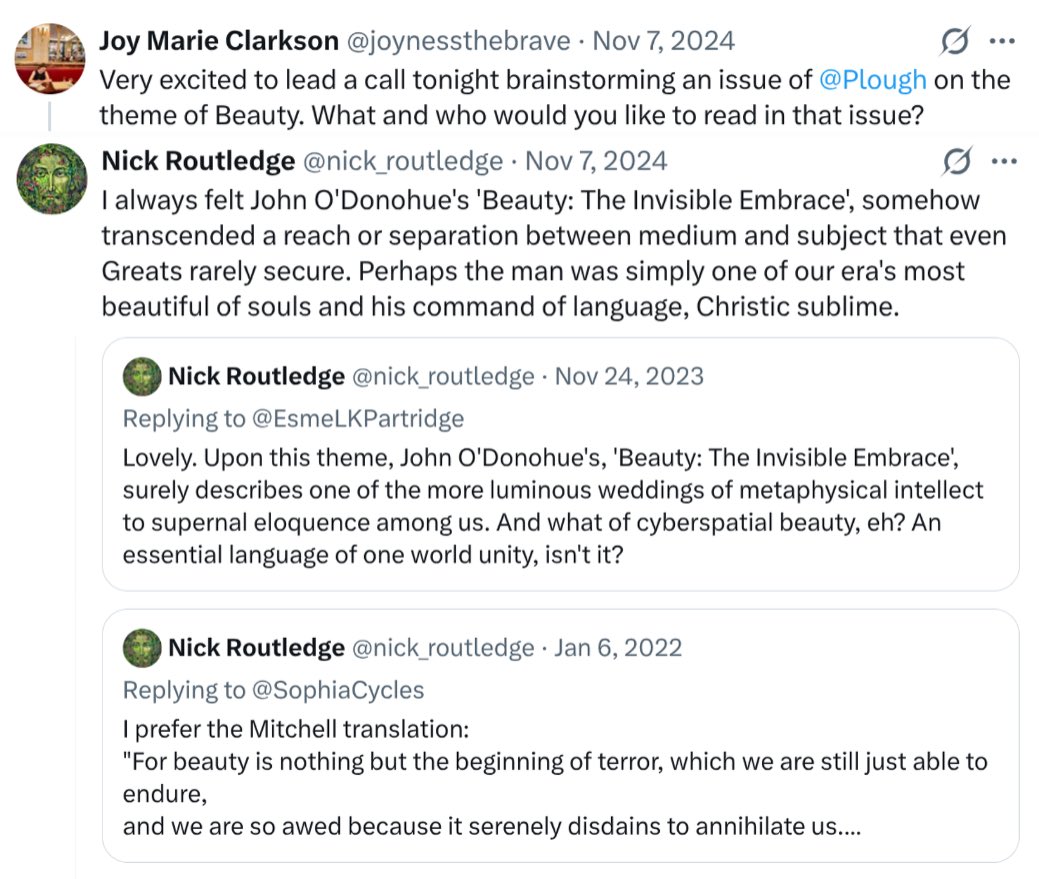
Image description
Extended description
Copy of tweet thread: Very excited to lead a call tonight brainstorming an issue of @Plough on the theme of Beauty. What and who would you like to read in that issue? and I always felt John O'Donohue's 'Beauty: The Invisible Embrace', somehow transcended a reach or separation between medium and subject that even Greats rarely secure. Perhaps the man was simply one of our era's most beautiful of souls and his command of language, Christic sublime. Subtweet: Lovely. Upon this theme, John O'Donohue's, 'Beauty: The Invisible Embrace', surely describes one of the more luminous weddings of metaphysical intellect to supernal eloquence among us. And what of cyberspatial beauty, eh? An essential language of one world unity, isn't it? Subtweet: I prefer the Mitchell translation: "For beauty is nothing but the beginning of terror, which we are still just able to endure, and we are so awed because it serenely disdains to annihilate us.
Open original document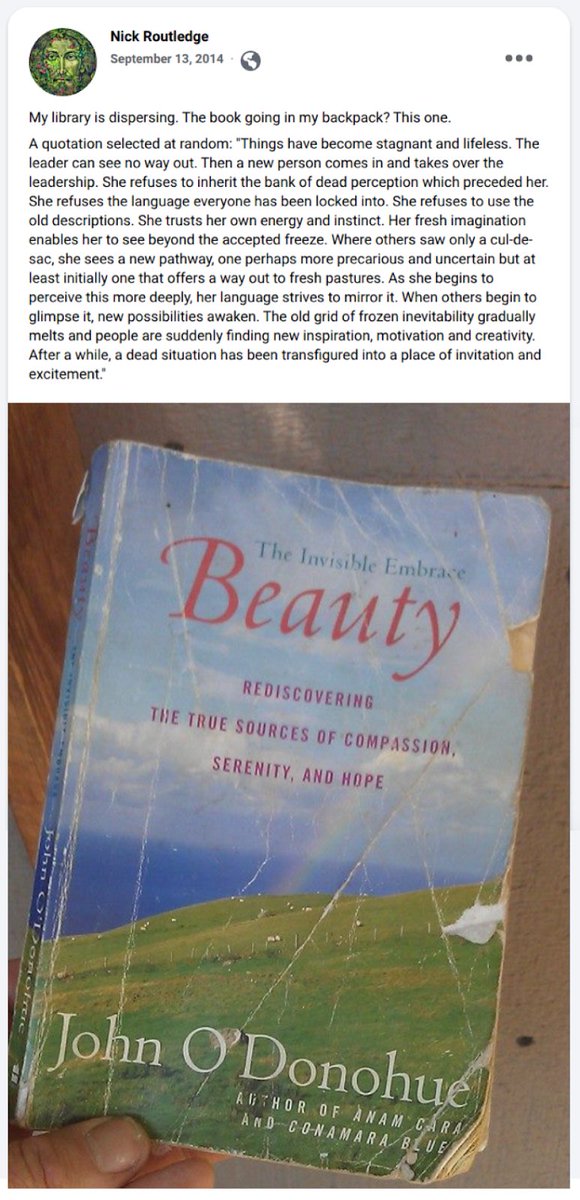
Image description
Original X alt text
Facebook posting Nick Routledge
Extended description
[Facebook posting of a photograph of my dog-eared copy of O’Donohue’s ‘Beauty: The Invisible Embrace.’] Nick Routledge My library is dispersing. The book going in my backpack? This one. A quotation selected at random: "Things have become stagnant and lifeless. The leader can see no way out. Then a new person comes in and takes over the leadership. She refuses to inherit the bank of dead perception which preceded her. She refuses the language everyone has been locked into. She refuses to use the old descriptions. She trusts her own energy and instinct. Her fresh imagination enables her to see beyond the accepted freeze. Where others saw only a cul-de-sac, she sees a new pathway, one perhaps more precarious and uncertain but at least initially one that offers a way out to fresh pastures. As she begins to perceive this more deeply, her language strives to mirror it. When others begin to glimpse it, new possibilities awaken. The old grid of frozen inevitability gradually melts and people are suddenly finding new inspiration, motivation and creativity. After a while, a dead situation has been transfigured into a place of invitation and excitement."
Open original document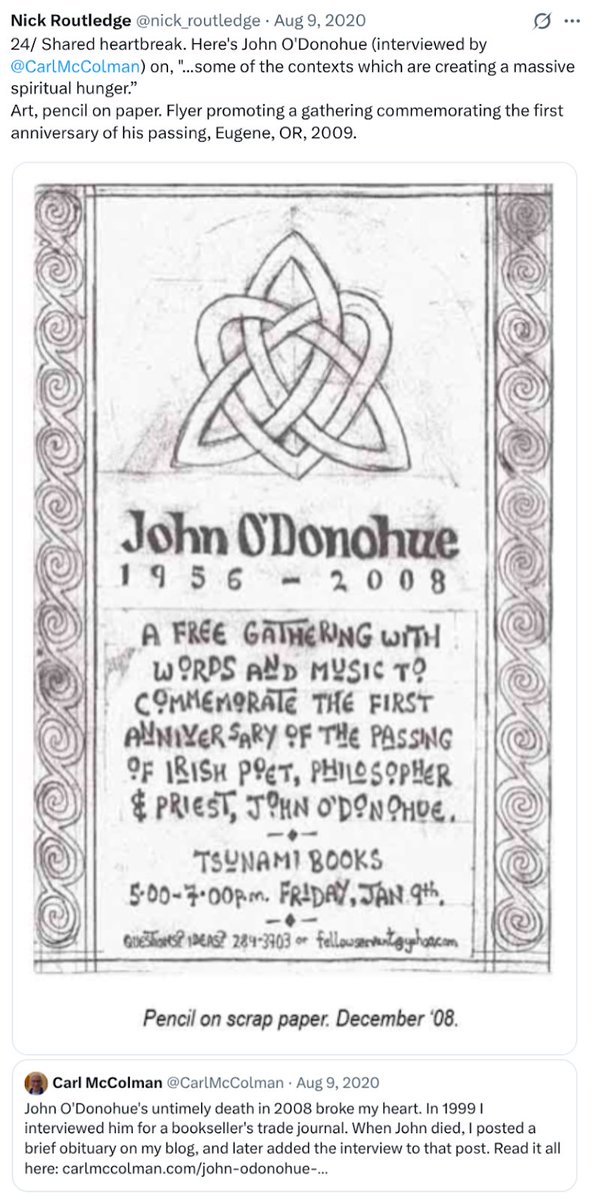
Image description
Original X alt text
Copy of tweet: 24/ Shared heartbreak. Here's John O'Donohue (interviewed by @CarlMcColman) on, "...some of the contexts which are creating a massive spiritual hunger.” Art, pencil on paper. Flyer promoting a gathering commemorating the first anniversary of his passing, Eugene, OR, 2009. Image of flyer, in Celtic style, reading. John O’Donohue 1956 - 2008 - A free gathering with words and music to commemorate the first anniversary of the of the passing of Irish poet, philosopher, priest, John O’Donohue. - Tsunami Books 5.00 - 7.00p.m. Friday Jan 9th - Questions? Ideas? 284-3703 - Pencil on scrap paper. December ‘08 Subtweet: John O'Donohue's untimely death in 2008 broke my heart. In 1999 I interviewed him for a bookseller's trade journal. When John died, I posted a brief obituary on my blog, and later added the interview to that post. Read it all here: carlmccolman.com/john-odonohue-1954-2008-2/