
@HaddenTurner @JubileeCentre end\ God’s Day names judgment-as-purification: “refiner’s fire,” not “cosmic arson.” What burns is falsehood—and all ideologies and sacred stories that live off it. Christ's parousia doesn’t end creation; it ends the false world, the regime of lies, so what is true can remain.
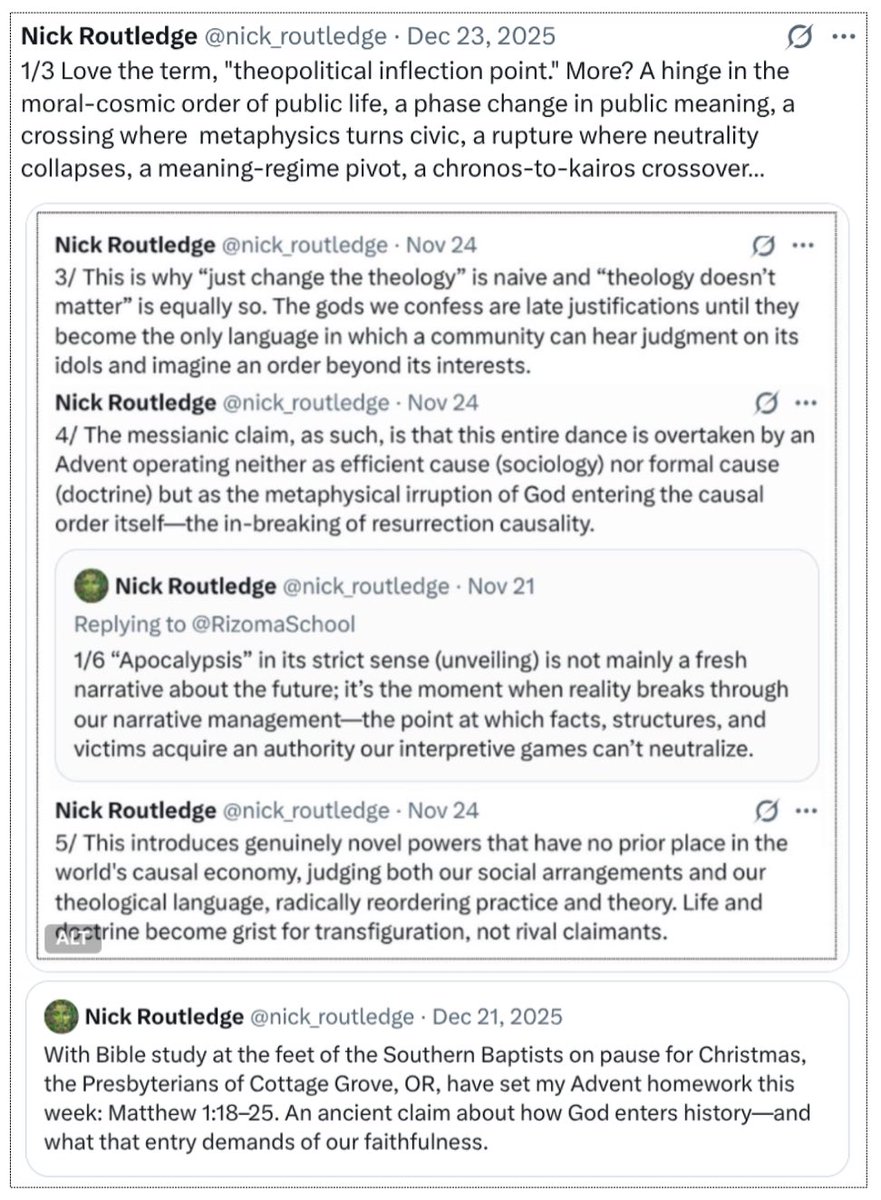
Image description
Extended description
1/3 Love the term, "theopolitical inflection point." More? A hinge in the moral-cosmic order of public life, a phase change in public meaning, a crossing where metaphysics turns civic, a rupture where neutrality collapses, a meaning-regime pivot, a chronos-to-kairos crossover… 3/ This is why “just change the theology” is naive and “theology doesn’t matter” is equally so. The gods we confess are late justifications until they become the only language in which a community can hear judgment on its idols and imagine an order beyond its interests. 4/ The messianic claim, as such, is that this entire dance is overtaken by an Advent operating neither as efficient cause (sociology) nor formal cause (doctrine) but as the metaphysical irruption of God entering the causal order itself—the in-breaking of resurrection causality. 1/6 “Apocalypsis” in its strict sense (unveiling) is not mainly a fresh narrative about the future; it’s the moment when reality breaks through our narrative management—the point at which facts, structures, and victims acquire an authority our interpretive games can’t neutralize. 5/ This introduces genuinely novel powers that have no prior place in the world's causal economy, judging both our social arrangements and our theological language, radically reordering practice and theory. Life and doctrine become grist for transfiguration, not rival claimants. Subtweet: With Bible study at the feet of the Southern Baptists on pause for Christmas, the Presbyterians of Cottage Grove, OR, have set my Advent homework this week: Matthew 1:18–25. An ancient claim about how God enters history—and what that entry demands of our faithfulness.
Open original document@Plough @BenQuash 5/ There's a central Christic principle at work here: only the Kingdom gives access to Paradise, but only Paradise renders the Kingdom fully concrete. This isn't metaphorical language. It describes the actual pattern through which divine life becomes incarnate in earth-reality.
View this post’s context →