
@HaddenTurner @affinitytalks 14/ Food—the daily sacrament modernity can’t virtualize—tells the truth about us. The table is where a people’s ontology gets enacted. We take the world into our bodies and live the consequences. Our foodways reveal our gods—speed, profit, control—or limits, gratitude, communion.
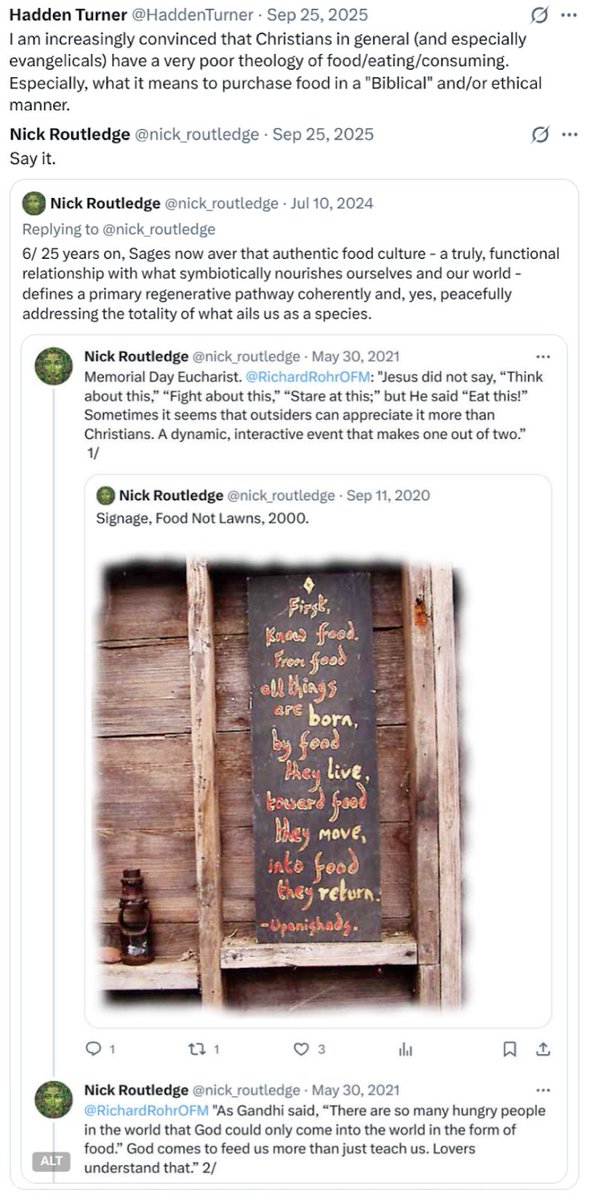
Image description
Extended description
I am increasingly convinced that Christians in general (and especially evangelicals) have a very poor theology of food/eating/consuming. Especially, what it means to purchase food in a "Biblical" and/or ethical manner. Say it. 6/ 25 years on, Sages now aver that authentic food culture - a truly, functional relationship with what symbiotically nourishes ourselves and our world - defines a primary regenerative pathway coherently and, yes, peacefully addressing the totality of what ails us as a species. Memorial Day Eucharist. @RichardRohrOFM: "Jesus did not say, “Think about this,” “Fight about this,” “Stare at this;” but He said “Eat this!” Sometimes it seems that outsiders can appreciate it more than Christians. A dynamic, interactive event that makes one out of two.” [Painting on wood. Signage. Food Not Lawns, 2000] First, know food. From food all things are born, by food they live, toward food they move, into food they return. - Upanishads "As Gandhi said, “There are so many hungry people in the world that God could only come into the world in the form of food.” God comes to feed us more than just teach us. Lovers understand that.” []
Open original documentSabbath. The true measure of a revolutionary renewal in the ontological status of humanity and our world, is that it encompasses our Wholeness within the greater coherence, communion and miracle of a symbiotic ecology of grace - a complete form of belonging, enfleshed as One.