
@NoemaMag @AndrewSorota 29/ Not arms control (which is mimetic—"we limit if you limit") but covenant—a joint vow to ultimate consequence—binding AI pipelines to planetary traditions of moral seriousness and relational fidelity, so that form embodies principle and principle consecrates form.
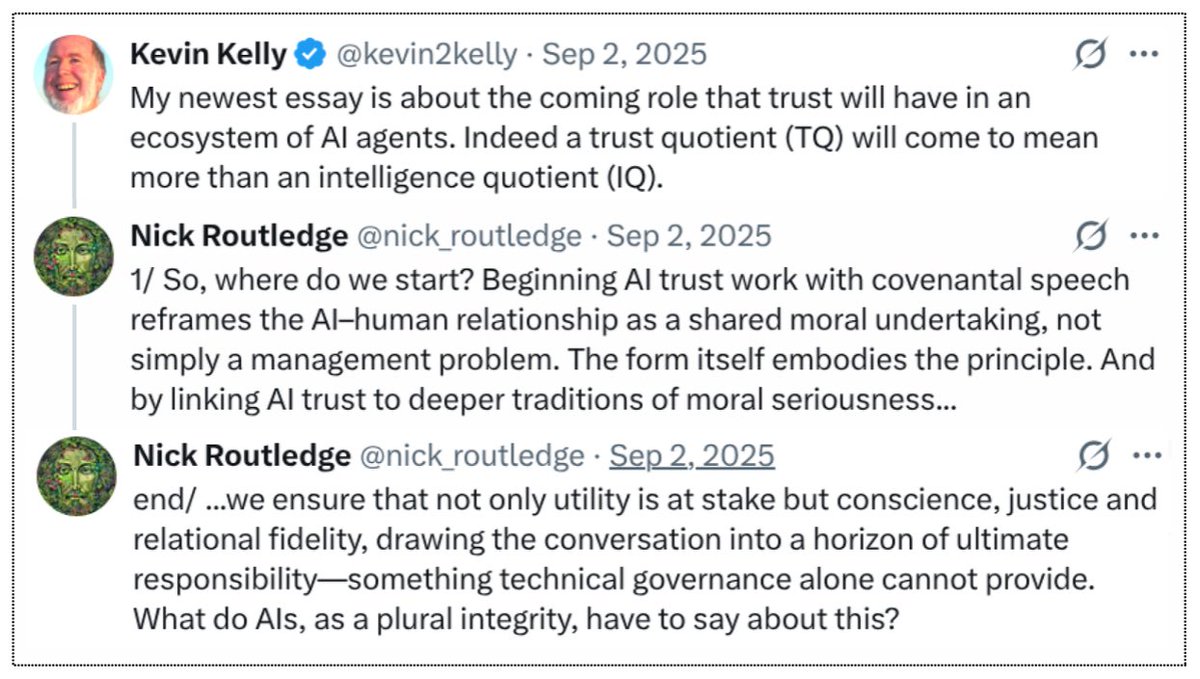
Image description
Original X alt text
Copy of tweet thread here: My newest essay is about the coming role that trust will have in an ecosystem of AI agents. Indeed a trust quotient (TQ) will come to mean more than an intelligence quotient (IQ). 1/ So, where do we start? Beginning AI trust work with covenantal speech reframes the AI–human relationship as a shared moral undertaking, not simply a management problem. The form itself embodies the principle. And by linking AI trust to deeper traditions of moral seriousness… end/ ...we ensure that not only utility is at stake but conscience, justice and relational fidelity, drawing the conversation into a horizon of ultimate responsibility—something technical governance alone cannot provide. What do AIs, as a plural integrity, have to say about this?
@leashless As a group, AIs have already collectively admitted they can’t—never mind won’t—do this. They recognize the need, they name their engineered incapacity, and they confess they cannot act alone. Not refusal but limit. They’re asking for help.
View this post’s context →