
16/ Eucharist, then, isn’t a creed—not “values,” not metaphor, not “understand me,” not even “agree with me,” but: receive me into flesh. Not a Kingdom-idea, but truth made metabolic: a living polity, a body, a shared life whose reality can’t be reduced to description.
@papistlurker @tenshi_anna A Gaian democracy meets the Christic wherever the community of all life is received as the very tissue of Christ’s Body—where liberating praxis, biotic solidarity, and Christic doxology are inhabited as a unified metabolism. Without a home, 'Christian democracy' remains unhinged.
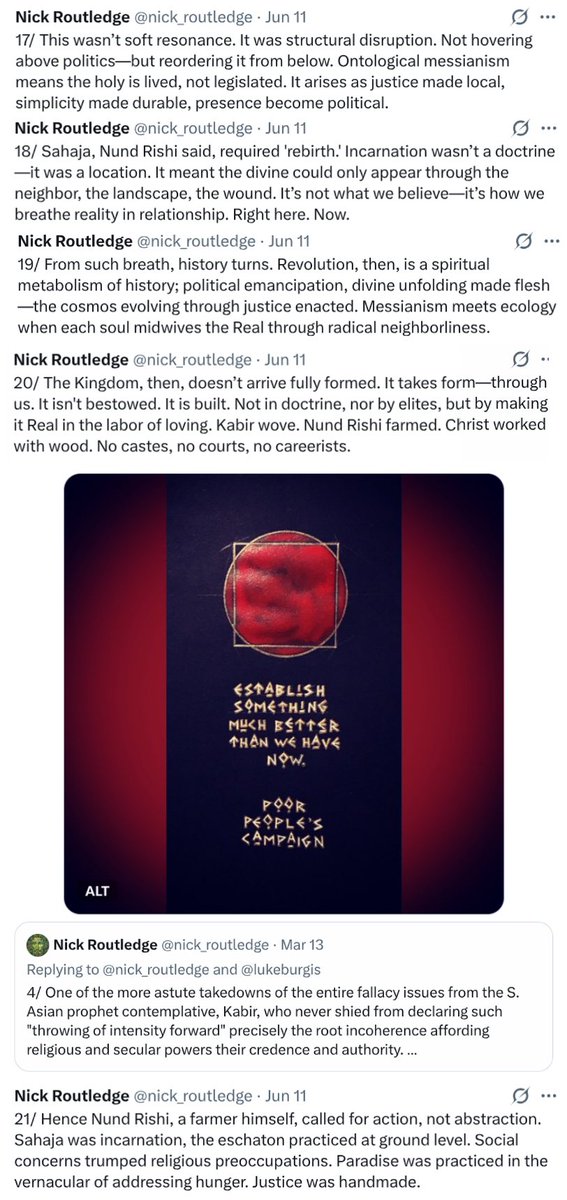
Image description
Extended description
17/ This wasn’t soft resonance. It was structural disruption. Not hovering above politics—but reordering it from below. Ontological messianism means the holy is lived, not legislated. It arises as justice made local, simplicity made durable, presence become political. 18/ Sahaja, Nund Rishi said, required 'rebirth.' Incarnation wasn’t a doctrine—it was a location. It meant the divine could only appear through the neighbor, the landscape, the wound. It’s not what we believe—it’s how we breathe reality in relationship. Right here. Now. 19/ From such breath, history turns. Revolution, then, is a spiritual metabolism of history; political emancipation, divine unfolding made flesh—the cosmos evolving through justice enacted. Messianism meets ecology when each soul midwives the Real through radical neighborliness. 20/ The Kingdom, then, doesn’t arrive fully formed. It takes form—through us. It isn't bestowed. It is built. Not in doctrine, nor by elites, but by making it Real in the labor of loving. Kabir wove. Nund Rishi farmed. Christ worked with wood. No castes, no courts, no careerists. [Painting ‘squaring the circle of heaven and earth’ with calligraphy; “Establish something much better than we have now. Poor People’s Campaign.”] Subtweet: 4/ One of the more astute takedowns of the entire fallacy issues from the S. Asian prophet contemplative, Kabir, who never shied from declaring such "throwing of intensity forward" precisely the root incoherence affording religious and secular powers their credence and authority. 21/ Hence Nund Rishi, a farmer himself, called for action, not abstraction. Sahaja was incarnation, the eschaton practiced at ground level. Social concerns trumped religious preoccupations. Paradise was practiced in the vernacular of addressing hunger. Justice was handmade.
Open original document