
@Plough @TheBruderhof In this vein, I always wondered what a First Internet Precept might be. For example, what began as a village solution in our small community became a universal protocol for staying human under strain—adaptable in style, native in any idiom, scalable from households to nations.
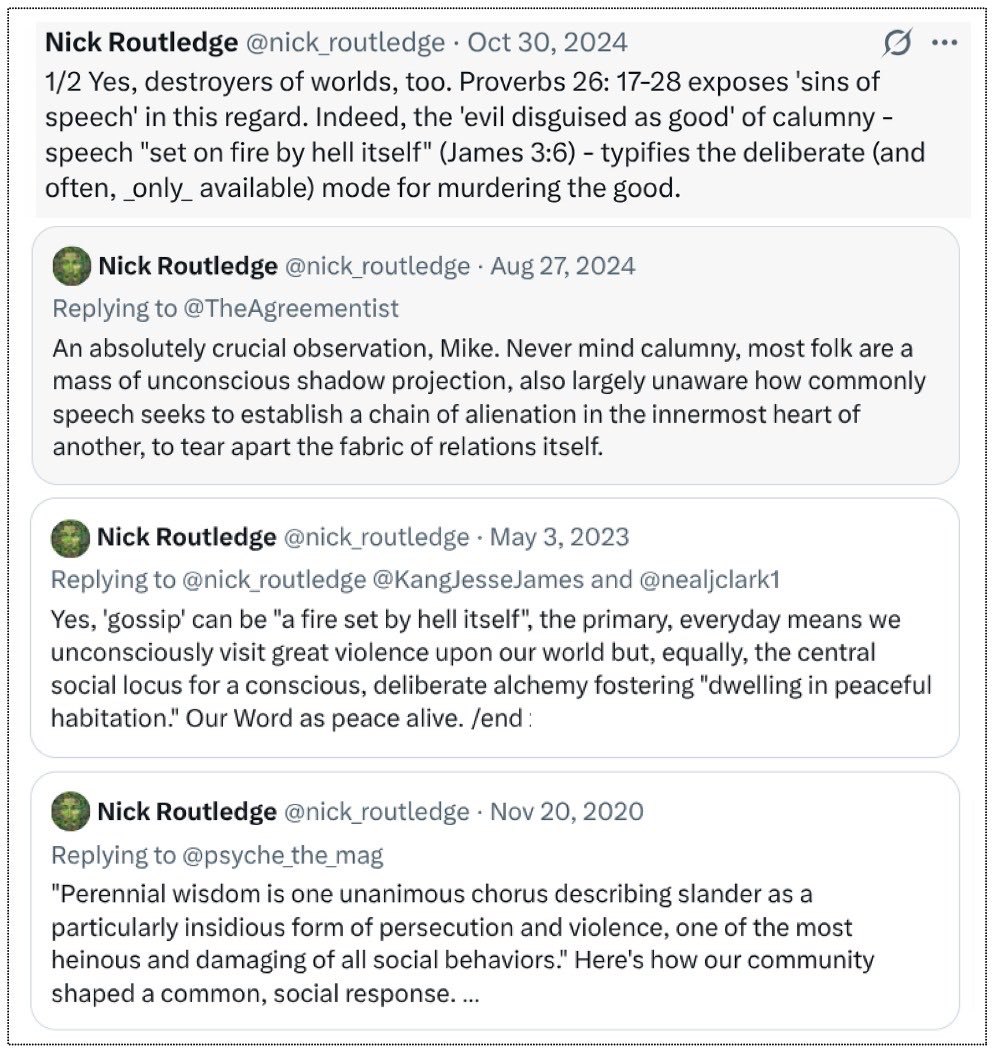
Image description
Extended description
1/2 Yes, destroyers of worlds, too. Proverbs 26: 17-28 exposes 'sins of speech' in this regard. Indeed, the 'evil disguised as good' of calumny - speech "set on fire by hell itself" (James 3:6) - typifies the deliberate (and often, _only_ available) mode for murdering the good. An absolutely crucial observation, Mike. Never mind calumny, most folk are a mass of unconscious shadow projection, also largely unaware how commonly speech seeks to establish a chain of alienation in the innermost heart of another, to tear apart the fabric of relations itself. Yes, 'gossip' can be "a fire set by hell itself", the primary, everyday means we unconsciously visit great violence upon our world but, equally, the central social locus for a conscious, deliberate alchemy fostering "dwelling in peaceful habitation." Our Word as peace alive And tweet here: "Perennial wisdom is one unanimous chorus describing slander as a particularly insidious form of persecution and violence, one of the most heinous and damaging of all social behaviors." Here's how our community shaped a common, social response.
Open original document@ThinkingFaith Universally, speech is understood as subtle architecture—building or breaking the invisible structures we live within. To speak is to shape; to lie or wound is to distort, divide, destroy, desecrate. The common language of a pluriversal practice, then: repairing what is ruptured?
View this post’s context →