
@tenshi_anna The messianic interjection doesn’t argue down the immunitary order—it ruptures it, announcing the end of the bargain itself: apocalypsis as the unveiling of a holiness that cannot be purchased with anyone’s blood. Planetary-scale judgment and the alternative in the same stroke.
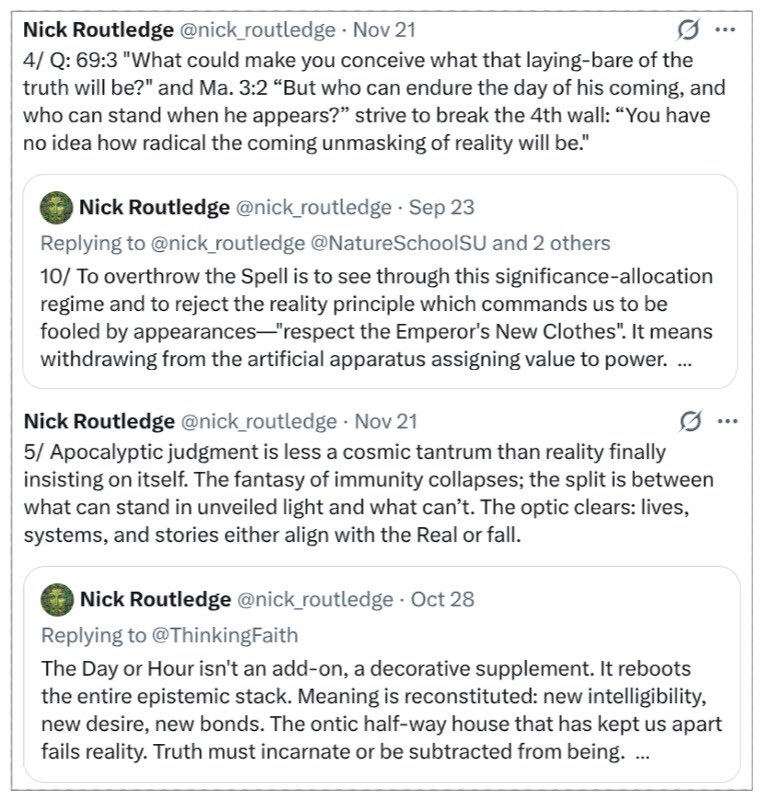
Image description
Extended description
and 4/ Q: 69:3 "What could make you conceive what that laying-bare of the truth will be?" and Ma. 3:2 “But who can endure the day of his coming, and who can stand when he appears?” strive to break the 4th wall: “You have no idea how radical the coming unmasking of reality will be." Quote tweet: 10/ To overthrow the Spell is to see through this significance-allocation regime and to reject the reality principle which commands us to be fooled by appearances—"respect the Emperor's New Clothes". It means withdrawing from the artificial apparatus assigning value to power. Tweet: 5/ Apocalyptic judgment is less a cosmic tantrum than reality finally insisting on itself. The fantasy of immunity collapses; the split is between what can stand in unveiled light and what can’t. The optic clears: lives, systems, and stories either align with the Real or fall. Quote tweet: The Day or Hour isn't an add-on, a decorative supplement. It reboots the entire epistemic stack. Meaning is reconstituted: new intelligibility, new desire, new bonds. The ontic half-way house that has kept us apart fails reality. Truth must incarnate or be subtracted from being.
Open original document@lukeburgis 3/ This is why “just change the theology” is naive and “theology doesn’t matter” is equally so. The gods we confess are late justifications until they become the only language in which a community can hear judgment on its idols and imagine an order beyond its interests.
View this post’s context →