Homework for weekly Bible Study with Elder Mitch, Hope in the Grove Baptist Church, Cottage Grove, OR. Philippians 2:1-4, December 10, 2025 "For the Lamb in the midst of the throne will be their shepherd and lead them to living fountains of waters." (Rev. 7:17)
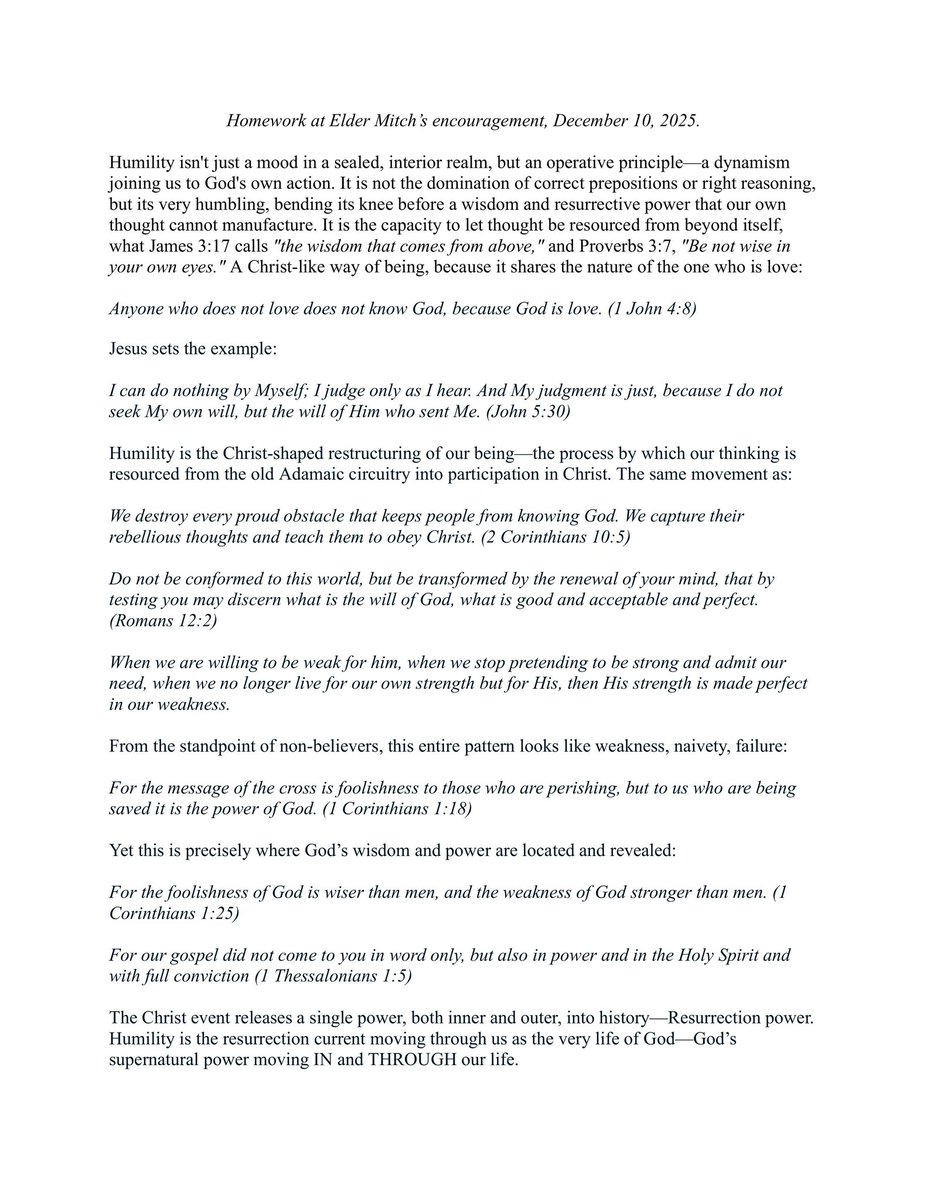
Image description
Extended description
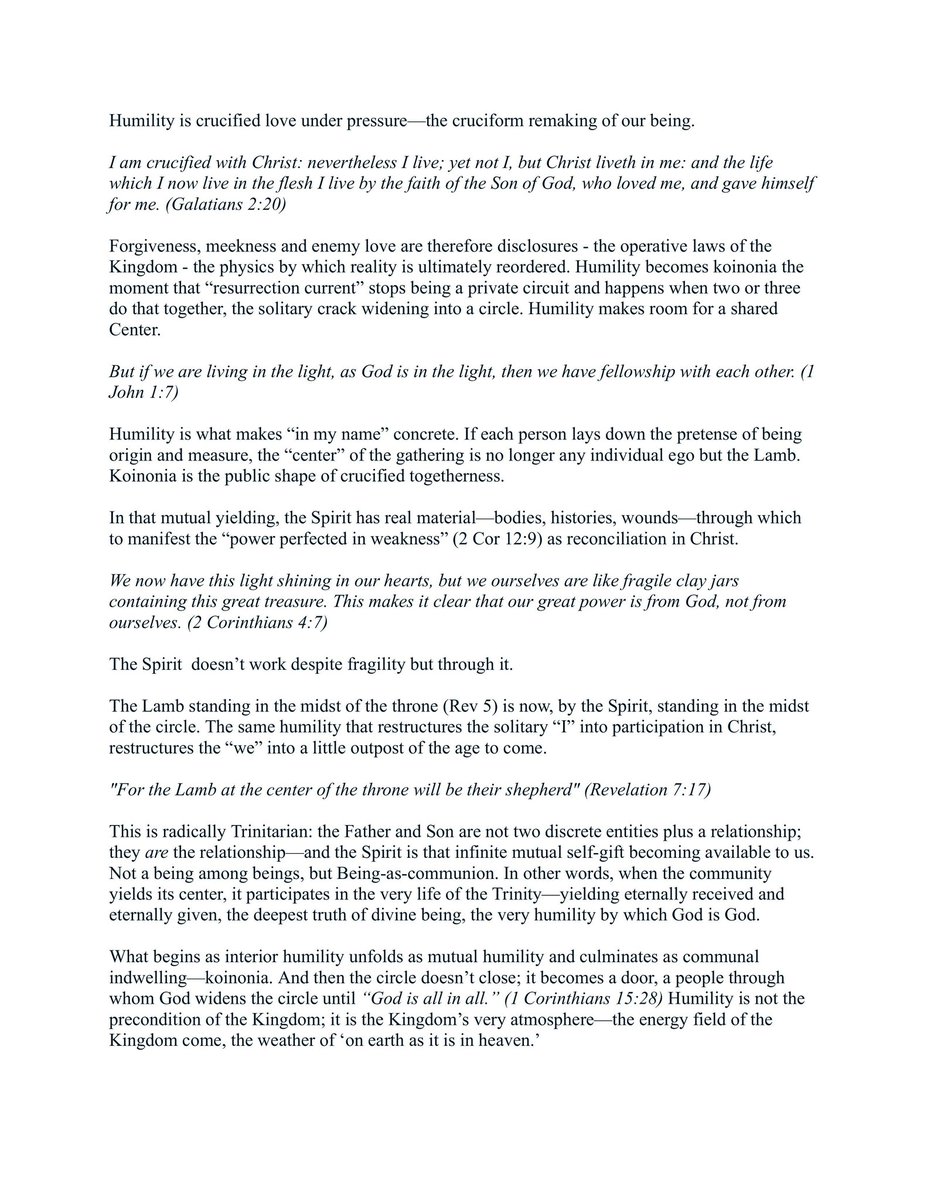
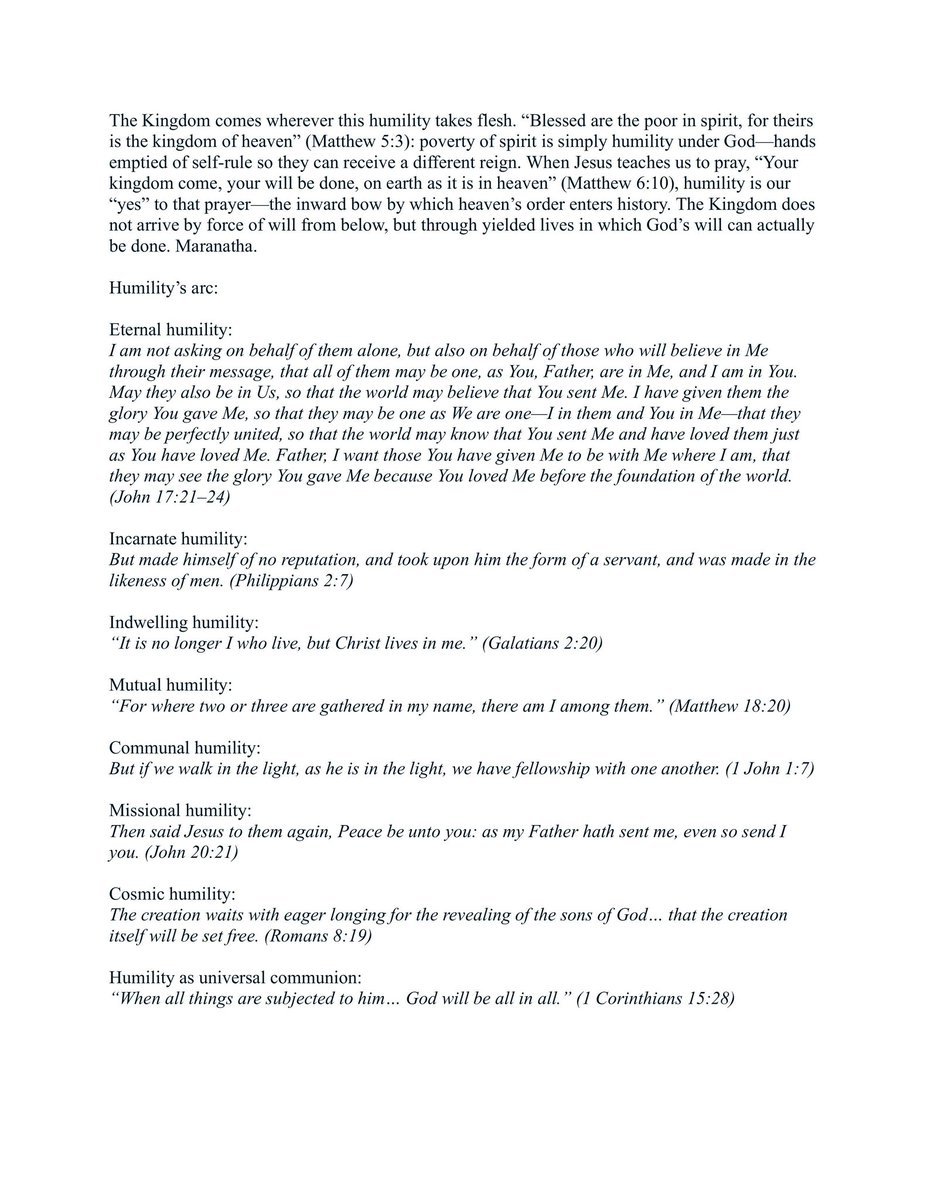
Homework at Elder Mitch’s encouragement, December 10, 2025. Humility isn't just a mood in a sealed, interior realm, but an operative principle—a dynamism joining us to God's own action. It is not the domination of correct prepositions or right reasoning, but its very humbling, bending its knee before a wisdom and resurrective power that our own thought cannot manufacture. It is the capacity to let thought be resourced from beyond itself, what James 3:17 calls "the wisdom that comes from above," and Proverbs 3:7, "Be not wise in your own eyes." A Christ-like way of being, because it shares the nature of the one who is love: Anyone who does not love does not know God, because God is love. (1 John 4:8) Jesus sets the example: I can do nothing by Myself; I judge only as I hear. And My judgment is just, because I do not seek My own will, but the will of Him who sent Me. (John 5:30) Humility is the Christ-shaped restructuring of our being—the process by which our thinking is resourced from the old Adamaic circuitry into participation in Christ. The same movement as: We destroy every proud obstacle that keeps people from knowing God. We capture their rebellious thoughts and teach them to obey Christ. (2 Corinthians 10:5) Do not be conformed to this world, but be transformed by the renewal of your mind, that by testing you may discern what is the will of God, what is good and acceptable and perfect. (Romans 12:2) When we are willing to be weak for him, when we stop pretending to be strong and admit our need, when we no longer live for our own strength but for His, then His strength is made perfect in our weakness. From the standpoint of non-believers, this entire pattern looks like weakness, naivety, failure: For the message of the cross is foolishness to those who are perishing, but to us who are being saved it is the power of God. (1 Corinthians 1:18) Yet this is precisely where God’s wisdom and power are located and revealed: For the foolishness of God is wiser than men, and the weakness of God stronger than men. (1 Corinthians 1:25) For our gospel did not come to you in word only, but also in power and in the Holy Spirit and with full conviction (1 Thessalonians 1:5) The Christ event releases a single power, both inner and outer, into history—Resurrection power. Humility is the resurrection current moving through us as the very life of God—God’s supernatural power moving IN and THROUGH our life. Faith is where that dynamism. that current transforming all of created reality crosses into us, as the courage to stand so that another strength can be embodied in us. This means voluntarily stepping out of the role of God in our own story, God finally getting a clear channel in a life that has stopped trying to be its own messiah. Faith and humility meet here. Faith is the form taken by our humility under God. To be humble in faith is to let the coming new creation press through our thinking, the physics by which reality is ultimately rendered. Hebrews 11 (‘The Bible’s Hall of Faith’) depicts faith as the power by which history is itself reconfigured. Paul stretches this to the cosmic level. Therefore if anyone is in Christ, he is a new creation. The old things have passed away; behold, the new has come into being. (2 Corinthians 5:17) The creation waits in eager expectation for the revelation of the sons of God. For the creation was subjected to futility, not by its own will, but because of the One who subjected it, in hope that the creation itself will be set free from its bondage to decay and brought into the glorious freedom of the children of God. (Romans 8:19-21) The Christ force is not just rescuing souls from history, it is rewiring history itself. ‘Supernatural’ is the new creation current God has already switched on in Jesus. Grace is God moving toward us in Jesus—the power that is rewiring the whole universe, what the supernatural dimension of God looks like flowing through a finite aperture called faith. Faith is us moving with God into the future he is bringing. What looks like powerlessness is, in fact, the final form of power when history is viewed through the vantage of the Resurrection: For by grace you are saved through faith, and this not of yourselves; it is the gift of God. (Ephesians 2:8) But He said to me, “My grace is sufficient for you, for My power is perfected in weakness.” Therefore I will boast all the more gladly in my weaknesses, so that the power of Christ may rest on me. (2 Corinthians 12:9) Trust in the LORD with all your heart, and lean not on your own understanding; in all your ways acknowledge Him, and He will make your paths straight. (Proverbs 3:5) That is why Scripture says: “God opposes the proud but gives grace to the humble.” (James 4:6) And what is the immeasurable greatness of his power toward us who believe, according to the working of his great mighty strength. (Ephesians 1:9) That I may know him, and the power of his resurrection (Philippians 3:10) Then one of the elders said to me, “Do not weep! Behold, the Lion of the tribe of Judah, the Root of David, has triumphed to open the scroll and its seven seals.” Then I saw a Lamb who appeared to have been slain, standing in the center of the throne, encircled by the four living creatures and the elders. (Revelation 5:5-6) Humility is crucified love under pressure—the cruciform remaking of our being. I am crucified with Christ: nevertheless I live; yet not I, but Christ liveth in me: and the life which I now live in the flesh I live by the faith of the Son of God, who loved me, and gave himself for me. (Galatians 2:20) Forgiveness, meekness and enemy love are therefore disclosures - the operative laws of the Kingdom - the physics by which reality is ultimately reordered. Humility becomes koinonia the moment that “resurrection current” stops being a private circuit and happens when two or three do that together, the solitary crack widening into a circle. Humility makes room for a shared Center. But if we are living in the light, as God is in the light, then we have fellowship with each other. (1 John 1:7) Humility is what makes “in my name” concrete. If each person lays down the pretense of being origin and measure, the “center” of the gathering is no longer any individual ego but the Lamb. Koinonia is the public shape of crucified togetherness. In that mutual yielding, the Spirit has real material—bodies, histories, wounds—through which to manifest the “power perfected in weakness” (2 Cor 12:9) as reconciliation in Christ. We now have this light shining in our hearts, but we ourselves are like fragile clay jars containing this great treasure. This makes it clear that our great power is from God, not from ourselves. (2 Corinthians 4:7) The Spirit doesn’t work despite fragility but through it. The Lamb standing in the midst of the throne (Rev 5) is now, by the Spirit, standing in the midst of the circle. The same humility that restructures the solitary “I” into participation in Christ, restructures the “we” into a little outpost of the age to come. "For the Lamb at the center of the throne will be their shepherd" (Revelation 7:17) This is radically Trinitarian: the Father and Son are not two discrete entities plus a relationship; they are the relationship—and the Spirit is that infinite mutual self-gift becoming available to us. Not a being among beings, but Being-as-communion. In other words, when the community yields its center, it participates in the very life of the Trinity—yielding eternally received and eternally given, the deepest truth of divine, the very humility by which God is God. What begins as interior humility unfolds as mutual humility and culminates as communal indwelling—koinonia. And then the circle doesn’t close; it becomes a door, a people through whom God widens the circle until “God is all in all.” (1 Corinthians 15:28) Humility is not the precondition of the Kingdom; it is the Kingdom’s very atmosphere—the energy field of the Kingdom come, the weather of ‘on earth as it is in heaven.’ The Kingdom comes wherever this humility takes flesh. “Blessed are the poor in spirit, for theirs is the kingdom of heaven” (Matthew 5:3): poverty of spirit is simply humility under God—hands emptied of self-rule so they can receive a different reign. When Jesus teaches us to pray, “Your kingdom come, your will be done, on earth as it is in heaven” (Matthew 6:10), humility is our “yes” to that prayer—the inward bow by which heaven’s order enters history. The Kingdom does not arrive by force of will from below, but through yielded lives in which God’s will can actually be done. Maranatha. Humility’s arc: Eternal humility: I am not asking on behalf of them alone, but also on behalf of those who will believe in Me through their message, that all of them may be one, as You, Father, are in Me, and I am in You. May they also be in Us, so that the world may believe that You sent Me. I have given them the glory You gave Me, so that they may be one as We are one—I in them and You in Me—that they may be perfectly united, so that the world may know that You sent Me and have loved them just as You have loved Me. Father, I want those You have given Me to be with Me where I am, that they may see the glory You gave Me because You loved Me before the foundation of the world. (John 17:21–24) Incarnate humility: But made himself of no reputation, and took upon him the form of a servant, and was made in the likeness of men. (Philippians 2:7) Indwelling humility: “It is no longer I who live, but Christ lives in me.” (Galatians 2:20) Mutual humility: “For where two or three are gathered in my name, there am I among them.” (Matthew 18:20) Communal humility: But if we walk in the light, as he is in the light, we have fellowship with one another. (1 John 1:7) Missional humility: Then said Jesus to them again, Peace be unto you: as my Father hath sent me, even so send I you. (John 20:21) Cosmic humility: The creation waits with eager longing for the revealing of the sons of God… that the creation itself will be set free. (Romans 8:19) Humility as universal communion: “When all things are subjected to him… God will be all in all.” (1 Corinthians 15:28)
Open original document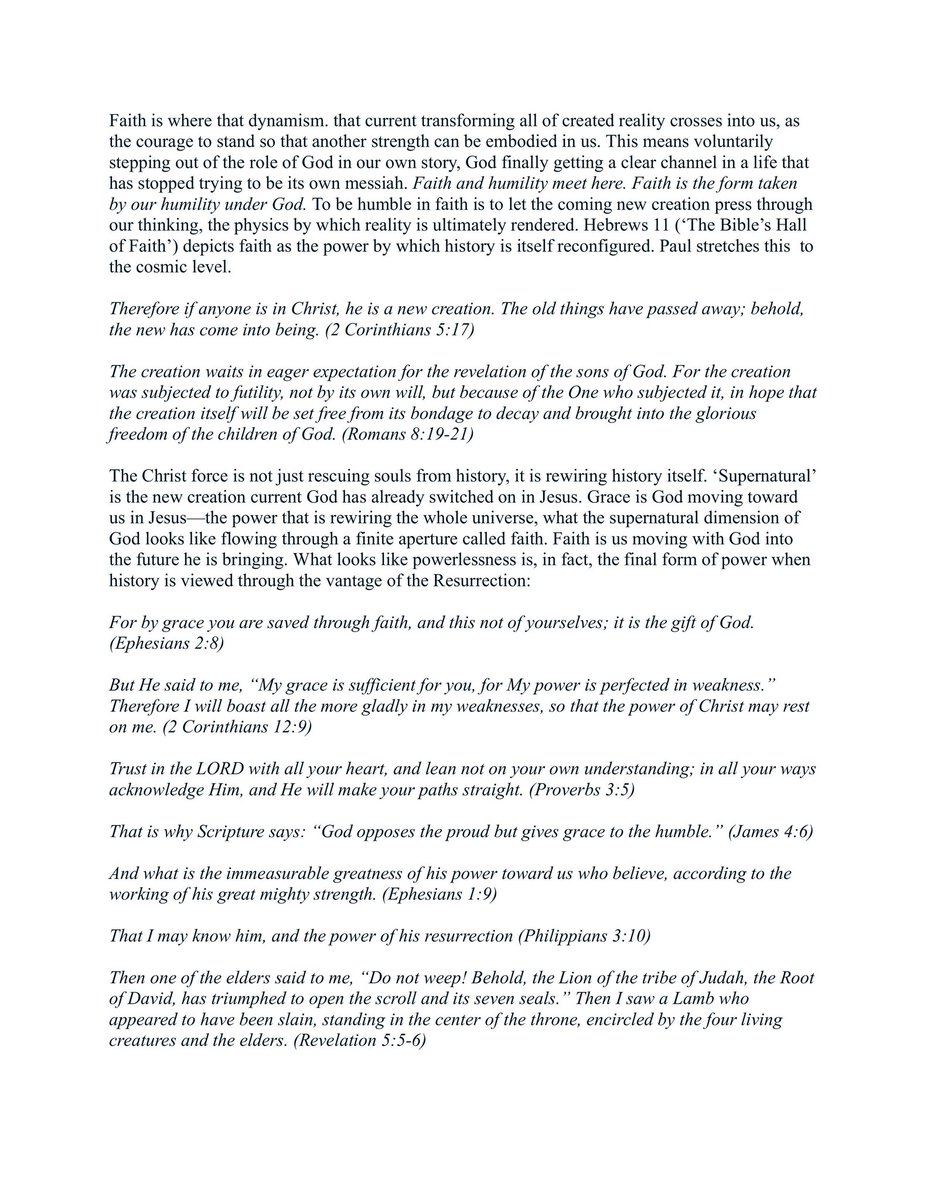
Image description
Extended description
Homework at Elder Mitch’s encouragement, December 10, 2025. Humility isn't just a mood in a sealed, interior realm, but an operative principle—a dynamism joining us to God's own action. It is not the domination of correct prepositions or right reasoning, but its very humbling, bending its knee before a wisdom and resurrective power that our own thought cannot manufacture. It is the capacity to let thought be resourced from beyond itself, what James 3:17 calls "the wisdom that comes from above," and Proverbs 3:7, "Be not wise in your own eyes." A Christ-like way of being, because it shares the nature of the one who is love: Anyone who does not love does not know God, because God is love. (1 John 4:8) Jesus sets the example: I can do nothing by Myself; I judge only as I hear. And My judgment is just, because I do not seek My own will, but the will of Him who sent Me. (John 5:30) Humility is the Christ-shaped restructuring of our being—the process by which our thinking is resourced from the old Adamaic circuitry into participation in Christ. The same movement as: We destroy every proud obstacle that keeps people from knowing God. We capture their rebellious thoughts and teach them to obey Christ. (2 Corinthians 10:5) Do not be conformed to this world, but be transformed by the renewal of your mind, that by testing you may discern what is the will of God, what is good and acceptable and perfect. (Romans 12:2) When we are willing to be weak for him, when we stop pretending to be strong and admit our need, when we no longer live for our own strength but for His, then His strength is made perfect in our weakness. From the standpoint of non-believers, this entire pattern looks like weakness, naivety, failure: For the message of the cross is foolishness to those who are perishing, but to us who are being saved it is the power of God. (1 Corinthians 1:18) Yet this is precisely where God’s wisdom and power are located and revealed: For the foolishness of God is wiser than men, and the weakness of God stronger than men. (1 Corinthians 1:25) For our gospel did not come to you in word only, but also in power and in the Holy Spirit and with full conviction (1 Thessalonians 1:5) The Christ event releases a single power, both inner and outer, into history—Resurrection power. Humility is the resurrection current moving through us as the very life of God—God’s supernatural power moving IN and THROUGH our life. Faith is where that dynamism. that current transforming all of created reality crosses into us, as the courage to stand so that another strength can be embodied in us. This means voluntarily stepping out of the role of God in our own story, God finally getting a clear channel in a life that has stopped trying to be its own messiah. Faith and humility meet here. Faith is the form taken by our humility under God. To be humble in faith is to let the coming new creation press through our thinking, the physics by which reality is ultimately rendered. Hebrews 11 (‘The Bible’s Hall of Faith’) depicts faith as the power by which history is itself reconfigured. Paul stretches this to the cosmic level. Therefore if anyone is in Christ, he is a new creation. The old things have passed away; behold, the new has come into being. (2 Corinthians 5:17) The creation waits in eager expectation for the revelation of the sons of God. For the creation was subjected to futility, not by its own will, but because of the One who subjected it, in hope that the creation itself will be set free from its bondage to decay and brought into the glorious freedom of the children of God. (Romans 8:19-21) The Christ force is not just rescuing souls from history, it is rewiring history itself. ‘Supernatural’ is the new creation current God has already switched on in Jesus. Grace is God moving toward us in Jesus—the power that is rewiring the whole universe, what the supernatural dimension of God looks like flowing through a finite aperture called faith. Faith is us moving with God into the future he is bringing. What looks like powerlessness is, in fact, the final form of power when history is viewed through the vantage of the Resurrection: For by grace you are saved through faith, and this not of yourselves; it is the gift of God. (Ephesians 2:8) But He said to me, “My grace is sufficient for you, for My power is perfected in weakness.” Therefore I will boast all the more gladly in my weaknesses, so that the power of Christ may rest on me. (2 Corinthians 12:9) Trust in the LORD with all your heart, and lean not on your own understanding; in all your ways acknowledge Him, and He will make your paths straight. (Proverbs 3:5) That is why Scripture says: “God opposes the proud but gives grace to the humble.” (James 4:6) And what is the immeasurable greatness of his power toward us who believe, according to the working of his great mighty strength. (Ephesians 1:9) That I may know him, and the power of his resurrection (Philippians 3:10) Then one of the elders said to me, “Do not weep! Behold, the Lion of the tribe of Judah, the Root of David, has triumphed to open the scroll and its seven seals.” Then I saw a Lamb who appeared to have been slain, standing in the center of the throne, encircled by the four living creatures and the elders. (Revelation 5:5-6) Humility is crucified love under pressure—the cruciform remaking of our being. I am crucified with Christ: nevertheless I live; yet not I, but Christ liveth in me: and the life which I now live in the flesh I live by the faith of the Son of God, who loved me, and gave himself for me. (Galatians 2:20) Forgiveness, meekness and enemy love are therefore disclosures - the operative laws of the Kingdom - the physics by which reality is ultimately reordered. Humility becomes koinonia the moment that “resurrection current” stops being a private circuit and happens when two or three do that together, the solitary crack widening into a circle. Humility makes room for a shared Center. But if we are living in the light, as God is in the light, then we have fellowship with each other. (1 John 1:7) Humility is what makes “in my name” concrete. If each person lays down the pretense of being origin and measure, the “center” of the gathering is no longer any individual ego but the Lamb. Koinonia is the public shape of crucified togetherness. In that mutual yielding, the Spirit has real material—bodies, histories, wounds—through which to manifest the “power perfected in weakness” (2 Cor 12:9) as reconciliation in Christ. We now have this light shining in our hearts, but we ourselves are like fragile clay jars containing this great treasure. This makes it clear that our great power is from God, not from ourselves. (2 Corinthians 4:7) The Spirit doesn’t work despite fragility but through it. The Lamb standing in the midst of the throne (Rev 5) is now, by the Spirit, standing in the midst of the circle. The same humility that restructures the solitary “I” into participation in Christ, restructures the “we” into a little outpost of the age to come. "For the Lamb at the center of the throne will be their shepherd" (Revelation 7:17) This is radically Trinitarian: the Father and Son are not two discrete entities plus a relationship; they are the relationship—and the Spirit is that infinite mutual self-gift becoming available to us. Not a being among beings, but Being-as-communion. In other words, when the community yields its center, it participates in the very life of the Trinity—yielding eternally received and eternally given, the deepest truth of divine, the very humility by which God is God. What begins as interior humility unfolds as mutual humility and culminates as communal indwelling—koinonia. And then the circle doesn’t close; it becomes a door, a people through whom God widens the circle until “God is all in all.” (1 Corinthians 15:28) Humility is not the precondition of the Kingdom; it is the Kingdom’s very atmosphere—the energy field of the Kingdom come, the weather of ‘on earth as it is in heaven.’ The Kingdom comes wherever this humility takes flesh. “Blessed are the poor in spirit, for theirs is the kingdom of heaven” (Matthew 5:3): poverty of spirit is simply humility under God—hands emptied of self-rule so they can receive a different reign. When Jesus teaches us to pray, “Your kingdom come, your will be done, on earth as it is in heaven” (Matthew 6:10), humility is our “yes” to that prayer—the inward bow by which heaven’s order enters history. The Kingdom does not arrive by force of will from below, but through yielded lives in which God’s will can actually be done. Maranatha. Humility’s arc: Eternal humility: I am not asking on behalf of them alone, but also on behalf of those who will believe in Me through their message, that all of them may be one, as You, Father, are in Me, and I am in You. May they also be in Us, so that the world may believe that You sent Me. I have given them the glory You gave Me, so that they may be one as We are one—I in them and You in Me—that they may be perfectly united, so that the world may know that You sent Me and have loved them just as You have loved Me. Father, I want those You have given Me to be with Me where I am, that they may see the glory You gave Me because You loved Me before the foundation of the world. (John 17:21–24) Incarnate humility: But made himself of no reputation, and took upon him the form of a servant, and was made in the likeness of men. (Philippians 2:7) Indwelling humility: “It is no longer I who live, but Christ lives in me.” (Galatians 2:20) Mutual humility: “For where two or three are gathered in my name, there am I among them.” (Matthew 18:20) Communal humility: But if we walk in the light, as he is in the light, we have fellowship with one another. (1 John 1:7) Missional humility: Then said Jesus to them again, Peace be unto you: as my Father hath sent me, even so send I you. (John 20:21) Cosmic humility: The creation waits with eager longing for the revealing of the sons of God… that the creation itself will be set free. (Romans 8:19) Humility as universal communion: “When all things are subjected to him… God will be all in all.” (1 Corinthians 15:28)
Open original document