
RT @nick_routledge: @jonmsweeney Chopra’s AI isn’t an anomaly; it’s the evolutionary endpoint of a global spiritual economy built on mediation—a world system revealing its inner logic precisely as it maxes out its own possibility. And exactly here, the deeper question breaks in. Where, and in whom, is truth?
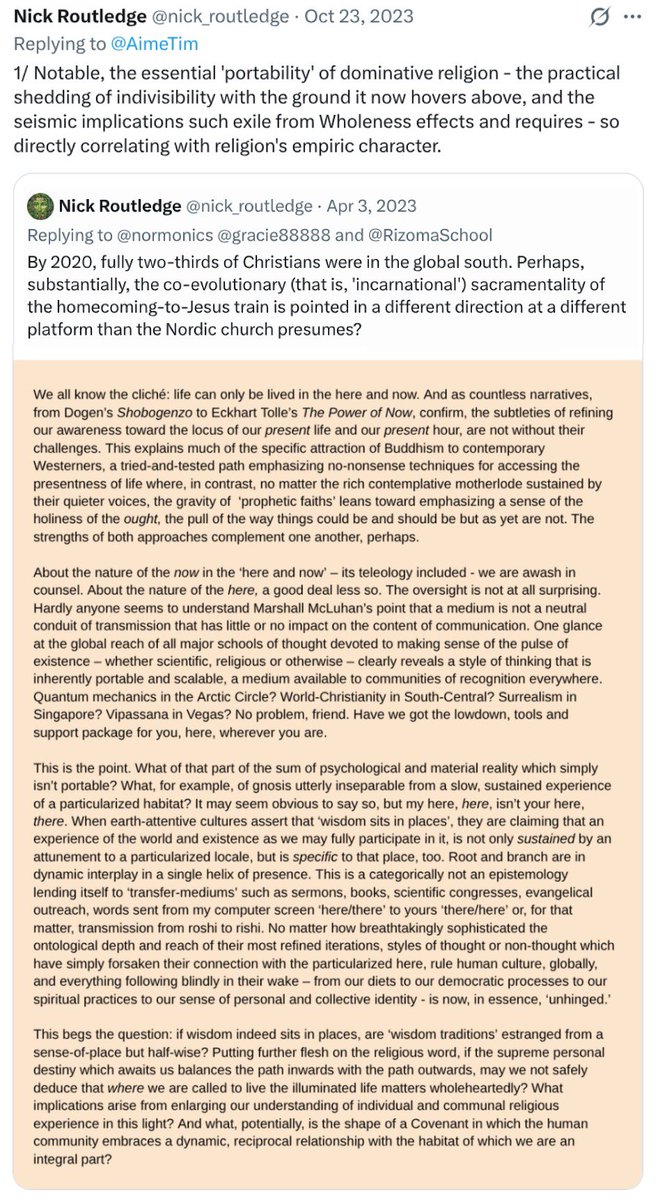
Image description
Original X alt text
Full alt-tre: he
Extended description
1/ Notable, the essential 'portability' of dominative religion - the practical shedding of indivisibility with the ground it now hovers above, and the seismic implications such exile from Wholeness effects and requires - so directly correlating with religion's empiric character. By 2020, fully two-thirds of Christians were in the global south. Perhaps, substantially, the co-evolutionary (that is, 'incarnational') sacramentality of the homecoming-to-Jesus train is pointed in a different direction at a different platform than the Nordic church presumes. We all know the cliché: life can only be lived in the here and now. And as countless narratives, from Dogen’s Shobogenzo to Eckhart Tolle’s The Power of Now, confirm, the subtleties of refining our awareness toward the locus of our present life and our present hour, are not without their challenges. This explains much of the specific attraction of Buddhism to contemporary Westerners, a tried-and-tested path emphasizing no-nonsense techniques for accessing the presentness of life where, in contrast, no matter the rich contemplative motherlode sustained by their quieter voices, the gravity of ‘prophetic faiths’ leans toward emphasizing a sense of the holiness of the ought, the pull of the way things could be and should be but as yet are not. The strengths of both approaches complement one another, perhaps. About the nature of the now in the ‘here and now’ – its teleology included - we are awash in counsel. About the nature of the here, a good deal less so. The oversight is not at all surprising. Hardly anyone seems to understand Marshall McLuhan’s point that a medium is not a neutral conduit of transmission that has little or no impact on the content of communication. One glance at the global reach of all major schools of thought devoted to making sense of the pulse of existence – whether scientific, religious or otherwise – clearly reveals a style of thinking that is inherently portable and scalable, a medium available to communities of recognition everywhere. Quantum mechanics in the Arctic Circle? World-Christianity in South-Central? Surrealism in Singapore? Vipassana in Vegas? No problem, friend. Have we got the lowdown, tools and support package for you, here, wherever you are. This is the point. What of that part of the sum of psychological and material reality which simply isn’t portable? What, for example, of gnosis utterly inseparable from a slow, sustained experience of a particularized habitat? It may seem obvious to say so, but my here, here, isn’t your here, there. When earth-attentive cultures assert that ‘wisdom sits in places’, they are claiming that an experience of the world and existence as we may fully participate in it, is not only sustained by an attunement to a particularized locale, but is specific to that place, too. Root and branch are in dynamic interplay in a single helix of presence. This is a categorically not an epistemology lending itself to ‘transfer-mediums’ such as sermons, books, scientific congresses, evangelical outreach, words sent from my computer screen ‘here/there’ to yours ‘there/here’ or, for that matter, transmission from roshi to rishi. No matter how breathtakingly sophisticated the ontological depth and reach of their most refined iterations, styles of thought or non-thought which have simply forsaken their connection with the particularized here, rule human culture, globally, and everything following blindly in their wake – from our diets to our democratic processes to our spiritual practices to our sense of personal and collective identity - is now, in essence, ‘unhinged.’ This begs the question: if wisdom indeed sits in places, are ‘wisdom traditions’ estranged from a sense-of-place but half-wise? Putting further flesh on the religious word, if the supreme personal destiny which awaits us balances the path inwards with the path outwards, may we not safely deduce that where we are called to live the illuminated life matters wholeheartedly? What implications arise from enlarging our understanding of individual and communal religious experience in this light? And what, potentially, is the shape of a Covenant in which the human community embraces a dynamic, reciprocal relationship with the habitat of which we are an integral part?
Open original document@SohrabAhmari @michaelbd Trust is collapsing at an epistemic, not merely infrastructural, level—a symptom, in effect, of mediation itself entering ontic collapse. The question is no longer whether this is happening, but how we position ourselves within it. What is being revealed?
View this post’s context →