
@GreenestHugh @BMcGrewvy @IVMiles end\ I use search lots. Long Covid brain complicates matters. Often, recalling a hook or the precise language I used to explain an idea, is toast. I used to use Twitter search until, was it, last week, when the algorithm stopped working. Now I search on my Twitter archive.
@AttilaTheLund @lukeburgis You might enjoy this, John. A chance-based book listing, served up non-hierarchically as a complete, unending cycle. The choices are those of John Chris Jones, author of "Designing Designing", and the paradigm-shattering cyberspatial treatment is by his ally, Jonathan Moberly.
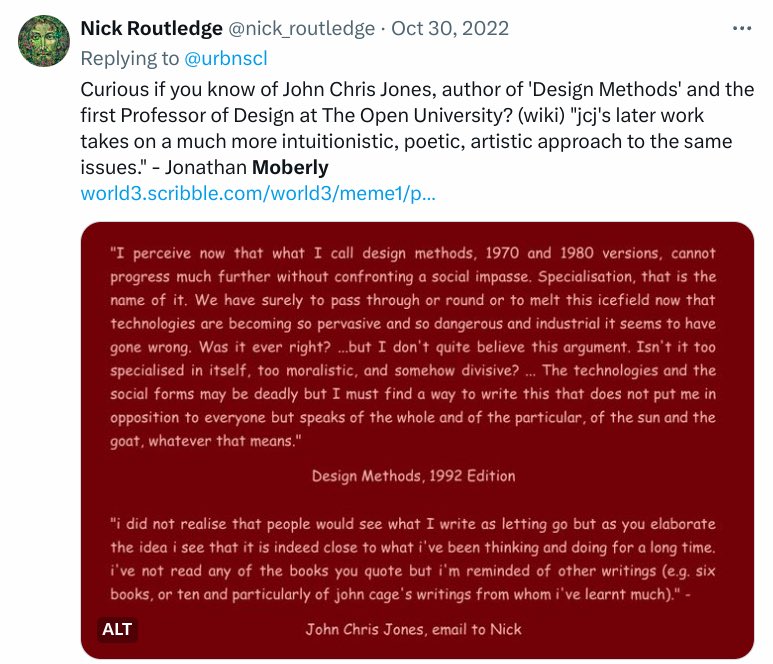
Image description
Original X alt text
Curious if you know of John Chris Jones, author of 'Design Methods' and the first Professor of Design at The Open University? (wiki) "jcj's later work takes on a much more intuitionistic, poetic, artistic approach to the same issues." - Jonathan Moberly "I perceive now that what I call design methods, 1970 and 1980 versions, cannot progress much further without confronting a social impasse. Specialisation, that is the name of it. We have surely to pass through or round or to melt this icefield now that technologies are becoming so pervasive and so dangerous and industrial it seems to have gone wrong. Was it ever right? ...but I don't quite believe this argument. Isn't it too specialised in itself, too moralistic, and somehow divisive? ... The technologies and the social forms may be deadly but I must find a way to write this that does not put me in opposition to everyone but speaks of the whole and of the particular, of the sun and the goat, whatever that means." Design Methods