
Nick Routledge@nick_routledge
Reply to @nick_routledge

@RizomaSchool 8/ This is why the poor stand at the leading edge of the eschaton. They disclose the truth the rest of us spend fortunes avoiding—that the world is remade at the point where our power ends and God’s coherence begins, where cosmic transfiguration has its earliest foothold.
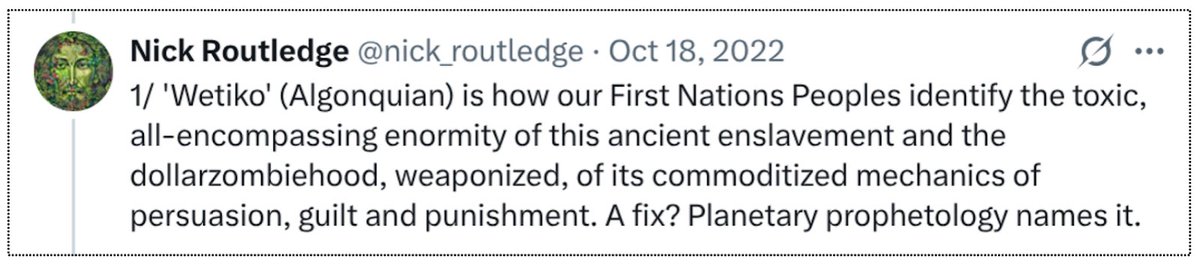
'Wetiko' (Algonquian) is how our First Nations Peoples identify the toxic, all-encompassing enormity of this ancient enslavement and the dollarzombiehood, weaponized, of its commoditized mechanics of persuasion, guilt and punishment. A fix? Planetary prophetology names it.
Image description

Original X alt text

'Wetiko' (Algonquian) is how our First Nations Peoples identify the toxic, all-encompassing enormity of this ancient enslavement and the dollarzombiehood, weaponized, of its commoditized mechanics of persuasion, guilt and punishment. A fix? Planetary prophetology names it.

Quoted or linked post

Nick Routledge@nick_routledge · 17 Aug 2025

@B__Daily @RizomaSchool To confess incarnation here is to rupture the myth of separation that undergirds capitalism's bastard substitution of abstractions for material realities. It is to hear the prophet’s cry: you are bound together, and the judgment is that you cannot unbind what God has woven.
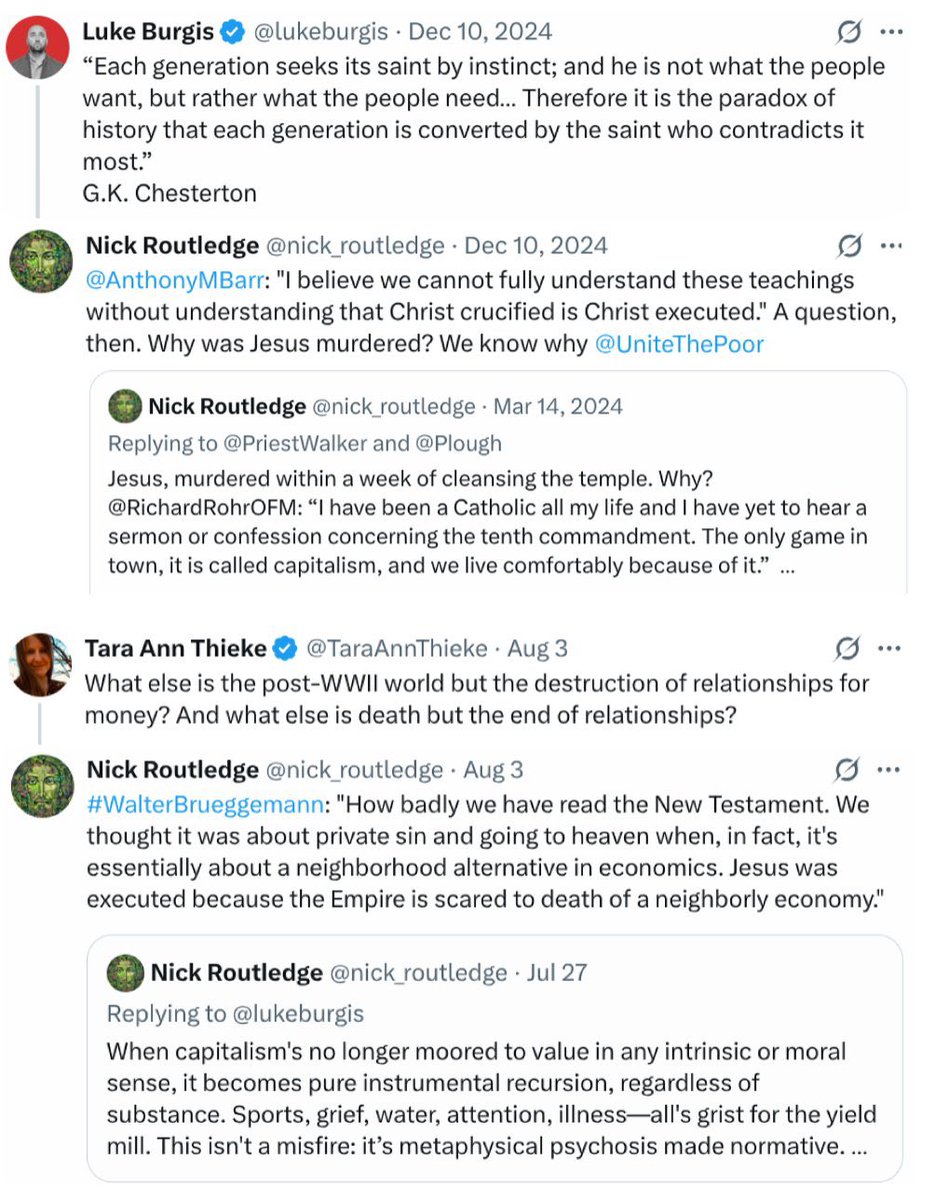
Copy of tweet thread here:

Allt-text for next image begins here due to space limits:

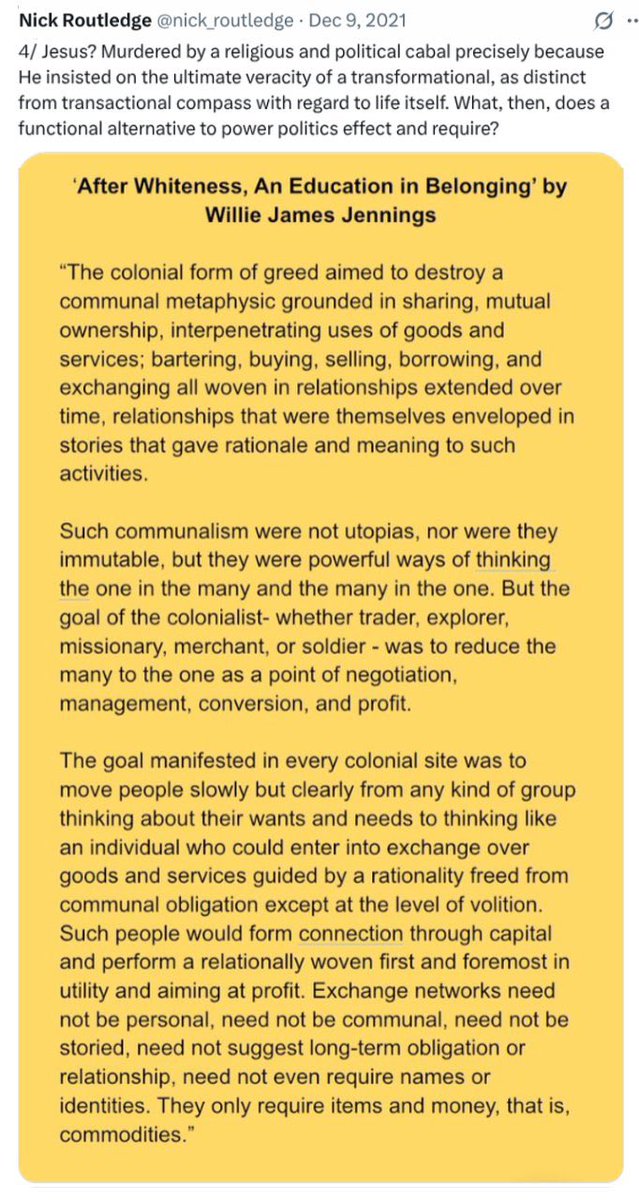
“After Whiteness, An Education in Belonging’ by Willie James Jennings.  “The colonial form of greed aimed to destroy a  communal metaphysic grounded in sharing, mutual ownership, interpenetrating uses of goods and services; bartering, buying, selling, borrowing, and ‘exchanging all woven in relationships extended over time, relationships that were themselves enveloped in stories that gave rationale and meaning to such  activities. Such communalism were not utopias, nor were they immutable, but they were powerful ways of thinking ~~ the one in the many and the many in the one.

Continued with alt-text in next image...
Image description

Original X alt text

Copy of tweet thread here: Allt-text for next image begins here due to space limits: “After Whiteness, An Education in Belonging’ by Willie James Jennings. “The colonial form of greed aimed to destroy a communal metaphysic grounded in sharing, mutual ownership, interpenetrating uses of goods and services; bartering, buying, selling, borrowing, and ‘exchanging all woven in relationships extended over time, relationships that were themselves enveloped in stories that gave rationale and meaning to such activities. Such communalism were not utopias, nor were they immutable, but they were powerful ways of thinking ~~ the one in the many and the many in the one. Continued with alt-text in next image...
ttps://x.com/nick_routledge/status/1469072626018488321

[First part of alt-text attached to previous image]
But the goal of the colonialist whether trader, explorer, missionary, merchant, or soldier - was to reduce the ‘many to the one as a point of negotiation, ‘management, conversion, and profit.  ‘The goal manifested in every colonial site was to  ‘move people slowly but clearly from any kind of group  thinking about their wants and needs to thinking like an individual who could enter into exchange over  goods and services guided by a rationality freed from communal obligation except at the level of volition. Such people would form connection through capital and perform a relationally woven first and foremost in utility and aiming at profit. Exchange networks need not be personal, need not be communal, need not be storied, need not suggest long-term obligation or relationship, need not even require names or identities. They only require items and money, that is, commodities.”
Image description

Original X alt text

ttps://x.com/nick_routledge/status/1469072626018488321 [First part of alt-text attached to previous image] But the goal of the colonialist whether trader, explorer, missionary, merchant, or soldier - was to reduce the ‘many to the one as a point of negotiation, ‘management, conversion, and profit. ‘The goal manifested in every colonial site was to ‘move people slowly but clearly from any kind of group thinking about their wants and needs to thinking like an individual who could enter into exchange over goods and services guided by a rationality freed from communal obligation except at the level of volition. Such people would form connection through capital and perform a relationally woven first and foremost in utility and aiming at profit. Exchange networks need not be personal, need not be communal, need not be storied, need not suggest long-term obligation or relationship, need not even require names or identities. They only require items and money, that is, commodities.”

View this post’s context →

Context in the archive

Quoted by@jasonwblakely 3/ America’s depth realm announces itself where suffering, song, land, Spirit, revolt, and ordinary mercy become inseparable—not as philosophy the academy can easily recognize, but as wisdom struggling to become flesh in history through witness, bodies, voices, and wounds.Quoted by@jeff_bilbro @Hannah_Cristine @herdyshepherd1 @SpenceSpencer01 @alexbronzini @DanielDenvir 3/ Yes, they will be. But the rich will not—because the Kingdom requires entry through the truth of a condition the wealthy have spent everything to purchase exemption from: the human condition itself, which is creaturely poverty before God. No one is self-originating.Quoted by@tenshi_anna @thomasowaller @TRIERTIUM end\ “Blessed are the poor” isn’t a moral compliment; it’s an ontological claim about how reality is wired, signaling the fissure where the Kingdom's already-arriving reality breaks into the present age as messianic revelation and liberation. The Kingdom disrupts from below.