
RT @nick_routledge: @mjkaul The church-academy complex shines as triumph and cage alike: a civilizational zenith yet equally an epistemic cordon sanitaire—enforcing a form of metaphysical quarantine barring strategies granting access to planes of relational embodiment rendering the unthinkable inhabitable.
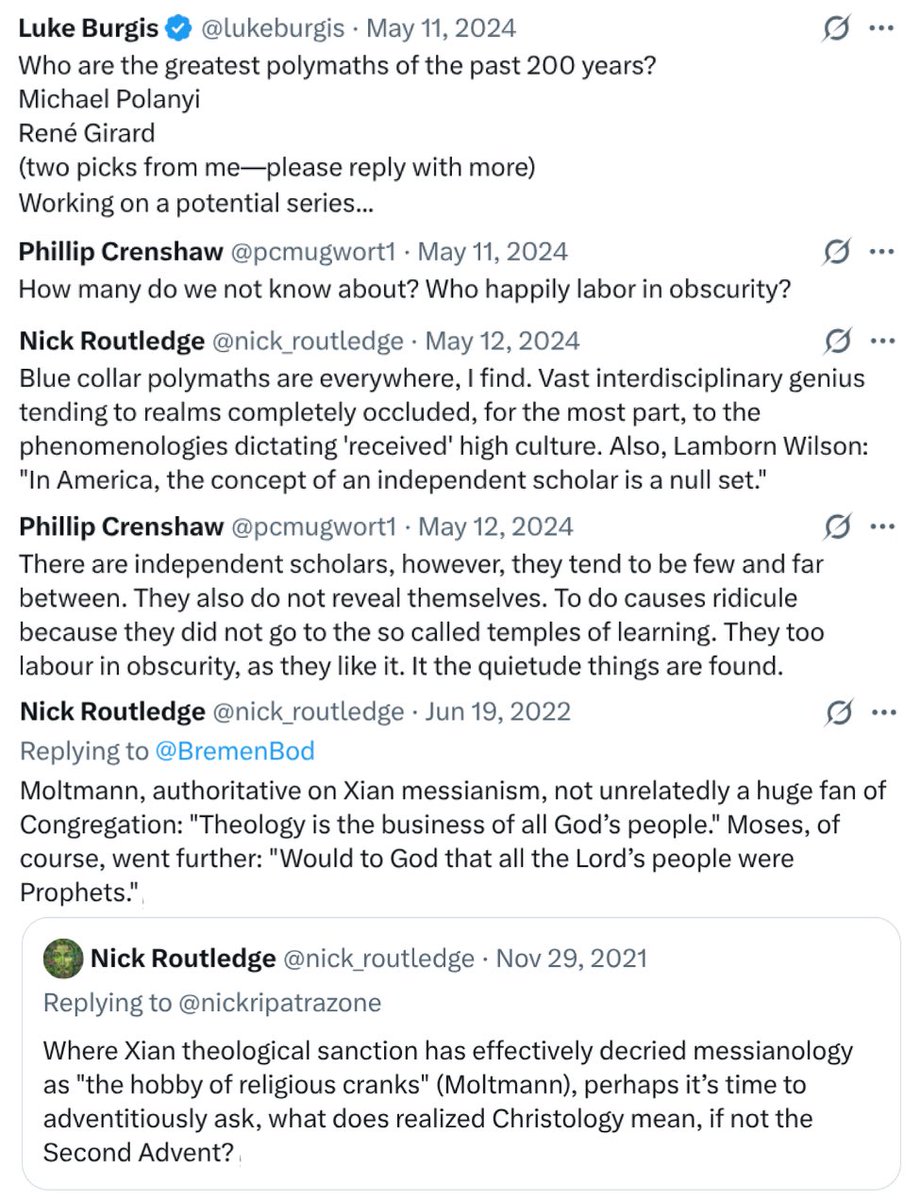
Image description
Extended description
Tweet thread here: Who are the greatest polymaths of the past 200 years? Michael Polanyi René Girard (two picks from me—please reply with more) Working on a potential series... How many do we not know about? Who happily labor in obscurity? and Blue collar polymaths are everywhere, I find. Vast interdisciplinary genius tending to realms completely occluded, for the most part, to the phenomenologies dictating 'received' high culture. Also, Lamborn Wilson: "In America, the concept of an independent scholar is a null set." There are independent scholars, however, they tend to be few and far between. They also do not reveal themselves. To do causes ridicule because they did not go to the so called temples of learning. They too labour in obscurity, as they like it. It the quietude things are found. Moltmann, authoritative on Xian messianism, not unrelatedly a huge fan of Congregation: "Theology is the business of all God’s people." Moses, of course, went further: "Would to God that all the Lord’s people were Prophets." A fresh start? Heschel: "Not to reject but surpass.” Quote tweet: Where Xian theological sanction has effectively decried messianology as "the hobby of religious cranks" (Moltmann), perhaps it’s time to adventitiously ask, what does realized Christology mean, if not the Second Advent?
Open original document@MutualSociology @TheBruderhof @KoinoniaFarm end\ The key theo-philosophical heirs of this relational revolution—Benjamin, Illich, Levinas, Moltmann, Metz among others—insist history remains open and the future of God already arrives as a demand on how we live together now. Revelation, in other words, is relational.
View this post’s context →