
@NatureSchoolSU @rabcyr_alt Those who will not learn in plenty to keep their place must learn it by their need when they have had their way and the fields spurn their seed. We have failed Thy grace. Lord, I flinch and pray, send Thy necessity. ~ Wendell Berry, We Who Prayed and Wept theguardian.com/commentisfree/emma-brockes-blog/2012/oct/11/wendell-berry-environmental-campaigner
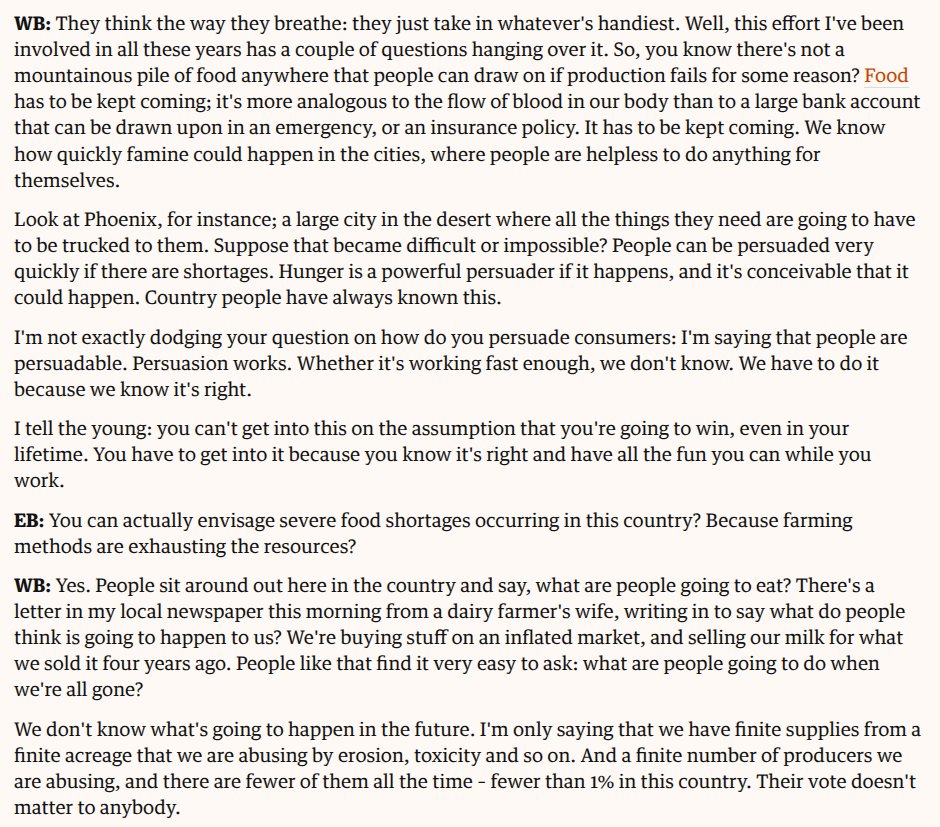
Image description
Extended description
EB: How do you get consumers to give more thought to what they're buying in the supermarket? At the end of a long day, that can be a tough sell. WB: They think the way they breathe: they just take in whatever's handiest. Well, this effort I've been involved in all these years has a couple of questions hanging over it. So, you know there's not a mountainous pile of food anywhere that people can draw on if production fails for some reason? Food has to be kept coming; it's more analogous to the flow of blood in our body than to a large bank account that can be drawn upon in an emergency, or an insurance policy. It has to be kept coming. We know how quickly famine could happen in the cities, where people are helpless to do anything for themselves. Look at Phoenix, for instance; a large city in the desert where all the things they need are going to have to be trucked to them. Suppose that became difficult or impossible? People can be persuaded very quickly if there are shortages. Hunger is a powerful persuader if it happens, and it's conceivable that it could happen. Country people have always known this. I'm not exactly dodging your question on how do you persuade consumers: I'm saying that people are persuadable. Persuasion works. Whether it's working fast enough, we don't know. We have to do it because we know it's right. I tell the young: you can't get into this on the assumption that you're going to win, even in your lifetime. You have to get into it because you know it's right and have all the fun you can while you work. EB: You can actually envisage severe food shortages occurring in this country? Because farming methods are exhausting the resources? WB: Yes. People sit around out here in the country and say, what are people going to eat? There's a letter in my local newspaper this morning from a dairy farmer's wife, writing in to say what do people think is going to happen to us? We're buying stuff on an inflated market, and selling our milk for what we sold it four years ago. People like that find it very easy to ask: what are people going to do when we're all gone? We don't know what's going to happen in the future. I'm only saying that we have finite supplies from a finite acreage that we are abusing by erosion, toxicity and so on. And a finite number of producers we are abusing, and there are fewer of them all the time – fewer than 1% in this country. Their vote doesn't matter to anybody.
Open original document