
@Kawaakibi @iyad_elbaghdadi 1/2 Here's political theologian Michael Kirwan SJ, who co-edited the volume Mimetic Theory and Islam: “The Wound Where Light Enters” with Ahmad Achtar. Elsewhere, he proposes a shared “Abrahamic revolution”. The pivot, in essence? Submission to revelation, and victim-concern. x.com/ThinkingFaith/status/1853316331543658775
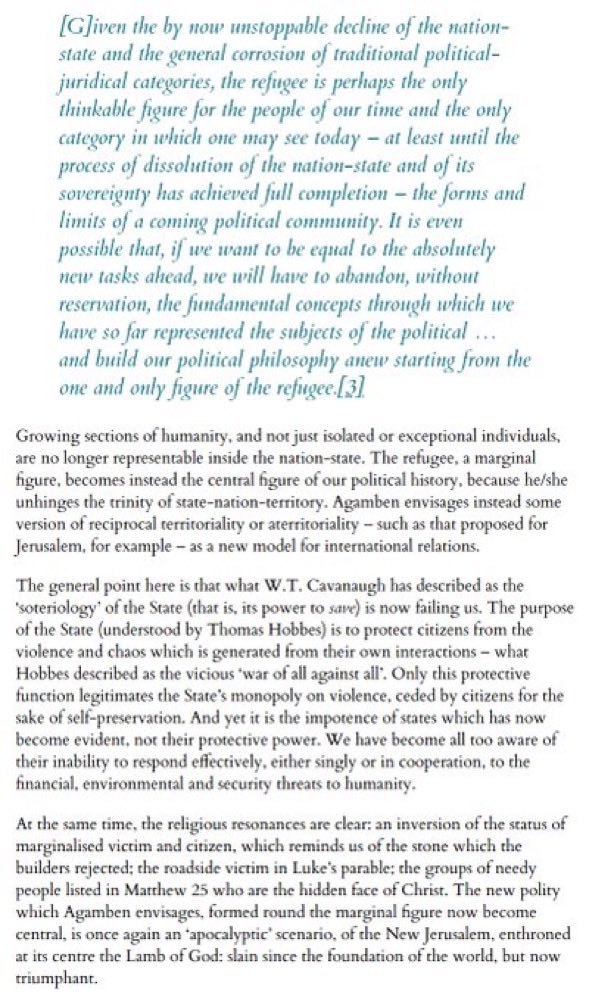
Image description
Extended description
Alt-text: [An excerpt from: [G]iven the by now unstoppable decline of the nation-state and the general corrosion of traditional political-juridical categories, the refugee is perhaps the only thinkable figure for the people of our time and the only category in which one may see today – at least until the process of dissolution of the nation-state and of its sovereignty has achieved full completion – the forms and limits of a coming political community. It is even possible that, if we want to be equal to the absolutely new tasks ahead, we will have to abandon, without reservation, the fundamental concepts through which we have so far represented the subjects of the political … and build our political philosophy anew starting from the one and only figure of the refugee.[3] Growing sections of humanity, and not just isolated or exceptional individuals, are no longer representable inside the nation-state. The refugee, a marginal figure, becomes instead the central figure of our political history, because he/she unhinges the trinity of state-nation-territory. Agamben envisages instead some version of reciprocal territoriality or aterritoriality – such as that proposed for Jerusalem, for example – as a new model for international relations. The general point here is that what W.T. Cavanaugh has described as the ‘soteriology’ of the State (that is, its power to save) is now failing us. The purpose of the State (understood by Thomas Hobbes) is to protect citizens from the violence and chaos which is generated from their own interactions – what Hobbes described as the vicious ‘war of all against all’. Only this protective function legitimates the State’s monopoly on violence, ceded by citizens for the sake of self-preservation. And yet it is the impotence of states which has now become evident, not their protective power. We have become all too aware of their inability to respond effectively, either singly or in cooperation, to the financial, environmental and security threats to humanity.
Open original document