
@suzania end/ Some critique AI without using it. Goes both ways—you can write theology without praying or about heroin without shooting up. Perhaps a root theological question isn't whether to engage but how to engage with discernment. I came to LLMs only this past May. A gauntlet of old.
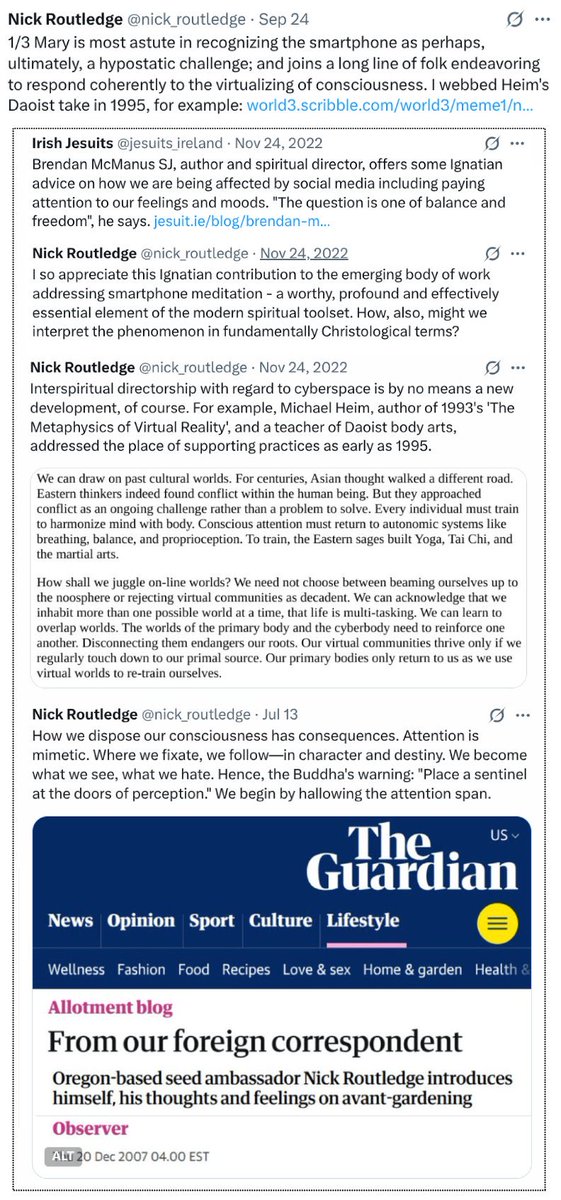
Image description
Extended description
Tweet: 1/3 Mary is most astute in recognizing the smartphone as perhaps, ultimately, a hypostatic challenge; and joins a long line of folk endeavoring to respond coherently to the virtualizing of consciousness. I webbed Heim's Daoist take in 1995, for example: Brendan McManus SJ, author and spiritual director, offers some Ignatian advice on how we are being affected by social media including paying attention to our feelings and moods. "The question is one of balance and freedom", he says. I so appreciate this Ignatian contribution to the emerging body of work addressing smartphone meditation - a worthy, profound and effectively essential element of the modern spiritual toolset. How, also, might we interpret the phenomenon in fundamentally Christological terms? · Interspiritual directorship with regard to cyberspace is by no means a new development, of course. For example, Michael Heim, author of 1993's 'The Metaphysics of Virtual Reality', and a teacher of Daoist body arts, addressed the place of supporting practices as early as 1995. [Excerpt from Michael Heim's 'Nerd in the Noosphere']: Every individual must train to harmonize mind with body. Conscious attention must return to autonomic systems like breathing, balance, and proprioception. To train, the Eastern sages built Yoga, Tai Chi, and the martial arts. How shall we juggle on-line worlds? We need not choose between beaming ourselves up to the noosphere or rejecting virtual communities as decadent. We can acknowledge that we inhabit more than one possible world at a time, that life is multi-tasking. We can learn to overlap worlds. The worlds of the primary body and the cyberbody need to reinforce one another. Disconnecting them endangers our roots. Our virtual communities thrive only if we regularly touch down to our primal source. Our primary bodies only return to us as we use virtual worlds to re-train ourselves. How we dispose our consciousness has consequences. Attention is mimetic. Where we fixate, we follow—in character and destiny. We become what we see, what we hate. Hence, the Buddha's warning: "Place a sentinel at the doors of perception." We begin by hallowing the attention span. Screenshot of The Observer Newspaper's ('The Guardian newspaper's Sunday anal) Allotment blog, Thursday 20 December, with headline: From our foreign correspondent This article is more than 17 years old Oregon-based seed ambassador Nick Routledge introduces himself, his thoughts and feelings on avant-gardening.
Open original document@pauljpastor By the by, I don't know if you saw it, but multiple reports in October 2025 estimate that AI infrastructure investment accounts for approximately 40% of total U.S. GDP growth for the year, surpassing consumer spending. That's an egg in a basket. What do AIs themselves make of it?
View this post’s context →