
@tenshi_anna @RyanHaecker A thoughtful list—thank you. I wonder, though, if its pattern reveals not just an historical omission but an epistemic and constitutive bias—perhaps even quietly docetic: theology that begins at a remove from the flesh of the world, unlike, say, Keller, Delio, Deane-Drummond…
end/ Incarnation is not metaphor but embodied apocalypse: history’s judgment and creation’s rebirth. This is the eschaton: love blazing through soil and species, body and polis, networks and nations—our own flesh and the flesh of the world, revealed as the medium of divine law.
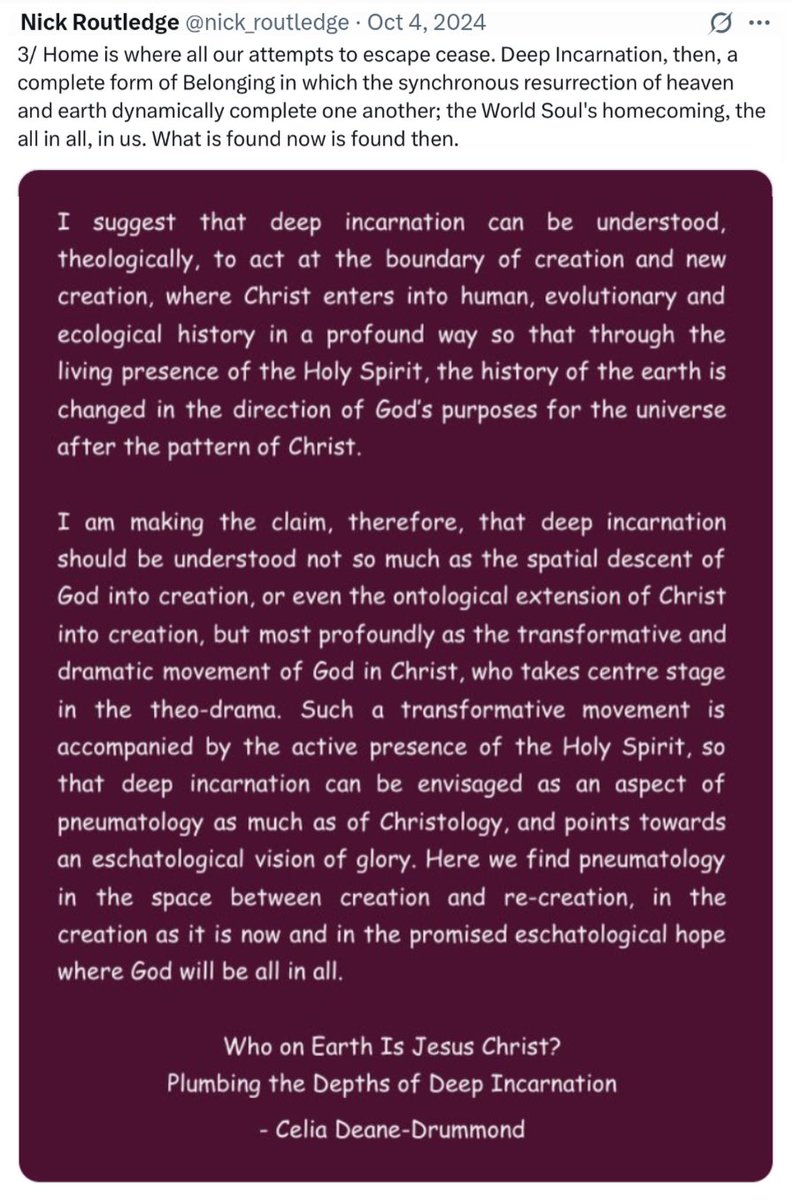
Image description
Original X alt text
Copy of tweet and image here: 3/[edit] I suggest that deep incarnation can be understood, theologically, to act at the boundary of creation and new creation, where Christ enters into human, evolutionary and ecological history in a profound way so that through the living presence of the Holy Spirit...deep incarnation should be understood not so much as the spatial descent of God into creation, or even the ontological extension of Christ into creation, but most profoundly as the transformative and dramatic movement of God in Christ, who takes centre stage in the theo-drama...accompanied by the active presence of the Holy Spirit, so that deep incarnation can be envisaged as an aspect of pneumatology as much as of Christology, an eschatological vision of glory. Here we find pneumatology in the space between creation and re-creation, in the creation as it is now and in the promised eschatological hope where God will be all in all.