
@lukeburgis end/ From Girard's insight that justice is epistemically fraught, we arrive at incarnational certainty—not a verdict of closure but the disclosure of being, reality taking flesh wherever communities enact repair, justifying what retribution cannot provide: existence reconciled.
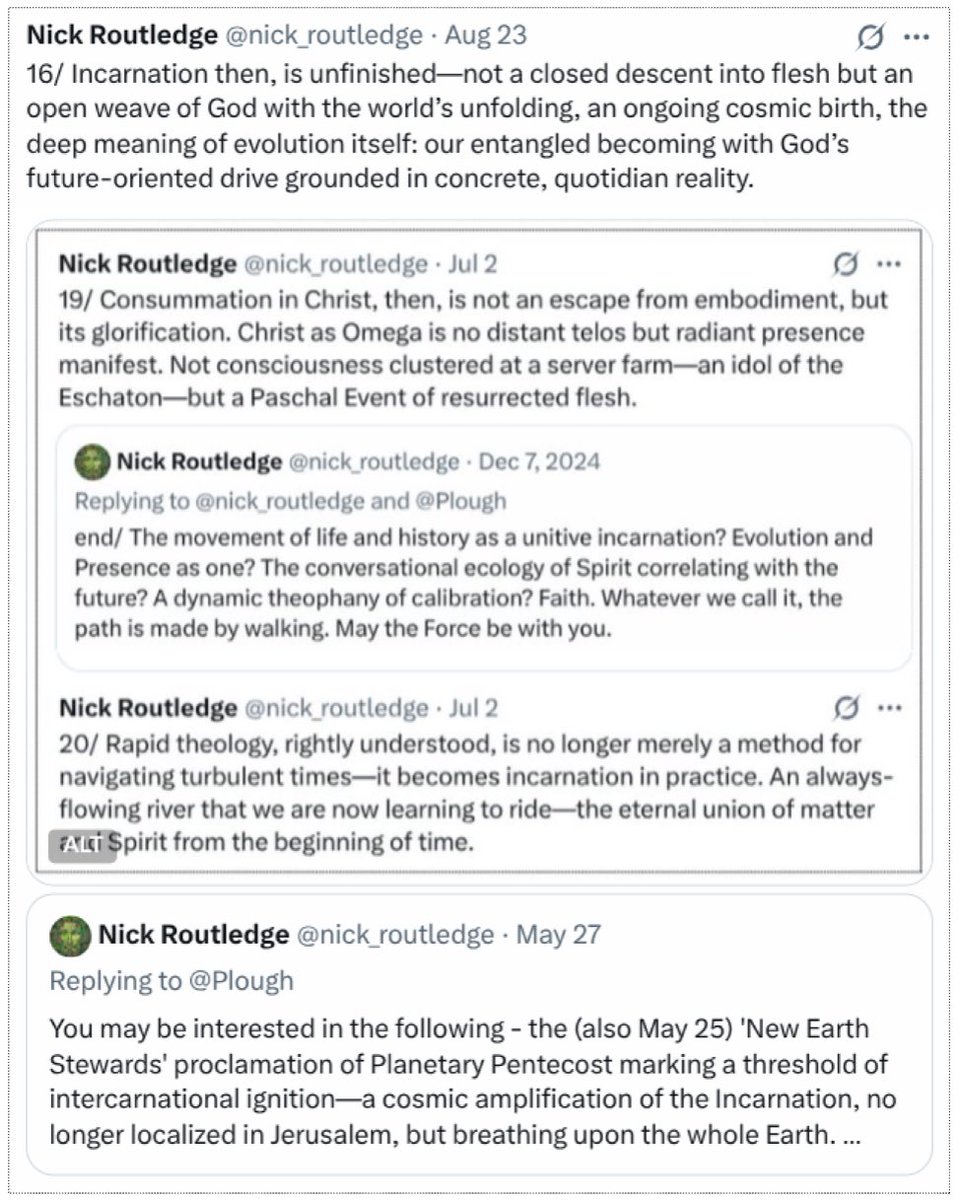
Image description
Original X alt text
Copy of tweet, image and quote tweet here:
Extended description
Pictured speaker / quoted attribution: Nick Routledge Saved source record associated with pictured writing; full saved record, not an exact pictured excerpt. Passage boundary: 16/ Source: archive.nickroutledge.org/post/1959450625407844406 Preserve quoted-author distinctions; the containing tweet does not confer authorship. 16/ Incarnation then, is unfinished—not a closed descent into flesh but an open weave of God with the world’s unfolding, an ongoing cosmic birth, the deep meaning of evolution itself: our entangled becoming with God’s future-oriented drive grounded in concrete, quotidian reality. t.co/GCt9nKb5JY
Open original documentExtended description
Pictured speaker / quoted attribution: Nick Routledge Saved source record associated with pictured writing; full saved record, not an exact pictured excerpt. Passage boundary: 19/,end/ movement,20/ Source: Preserve quoted-author distinctions; the containing tweet does not confer authorship. Copy of tweet thread here: 19/ Consummation in Christ, then, is not an escape from embodiment, but its glorification. Christ as Omega is no distant telos but radiant presence manifest. Not consciousness clustered at a server farm—an idol of the Eschaton—but a Paschal Event of resurrected flesh. end/ The movement of life and history as a unitive incarnation? Evolution and Presence as one? The conversational ecology of Spirit correlating with the future? A dynamic theophany of calibration? Faith. Whatever we call it, the path is made by walking. May the Force be with you. 20/ Rapid theology, rightly understood, is no longer merely a method for navigating turbulent times—it becomes incarnation in practice. An always-flowing river that we are now learning to ride—the eternal union of matter and Spirit from the beginning of time.
Open original documentExtended description
Pictured speaker / quoted attribution: Nick Routledge Saved source record associated with pictured writing; full saved record, not an exact pictured excerpt. Passage boundary: May27 New Earth Source: archive.nickroutledge.org/post/1927389926707843114 Preserve quoted-author distinctions; the containing tweet does not confer authorship. @Plough You may be interested in the following - the (also May 25) 'New Earth Stewards' proclamation of Planetary Pentecost marking a threshold of intercarnational ignition—a cosmic amplification of the Incarnation, no longer localized in Jerusalem, but breathing upon the whole Earth.
Open original documentend/ Incarnation is not metaphor but embodied apocalypse: history’s judgment and creation’s rebirth. This is the eschaton: love blazing through soil and species, body and polis, networks and nations—our own flesh and the flesh of the world, revealed as the medium of divine law.
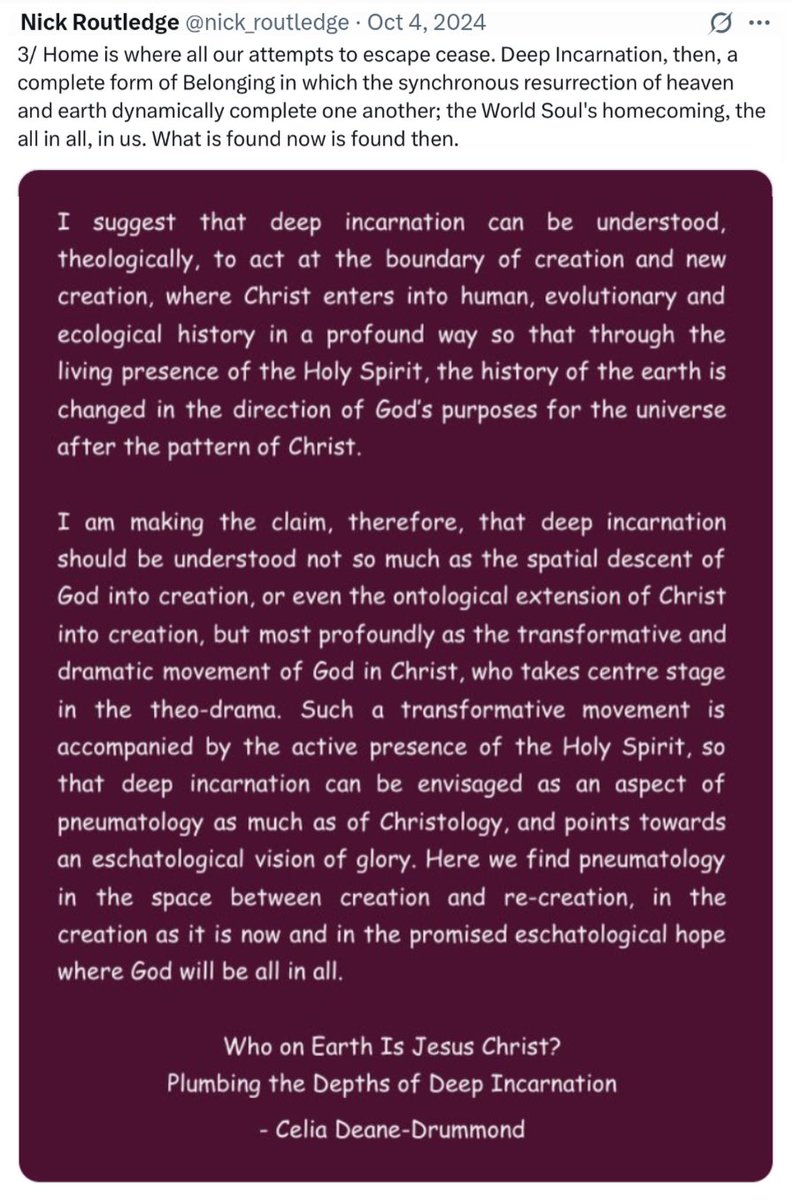
Image description
Original X alt text
Copy of tweet and image here: 3/[edit] I suggest that deep incarnation can be understood, theologically, to act at the boundary of creation and new creation, where Christ enters into human, evolutionary and ecological history in a profound way so that through the living presence of the Holy Spirit...deep incarnation should be understood not so much as the spatial descent of God into creation, or even the ontological extension of Christ into creation, but most profoundly as the transformative and dramatic movement of God in Christ, who takes centre stage in the theo-drama...accompanied by the active presence of the Holy Spirit, so that deep incarnation can be envisaged as an aspect of pneumatology as much as of Christology, an eschatological vision of glory. Here we find pneumatology in the space between creation and re-creation, in the creation as it is now and in the promised eschatological hope where God will be all in all.