
@RichardRohrOFM That's but the half of it. The messianic moment is not mere presence but the union of time and eternity; history’s conflicts and wounds not abandoned but taken up, metabolized and recalibrated as Kingdom depth. Temporality itself transfigured in the locus of personal experience.
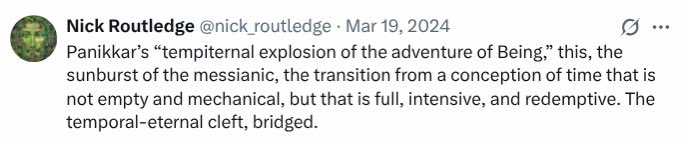
Image description
Original X alt text
Copy of tweet here: Panikkar’s “tempiternal explosion of the adventure of Being,” this, the sunburst of the messianic, the transition from a conception of time that is not empty and mechanical, but that is full, intensive, and redemptive. The temporal-eternal cleft, bridged.
@RobertEllsberg @OrbisBooks 2/6 On Christic time—tempieterity as the mercy of the Messiah—Panikkar is supreme. And though he never named the bridge ("There may be no more formidable problem than the problem of time") his kairotic alignment with Judaic cosmology registers as pivotal to messianic convergence.
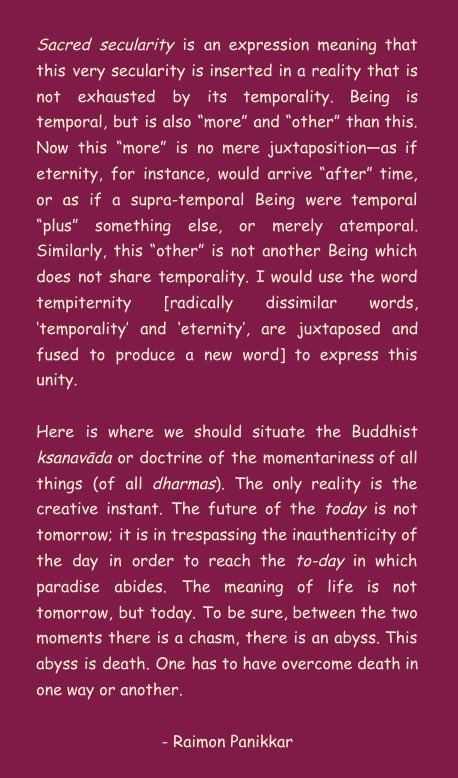
Image description
Original X alt text
Sacred secularity is an expression meaning that this very secularity is inserted in a reality that is not exhausted by its temporality. Being is temporal, but is also “more” and “other” than this. Now this “more” is no mere juxtaposition—as if eternity, for instance, would arrive “after” time, or as if a supra-temporal Being were temporal “plus” something else, or merely atemporal. Similarly, this “other” is not another Being which does not share temporality. I would use the word tempiternity [radically dissimilar words, ‘temporality’ and ‘eternity’, are juxtaposed and fused to produce a new word] to express this unity. Here is where we should situate the Buddhist ksanavāda or doctrine of the momentariness of all things (of all dharmas). The only reality is the creative instant. The future of the today is not tomorrow; it is in trespassing the inauthenticity of the day in order to reach the to-day in which paradise abides. The meaning of life is not tomorrow, but today. Panikkar