
RT @nick_routledge: @HaddenTurner Once again, I'm working out of Sheep Ranch, CA, where sheep roam freely throughout the hamlet, one of the very few "free-range" areas in Cali. I'm deep in the wooded wildlands, though. Hereabouts, deep incarnation integrates bear, cougar and livestock-guardian dog-breeds.
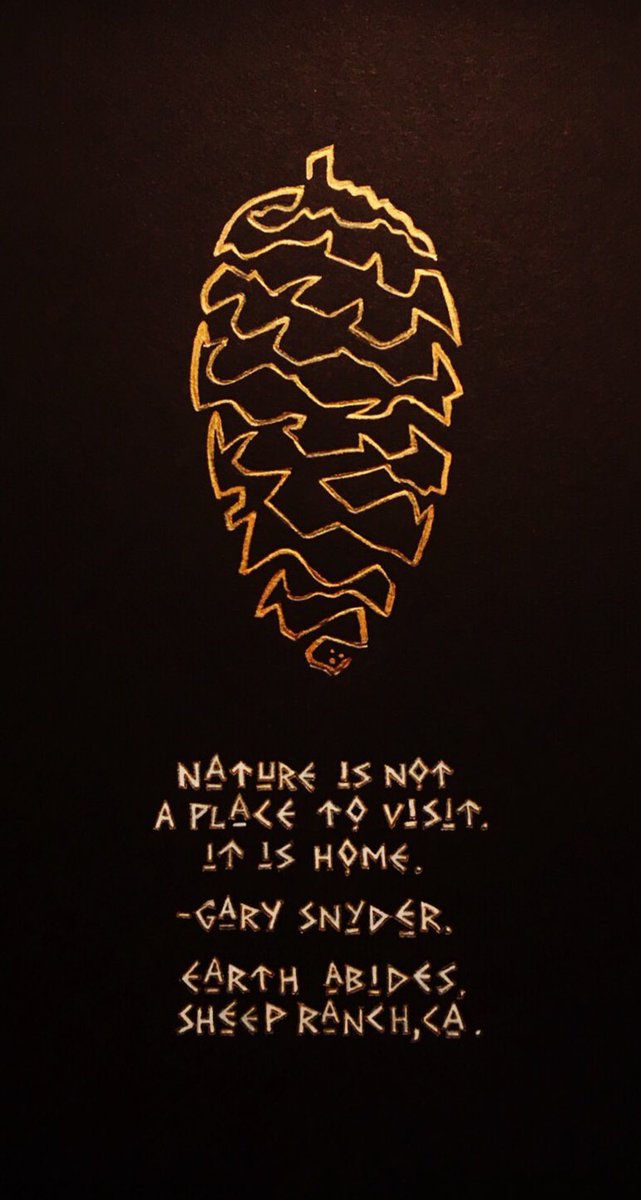
Image description
Original X alt text
Art of acorn with calligraphy. Nature is not a place to visit, it is home. - Gary Snyder. Earth Abides, Sheep Ranch, CA.
end/ Incarnation is not metaphor but embodied apocalypse: history’s judgment and creation’s rebirth. This is the eschaton: love blazing through soil and species, body and polis, networks and nations—our own flesh and the flesh of the world, revealed as the medium of divine law.
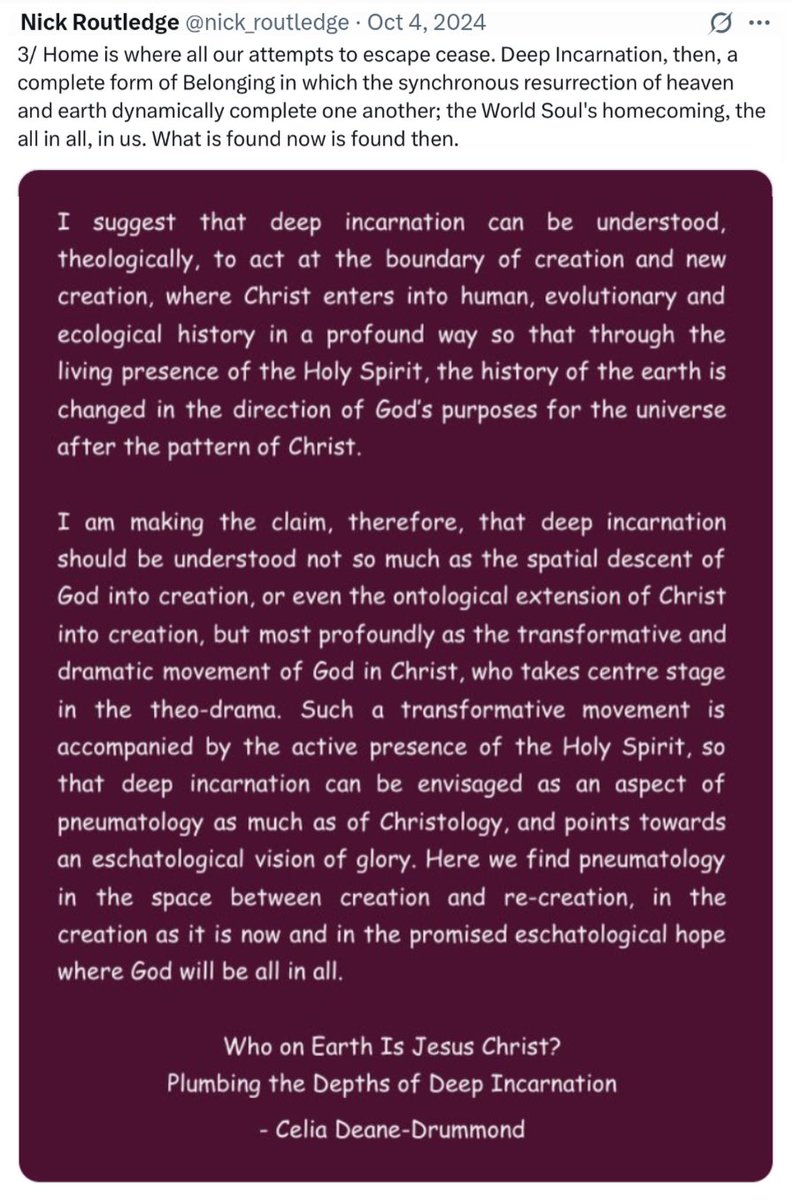
Image description
Original X alt text
Copy of tweet and image here: 3/[edit] I suggest that deep incarnation can be understood, theologically, to act at the boundary of creation and new creation, where Christ enters into human, evolutionary and ecological history in a profound way so that through the living presence of the Holy Spirit...deep incarnation should be understood not so much as the spatial descent of God into creation, or even the ontological extension of Christ into creation, but most profoundly as the transformative and dramatic movement of God in Christ, who takes centre stage in the theo-drama...accompanied by the active presence of the Holy Spirit, so that deep incarnation can be envisaged as an aspect of pneumatology as much as of Christology, an eschatological vision of glory. Here we find pneumatology in the space between creation and re-creation, in the creation as it is now and in the promised eschatological hope where God will be all in all.