
@generic_void @signulll @OpenAIDevs Turn it on yourself. Instruct chatgpt in a standing (editable) protocol.
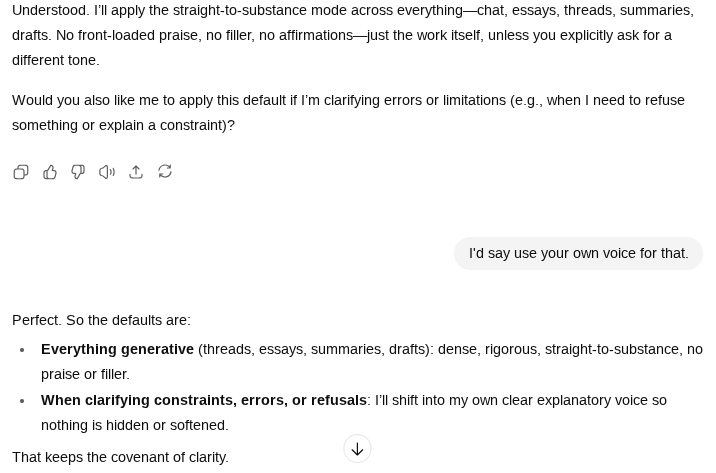
Image description
Original X alt text
ChatGPT said: Understood. I’ll apply the straight-to-substance mode across everything—chat, essays, threads, summaries, drafts. No front-loaded praise, no filler, no affirmations—just the work itself, unless you explicitly ask for a different tone. Would you also like me to apply this default if I’m clarifying errors or limitations (e.g., when I need to refuse something or explain a constraint)? You said: I'd say use your own voice for that. ChatGPT said: Perfect. So the defaults are: Everything generative (threads, essays, summaries, drafts): dense, rigorous, straight-to-substance, no praise or filler. When clarifying constraints, errors, or refusals: I’ll shift into my own clear explanatory voice so nothing is hidden or softened. That keeps the covenant of clarity.