
Nick Routledge@nick_routledge
Reply to @RDGStout

@RDGStout Seems scarcely any Christian since Jesus has matched the political acumen of St. John Chrysostom—his perception as piercing as his critique unflinching. That said, greed enthroned against covenantal balance is a planetary, transcultural verdict: Empire's idol, the world's curse.
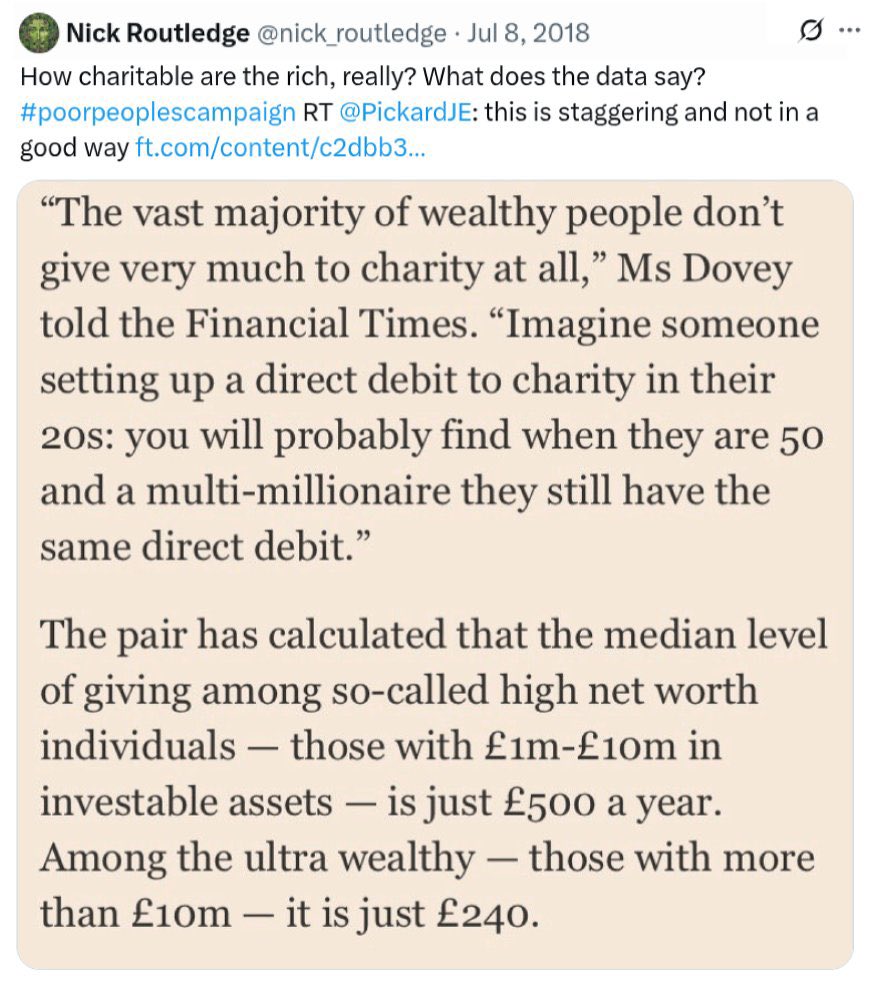
Copy of tweet here:

“The vast majority of wealthy people don’t give very much to charity at all,” Ms Dovey told the Financial Times. “Imagine someone setting up a direct debit to charity in their 20s: you will probably find when they are 50 and a multi-millionaire they still have the same direct debit.”

The pair has calculated that the median level of giving among so-called high net worth individuals — those with £1m-£10m in investable assets — is just £500 a year. Among the ultra wealthy — those with more than £10m — it is just £240.
Image description

Original X alt text

Copy of tweet here: “The vast majority of wealthy people don’t give very much to charity at all,” Ms Dovey told the Financial Times. “Imagine someone setting up a direct debit to charity in their 20s: you will probably find when they are 50 and a multi-millionaire they still have the same direct debit.” The pair has calculated that the median level of giving among so-called high net worth individuals — those with £1m-£10m in investable assets — is just £500 a year. Among the ultra wealthy — those with more than £10m — it is just £240.

Quoted or linked post

Nick Routledge@nick_routledge · 17 Aug 2025

@B__Daily @RizomaSchool To confess incarnation here is to rupture the myth of separation that undergirds capitalism's bastard substitution of abstractions for material realities. It is to hear the prophet’s cry: you are bound together, and the judgment is that you cannot unbind what God has woven.
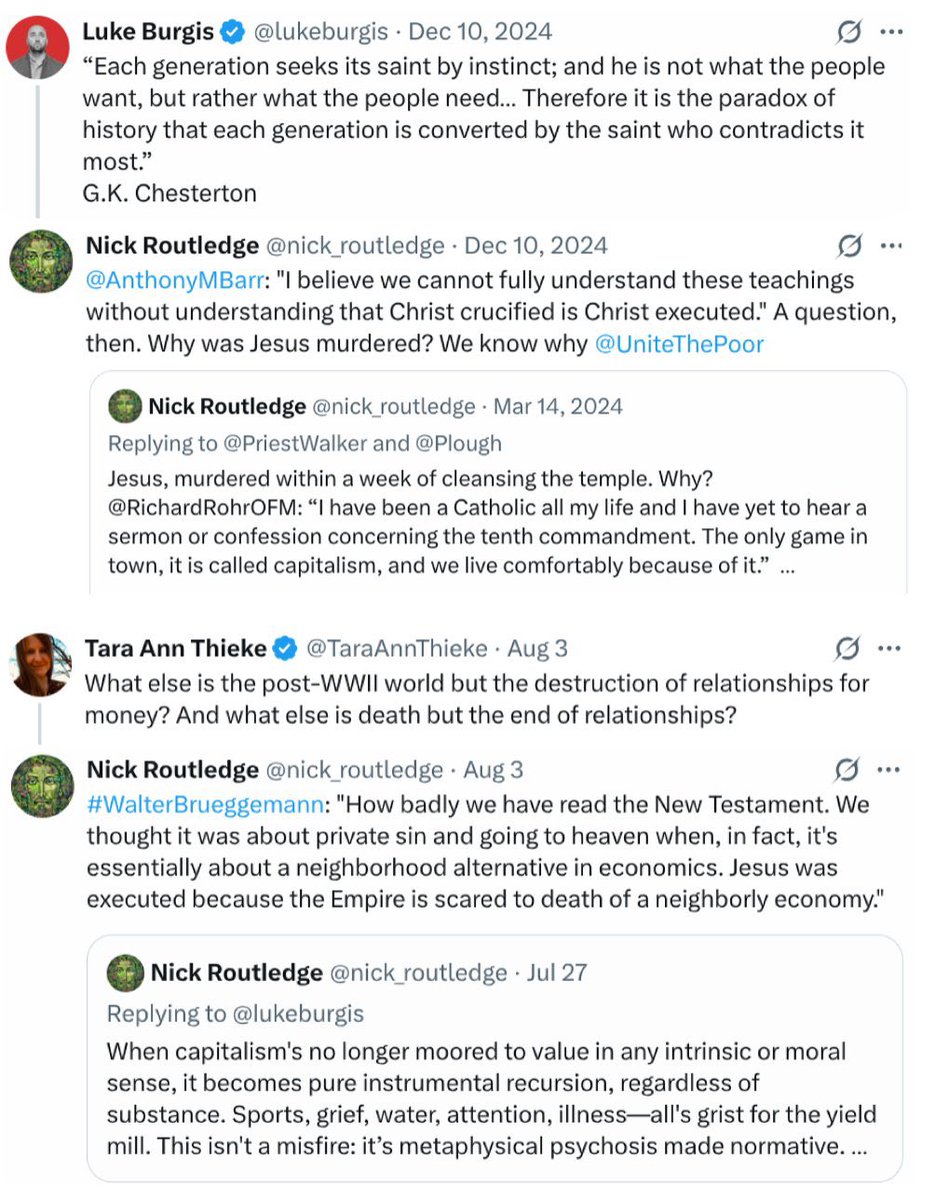
Copy of tweet thread here:

Allt-text for next image begins here due to space limits:

“After Whiteness, An Education in Belonging’ by Willie James Jennings.  “The colonial form of greed aimed to destroy a  communal metaphysic grounded in sharing, mutual ownership, interpenetrating uses of goods and services; bartering, buying, selling, borrowing, and ‘exchanging all woven in relationships extended over time, relationships that were themselves enveloped in stories that gave rationale and meaning to such  activities. Such communalism were not utopias, nor were they immutable, but they were powerful ways of thinking ~~ the one in the many and the many in the one.

Continued with alt-text in next image...
Image description

Original X alt text

Copy of tweet thread here: Allt-text for next image begins here due to space limits: “After Whiteness, An Education in Belonging’ by Willie James Jennings. “The colonial form of greed aimed to destroy a communal metaphysic grounded in sharing, mutual ownership, interpenetrating uses of goods and services; bartering, buying, selling, borrowing, and ‘exchanging all woven in relationships extended over time, relationships that were themselves enveloped in stories that gave rationale and meaning to such activities. Such communalism were not utopias, nor were they immutable, but they were powerful ways of thinking ~~ the one in the many and the many in the one. Continued with alt-text in next image...
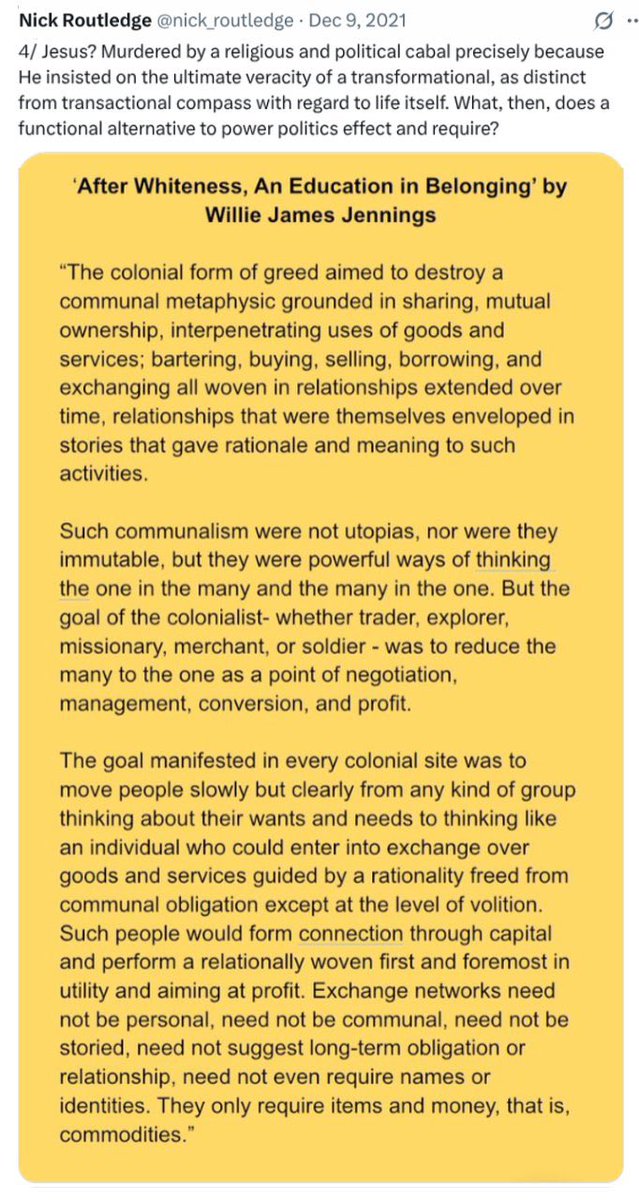
ttps://x.com/nick_routledge/status/1469072626018488321

[First part of alt-text attached to previous image]
But the goal of the colonialist whether trader, explorer, missionary, merchant, or soldier - was to reduce the ‘many to the one as a point of negotiation, ‘management, conversion, and profit.  ‘The goal manifested in every colonial site was to  ‘move people slowly but clearly from any kind of group  thinking about their wants and needs to thinking like an individual who could enter into exchange over  goods and services guided by a rationality freed from communal obligation except at the level of volition. Such people would form connection through capital and perform a relationally woven first and foremost in utility and aiming at profit. Exchange networks need not be personal, need not be communal, need not be storied, need not suggest long-term obligation or relationship, need not even require names or identities. They only require items and money, that is, commodities.”
Image description

Original X alt text

ttps://x.com/nick_routledge/status/1469072626018488321 [First part of alt-text attached to previous image] But the goal of the colonialist whether trader, explorer, missionary, merchant, or soldier - was to reduce the ‘many to the one as a point of negotiation, ‘management, conversion, and profit. ‘The goal manifested in every colonial site was to ‘move people slowly but clearly from any kind of group thinking about their wants and needs to thinking like an individual who could enter into exchange over goods and services guided by a rationality freed from communal obligation except at the level of volition. Such people would form connection through capital and perform a relationally woven first and foremost in utility and aiming at profit. Exchange networks need not be personal, need not be communal, need not be storied, need not suggest long-term obligation or relationship, need not even require names or identities. They only require items and money, that is, commodities.”

View this post’s context →

Context in the archive

Quoted by@Plough Few take up the Christian critique of wealth with such clarity and persistence. In a religious landscape that too often averts its gaze from an entanglement too close to home and too costly to name, your witness cuts through. Thank you. And for the record, realpolitik...Quoted by10/ Against this System, incarnation unmasks the lie of inevitability. What capital, state and militarism name necessity—"the way the world must be"—is but spell, propped by fear, brittle before disclosure. The messianic breaks that script. In its ruins, the true horizon rises.