
21/ Acceptance is no longer about access, but our existential stance toward what now appears. This is the parousia: the eruption that judges by its own presence. The revelation doesn't argue or persuade—it unveils what power is, not what we were made to believe.
4/ But—and this is key—the seeing itself is judgment. Not just insight, but unveiling with consequences. The Real breaks through in a way that redeems and exposes. This, the scandal of the eschaton: one event, whose meaning diverges based on the state of the one beholding it.
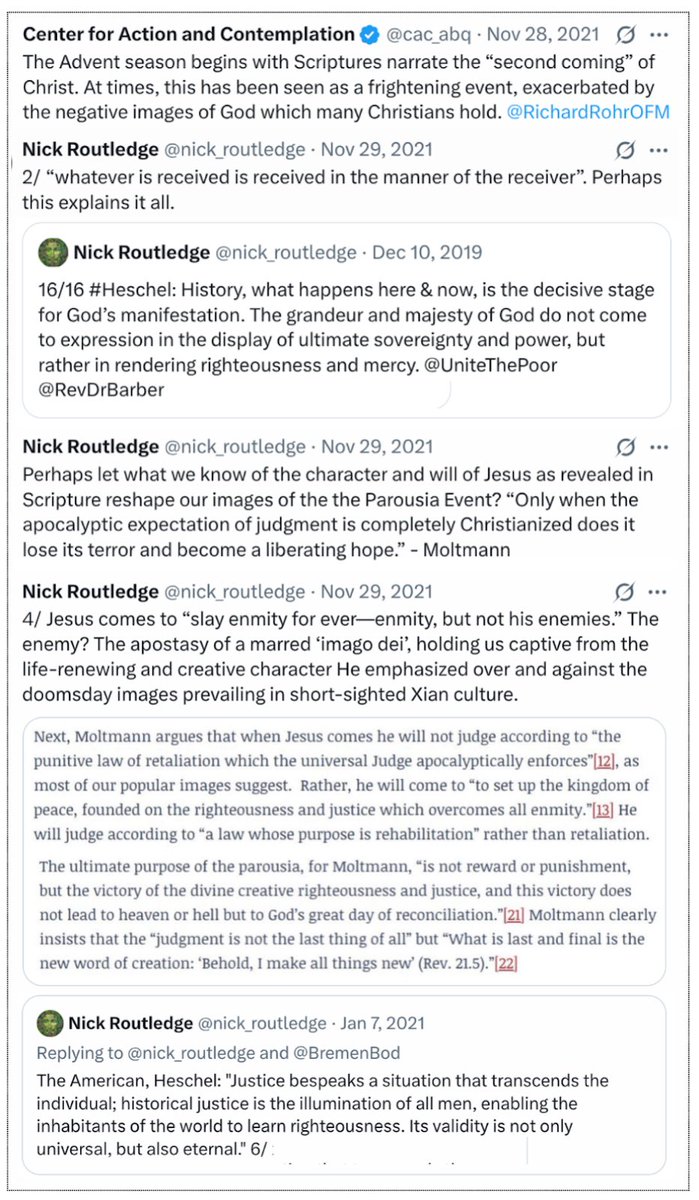
Image description
Original X alt text
Copy of tweet thread here: Alt-text truncated. Here, alt-text not available elsewhere: Next, Moltmann argues that when Jesus comes he will not judge according to “the punitive law of retaliation which the universal Judge apocalyptically enforces”[12], as most of our popular images suggest. Rather, he will come to “to set up the kingdom of peace, founded on the righteousness and justice which overcomes all enmity.”[13] He will judge according to “a law whose purpose is rehabilitation” rather than retaliation. The ultimate purpose of the parousia, for Moltmann, “is not reward or punishment, but the victory of the divine creative righteousness and justice, and this victory does not lead to heaven or hell but to God's great day of reconciliation.”[21] Moltmann clearly insists that the “judgment is not the last thing of all” but “What is last and final is the new word of creation: ‘Behold, I make all things new’ (Rev. 21.5).”[22]