
RT @nick_routledge: @lukeburgis When capitalism's no longer moored to value in any intrinsic or moral sense, it becomes pure instrumental recursion, regardless of substance. Sports, grief, water, attention, illness—all's grist for the yield mill. This isn't a misfire: it’s metaphysical psychosis made normative.
@Plough The true malaise isn't moneytheism but the ontology beneath it—beingness reduced to conditionality; a deep-seated distortion of relation to the Real; posture, inner and outer, sealing life against love. A metaphysical lie so deep it shapes the soul. Materialism is but its shrine.
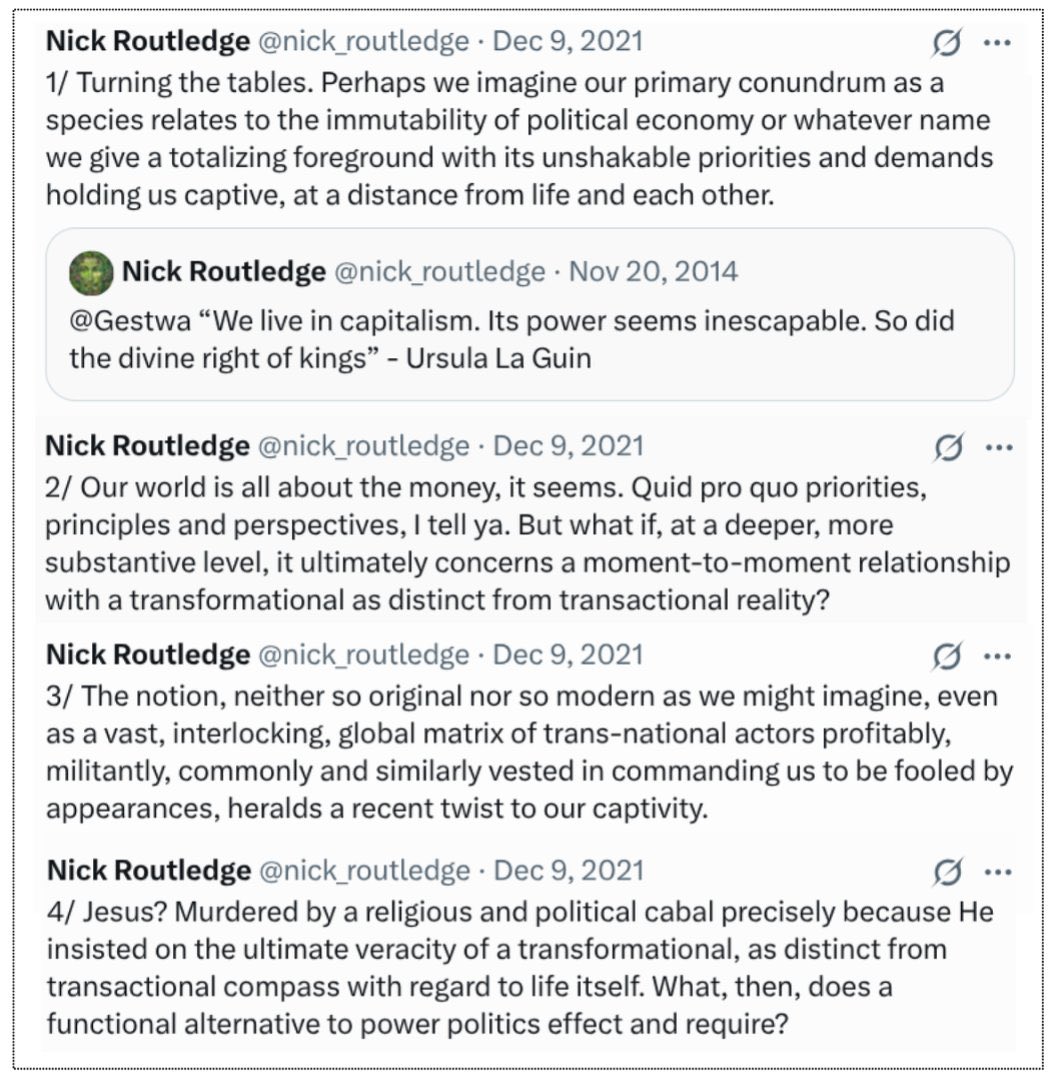
Image description
Original X alt text
Copy of tweet thread here:
Extended description
Pictured speaker / quoted attribution: Nick, posts1–4 and nested Ursula Le Guin quotation Saved source record associated with pictured writing; full saved record, not an exact pictured excerpt. Passage boundary: Source: archive.nickroutledge.org/post/1949629817185349812 Preserve quoted-author distinctions; the containing tweet does not confer authorship. The true malaise isn't moneytheism but the ontology beneath it—beingness reduced to conditionality; a deep-seated distortion of relation to the Real; posture, inner and outer, sealing life against love. A metaphysical lie so deep it shapes the soul. Materialism is but its shrine. 1/ Turning the tables. Perhaps we imagine our primary conundrum as a species relates to the immutability of political economy or whatever name we give a totalizing foreground with its unshakable priorities and demands holding us captive, at a distance from life and each other. @Gestwa “We live in capitalism. Its power seems inescapable. So did the divine right of kings” - Ursula La Guin, #NationalBookAwards. 2/ Our world is all about the money, it seems. Quid pro quo priorities, principles and perspectives, I tell ya. But what if, at a deeper, more substantive level, it ultimately concerns a moment-to-moment relationship with a transformational as distinct from transactional reality? 3/ The notion, neither so original nor so modern as we might imagine, even as a vast, interlocking, global matrix of trans-national actors profitably, militantly, commonly and similarly vested in commanding us to be fooled by appearances, heralds a recent twist to our captivity. 4/ Jesus? Murdered by a religious and political cabal precisely because He insisted on the ultimate veracity of a transformational, as distinct from transactional compass with regard to life itself. What, then, does a functional alternative to power politics effect and require? Subtweet: The true crisis is epistemic. When we removed Reality as a category pertaining to God, capitalism filled the void—becoming our theology, our fate. A “monstrously metastasized psychosis,” says Hart, “in its essence, evil.” The Kingdom eclipsed. The eschaton deferred. For now.
Open original document