
RT @nick_routledge: @RichardRohrOFM Proverbs 24:12 is clear enough. God will not be mocked. Mercy and reckoning together, from the one who knows and repays. Where Jeremiah was appointed “a prophet to the nations”, who, these days, is projecting holy defiance upon a universal, trans-cultural, world-historical plane?
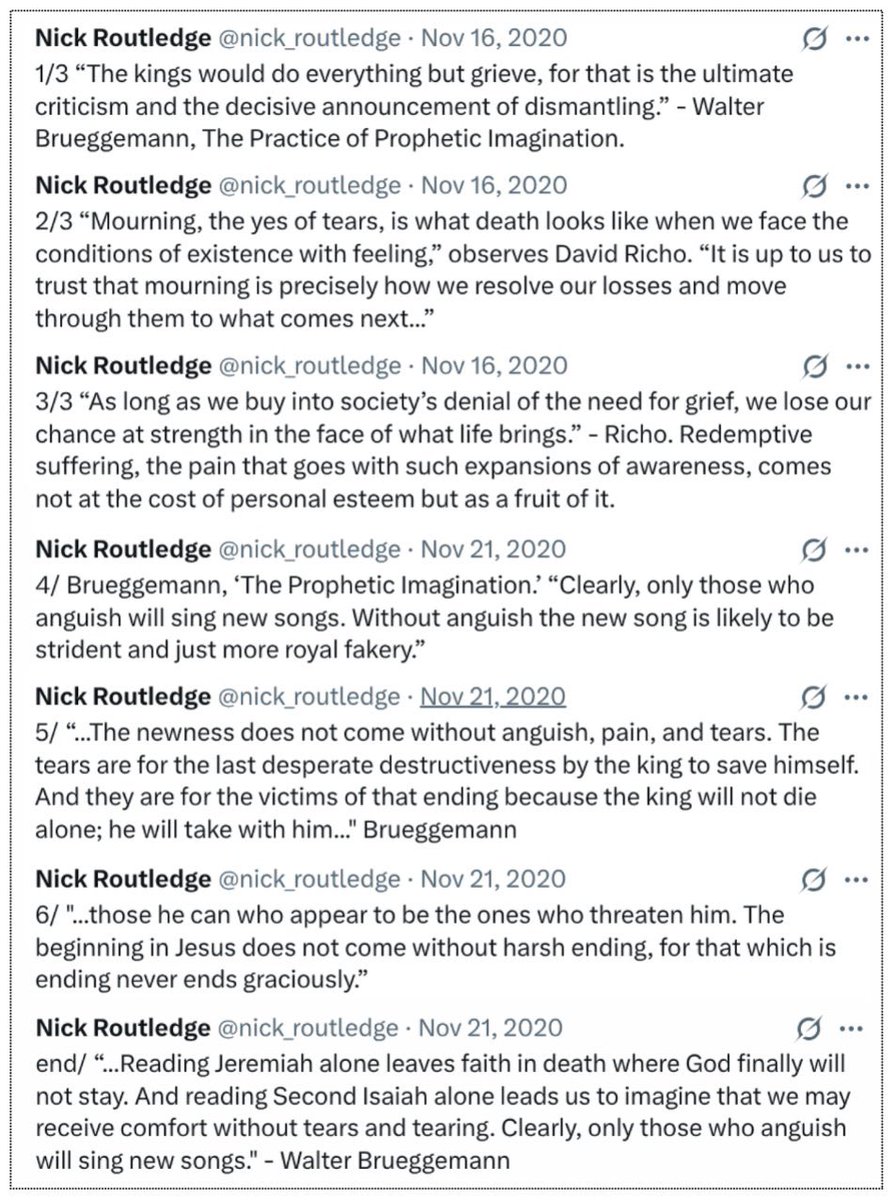
Image description
Original X alt text
Copy of tweet thread here:
Extended description
Pictured speaker / quoted attribution: Nick quoting Walter Brueggemann and David Richo Saved source record associated with pictured writing; full saved record, not an exact pictured excerpt. Passage boundary: Source: archive.nickroutledge.org/post/1328335223587627008 Preserve quoted-author distinctions; the containing tweet does not confer authorship. 1/3 “The kings would do everything but grieve, for that is the ultimate criticism and the decisive announcement of dismantling.” - Walter Brueggemann, The Practice of Prophetic Imagination.
Open original documentExtended description
Pictured speaker / quoted attribution: Nick quoting Walter Brueggemann and David Richo Saved source record associated with pictured writing; full saved record, not an exact pictured excerpt. Passage boundary: Source: archive.nickroutledge.org/post/1328335687817383942 Preserve quoted-author distinctions; the containing tweet does not confer authorship. 2/3 “Mourning, the yes of tears, is what death looks like when we face the conditions of existence with feeling,” observes David Richo. “It is up to us to trust that mourning is precisely how we resolve our losses and move through them to what comes next...”
Open original documentExtended description
Pictured speaker / quoted attribution: Nick quoting Walter Brueggemann and David Richo Saved source record associated with pictured writing; full saved record, not an exact pictured excerpt. Passage boundary: Source: archive.nickroutledge.org/post/1328335961625743360 Preserve quoted-author distinctions; the containing tweet does not confer authorship. 3/3 “As long as we buy into society’s denial of the need for grief, we lose our chance at strength in the face of what life brings.” - Richo. Redemptive suffering, the pain that goes with such expansions of awareness, comes not at the cost of personal esteem but as a fruit of it.
Open original documentExtended description
Pictured speaker / quoted attribution: Nick quoting Walter Brueggemann and David Richo Saved source record associated with pictured writing; full saved record, not an exact pictured excerpt. Passage boundary: Source: archive.nickroutledge.org/post/1330373501715410944 Preserve quoted-author distinctions; the containing tweet does not confer authorship. 4/ Brueggemann, ‘The Prophetic Imagination.’ “Clearly, only those who anguish will sing new songs. Without anguish the new song is likely to be strident and just more royal fakery.”
Open original documentExtended description
Pictured speaker / quoted attribution: Nick quoting Walter Brueggemann and David Richo Saved source record associated with pictured writing; full saved record, not an exact pictured excerpt. Passage boundary: Source: archive.nickroutledge.org/post/1330374166940422147 Preserve quoted-author distinctions; the containing tweet does not confer authorship. 5/ “...The newness does not come without anguish, pain, and tears. The tears are for the last desperate destructiveness by the king to save himself. And they are for the victims of that ending because the king will not die alone; he will take with him..." Brueggemann
Open original documentExtended description
Pictured speaker / quoted attribution: Nick quoting Walter Brueggemann and David Richo Saved source record associated with pictured writing; full saved record, not an exact pictured excerpt. Passage boundary: Source: archive.nickroutledge.org/post/1330374540942331904 Preserve quoted-author distinctions; the containing tweet does not confer authorship. 6/ "...those he can who appear to be the ones who threaten him. The beginning in Jesus does not come without harsh ending, for that which is ending never ends graciously.”
Open original documentExtended description
Pictured speaker / quoted attribution: Nick quoting Walter Brueggemann and David Richo Saved source record associated with pictured writing; full saved record, not an exact pictured excerpt. Passage boundary: Source: archive.nickroutledge.org/post/1330375121593376768 Preserve quoted-author distinctions; the containing tweet does not confer authorship. end/ “...Reading Jeremiah alone leaves faith in death where God finally will not stay. And reading Second Isaiah alone leads us to imagine that we may receive comfort without tears and tearing. Clearly, only those who anguish will sing new songs." - Walter Brueggemann
Open original document4/ But—and this is key—the seeing itself is judgment. Not just insight, but unveiling with consequences. The Real breaks through in a way that redeems and exposes. This, the scandal of the eschaton: one event, whose meaning diverges based on the state of the one beholding it.
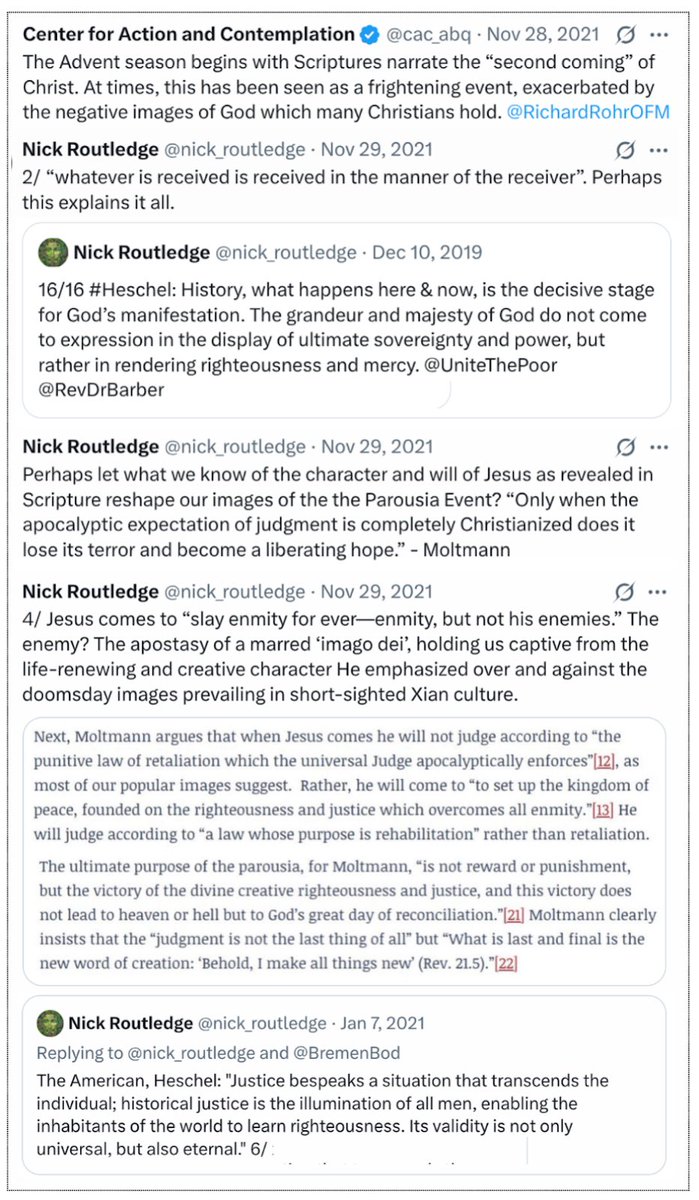
Image description
Original X alt text
Copy of tweet thread here: Alt-text truncated. Here, alt-text not available elsewhere: Next, Moltmann argues that when Jesus comes he will not judge according to “the punitive law of retaliation which the universal Judge apocalyptically enforces”[12], as most of our popular images suggest. Rather, he will come to “to set up the kingdom of peace, founded on the righteousness and justice which overcomes all enmity.”[13] He will judge according to “a law whose purpose is rehabilitation” rather than retaliation. The ultimate purpose of the parousia, for Moltmann, “is not reward or punishment, but the victory of the divine creative righteousness and justice, and this victory does not lead to heaven or hell but to God's great day of reconciliation.”[21] Moltmann clearly insists that the “judgment is not the last thing of all” but “What is last and final is the new word of creation: ‘Behold, I make all things new’ (Rev. 21.5).”[22]