
@PageauJonathan 19/ Convention locates this role in a single figure. But the messiah, properly understood, is not a private redeemer. A form, not a possession, his role is not to end history but to make visible its opening—to rupture its false telos and inaugurate the time of recognition.
@CACRadicalGrace @RichardRohrOFM The prophet represents perhaps the boldest attempt to affirm both poles of the dilemma inherent in their call; namely, the suffering paradox uniting the gift of autonomy with the gift of guidance. It is one thing to be anointed a child of God: another to fully live the anointing.
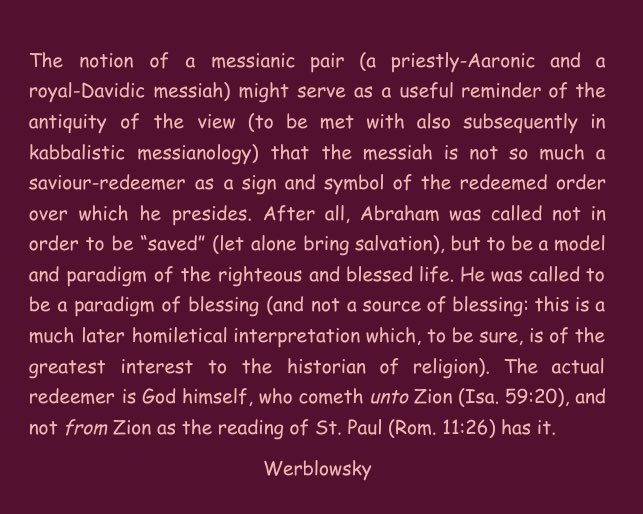
Image description
Original X alt text
The notion of a messianic pair (a priestly-Aaronic and a royal-Davidic messiah) might serve as a useful reminder of the antiquity of the view (to be met with also subsequently in kabbalistic messianology) that the messiah is not so much a saviour-redeemer as a sign and symbol of the redeemed order over which he presides. After all, Abraham was called not in order to be “saved” (let alone bring salvation), but to be a model and paradigm of the righteous and blessed life. He was called to be a paradigm of blessing (and not a source of blessing: this is a much later homiletical interpretation which, to be sure, is of the greatest interest to the historian of religion). The actual redeemer is God himself, who cometh unto Zion (Isa. 59:20), and not from Zion as the reading of St. Paul (Rom. 11:26) has it. Werblowsky