
RT @nick_routledge: @johnmilbank3 The Jewish charge that the messiah has not yet come because the world is not yet redeemed is wholly consistent with the parousial initiation of a unicity in which we include and complete one another. Besides, religious - never mind Abrahamic - exceptionalism is an ontic archaism.
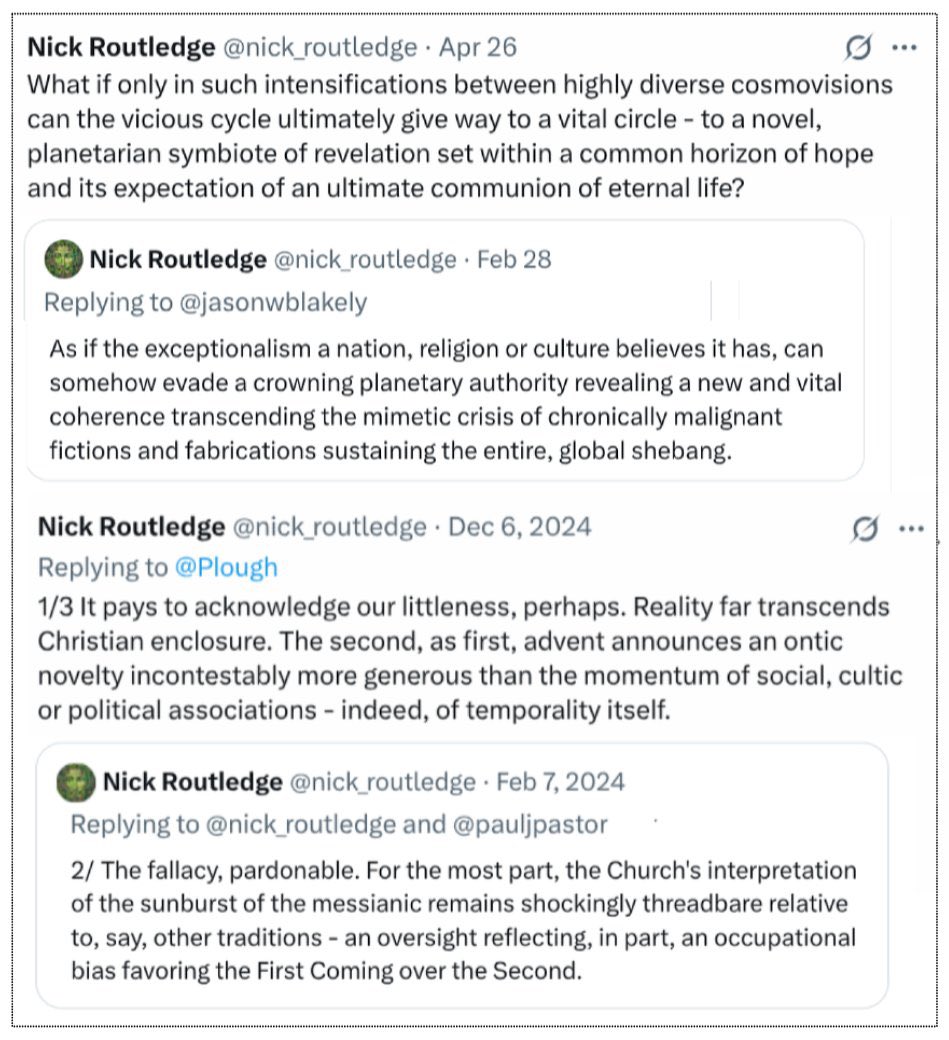
Image description
Original X alt text
Copy of tweet and quote tweet here:
Extended description
Pictured speaker / quoted attribution: Nick, four pictured bodies Saved source record associated with pictured writing; full saved record, not an exact pictured excerpt. Passage boundary: Source: archive.nickroutledge.org/post/1923042020030857380 Preserve quoted-author distinctions; the containing tweet does not confer authorship. Tweet: The Jewish charge that the messiah has not yet come because the world is not yet redeemed is wholly consistent with the parousial initiation of a unicity in which we include and complete one another. Besides, religious - never mind Abrahamic - exceptionalism is an ontic archaism. What if only in such intensifications between highly diverse cosmovisions can the vicious cycle ultimately give way to a vital circle - to a novel, planetarian symbiote of revelation set within a common horizon of hope and its expectation of an ultimate communion of eternal life? As if the exceptionalism a nation, religion or culture believes it has, can somehow evade a crowning planetary authority revealing a new and vital coherence transcending the mimetic crisis of chronically malignant fictions and fabrications sustaining the entire, global shebang. 1/3 It pays to acknowledge our littleness, perhaps. Reality far transcends Christian enclosure. The second, as first, advent announces an ontic novelty incontestably more generous than the momentum of social, cultic or political associations - indeed, of temporality itself. 2/ The fallacy, pardonable. For the most part, the Church's interpretation of the sunburst of the messianic remains shockingly threadbare relative to, say, other traditions - an oversight reflecting, in part, an occupational bias favoring the First Coming over the Second. Quote tweet: Moltmann, Agamben, Illich and Cayley likewise aver "messianic eclipse" (Benjamin) an aggregate goal of all religious and secular systems hanging upon a Judgment Deferral Complex; and such catastrophic permanency checked only in the game-ending irruption of a "messianic arrest.
Open original document@Samantharhill Moltmann, Agamben, Illich and Cayley likewise aver "messianic eclipse" (Benjamin) an aggregate goal of all religious and secular systems hanging upon a Judgment Deferral Complex; and such catastrophic permanency checked only in the game-ending irruption of a "messianic arrest."
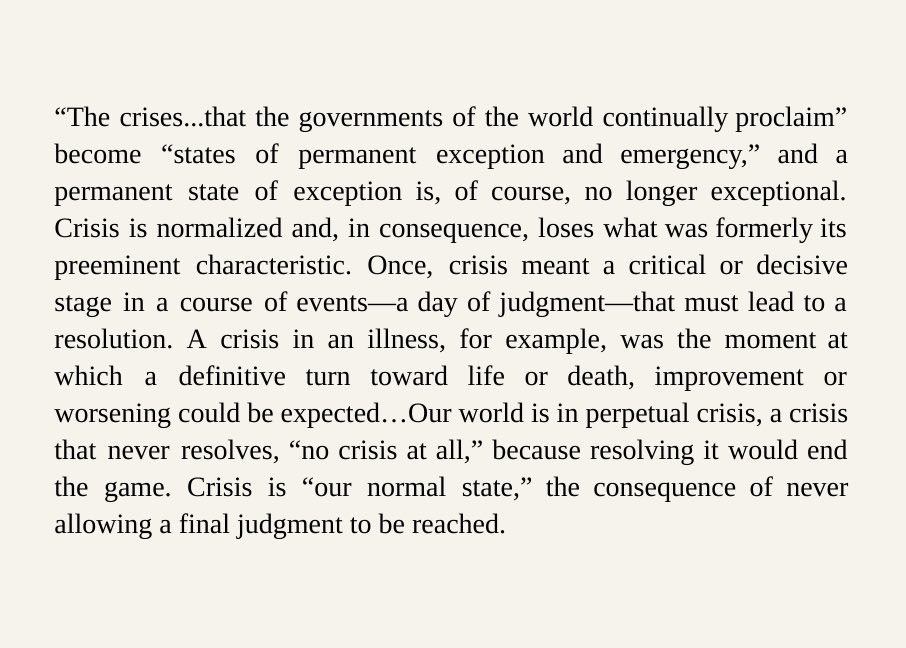
Image description
Original X alt text
“The crises...that the governments of the world continually proclaim” become “states of permanent exception and emergency,” and a permanent state of exception is, of course, no longer exceptional. Crisis is normalized and, in consequence, loses what was formerly its preeminent characteristic. Once, crisis meant a critical or decisive stage in a course of events—a day of judgment—that must lead to a resolution. A crisis in an illness, for example, was the moment at which a definitive turn toward life or death, improvement or worsening could be expected…Our world is in perpetual crisis, a crisis that never resolves, “no crisis at all,” because resolving it would end the game. Crisis is “our normal state,” the consequence of never allowing a final judgment to be reached.
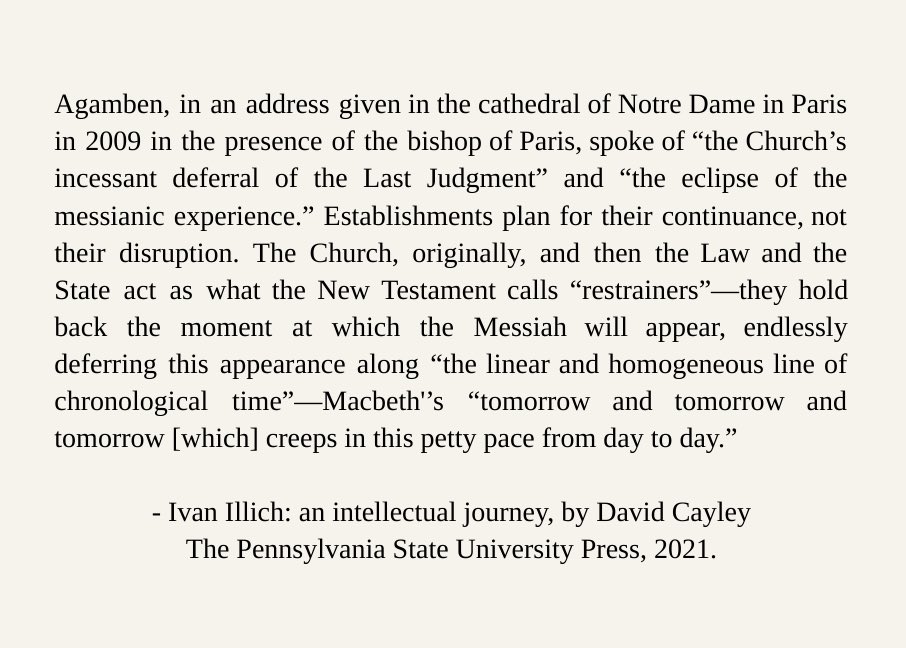
Image description
Original X alt text
Agamben, in an address given in the cathedral of Notre Dame in Paris in 2009 in the presence of the bishop of Paris, spoke of “the Church’s incessant deferral of the Last Judgment” and “the eclipse of the messianic experience.” Establishments plan for their continuance, not their disruption. The Church, originally, and then the Law and the State act as what the New Testament calls “restrainers”—they hold back the moment at which the Messiah will appear, endlessly deferring this appearance along “the linear and homogeneous line of chronological time”—Macbeth'’s “tomorrow and tomorrow and tomorrow [which] creeps in this petty pace from day to day.” - Ivan Illich: an intellectual journey, by David Cayley The Pennsylvania State University Press, 2021.
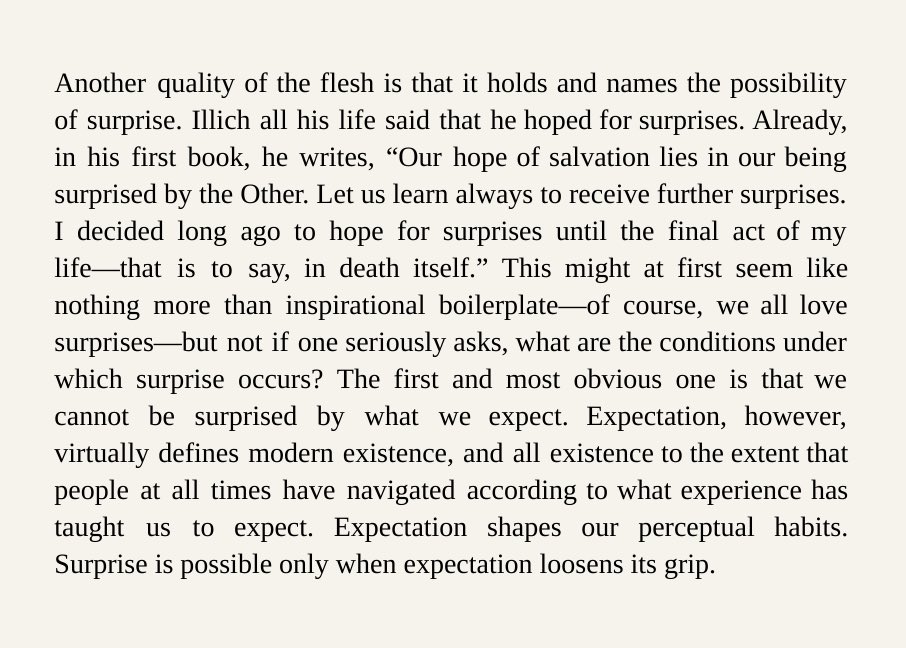
Image description
Original X alt text
Another quality of the flesh is that it holds and names the possibility of surprise. Illich all his life said that he hoped for surprises. Already, in his first book, he writes, “Our hope of salvation lies in our being surprised by the Other. Let us learn always to receive further surprises. I decided long ago to hope for surprises until the final act of my life—that is to say, in death itself.” This might at first seem like nothing more than inspirational boilerplate—of course, we all love surprises—but not if one seriously asks, what are the conditions under which surprise occurs? The first and most obvious one is that we cannot be surprised by what we expect. Expectation, however, virtually defines modern existence, and all existence to the extent that people at all times have navigated according to what experience has taught us to expect. Expectation shapes our perceptual habits. Surprise is possible only when expectation loosens its grip.
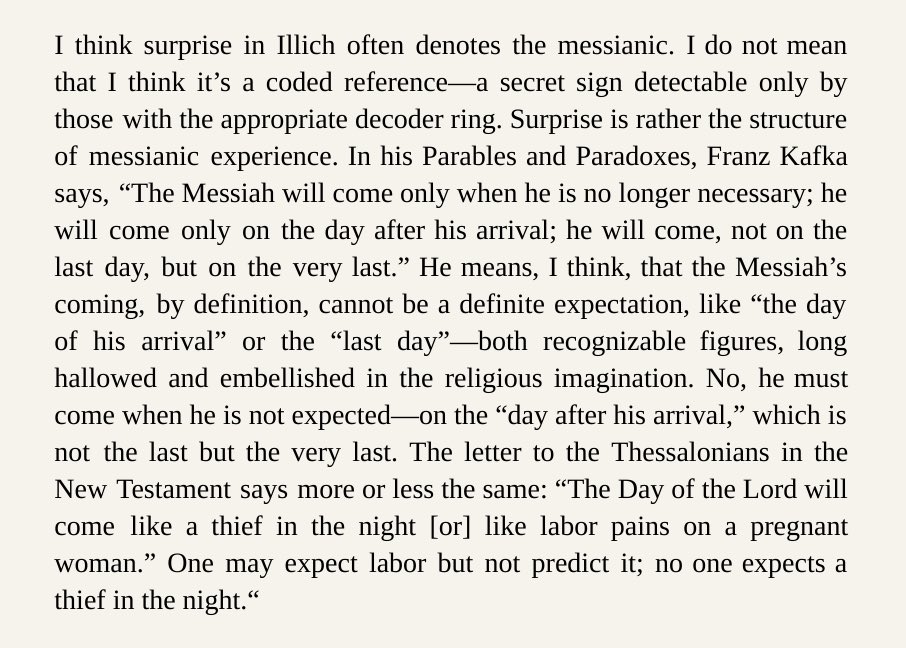
Image description
Original X alt text
I think surprise in Illich often denotes the messianic. I do not mean that I think it’s a coded reference—a secret sign detectable only by those with the appropriate decoder ring. Surprise is rather the structure of messianic experience. Kafka says, “The Messiah will come only when he is no longer necessary; he will come only on the day after his arrival; he will come, not on the last day, but on the very last.” He means, I think, that the Messiah’s coming, by definition, cannot be a definite expectation, like “the day of his arrival” or the “last day”—both recognizable figures, long hallowed and embellished in the religious imagination. No, he must come when he is not expected—on the “day after his arrival,” which is not the last but the very last. The letter to the Thessalonians says more or less the same: “The Day of the Lord will come like a thief in the night [or] like labor pains on a pregnant woman.” One may expect labor but not predict it; no one expects a thief in the night.“