
It's DRAFT INSTANT, y'all!! ~ Image: Raimon Panikkar, Opera Omnia (Vol. 1) - The Christian Language
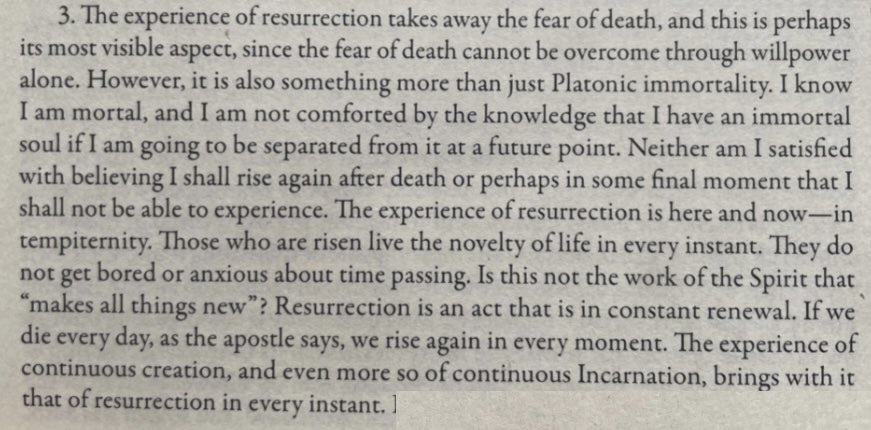
Image description
Original X alt text
3. The experience of resurrection takes away the fear of death, and this is perhaps its most visible aspect, since the fear of death cannot be overcome through willpower alone. However, it is also something more than just Platonic immortality. I know I am mortal, and I am not comforted by the knowledge that I have an immortal soul if I am going to be separated from it at a future point. Neither am I satisfied with believing I shall rise again after death or perhaps in some final moment that I shall not be able to experience. The experience of resurrection is here and now—in tempiternity. Those who are risen live the novelty of life in every instant...Is this not the work of the Spirit that "makes all things new"? Resurrection is an act that is in constant renewal. If we die every day, as the apostle says, we rise again in every moment. The experience of continuous creation, and even more so of continuous Incarnation, brings with it that of resurrection in every instant.
@lukeburgis For Mosès, as others, "the very nub of the perception of time" defines the bridge whereby the temporal-eternal cleft is bridged and, as such, quotidian experience as the covenantal realm of God's coming and arrival, our "breakthrough into, not out of, concrete history." (Agamben)
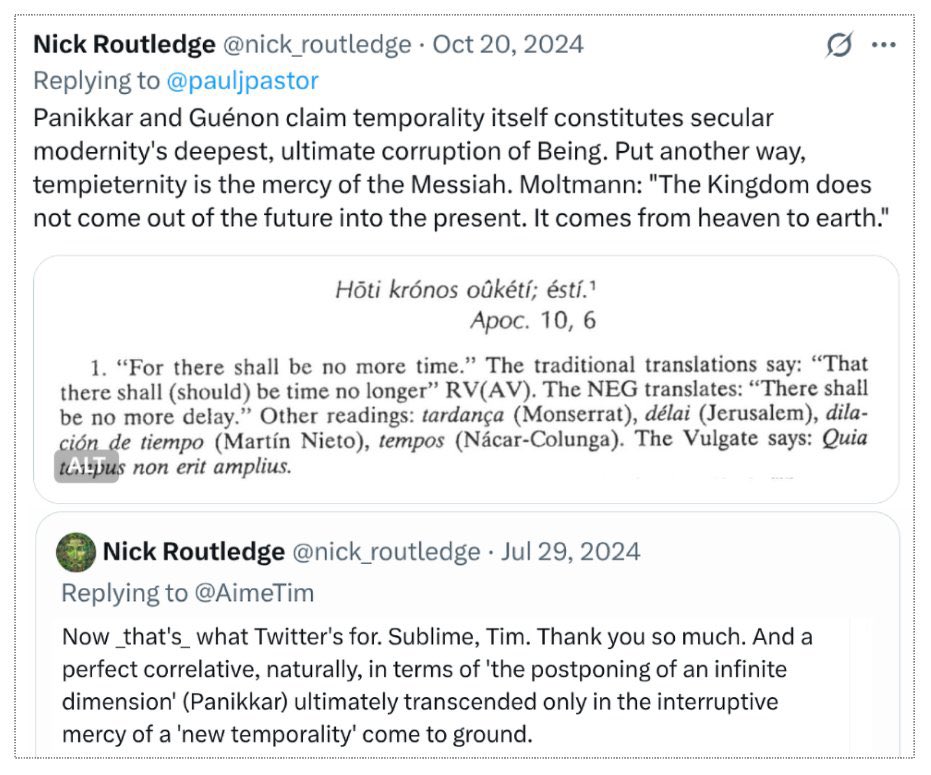
Image description
Original X alt text
Panikkar and Guénon claim temporality itself constitutes secular modernity's deepest, ultimate corruption of Being. Put another way, tempieternity is the mercy of the Messiah. Moltmann: "The Kingdom does not come out of the future into the present. It comes from heaven to earth." Hóti krónos oὐkéti; ésti. Apoc. 10, 6 1. “For there shall be no more time.” The traditional translations say: “That there shall (should) be time no longer” RV(AV). The NEG translates: “There shall be no more delay.” Other readings: tardança (Monserrat), délai (Jerusalem), dilación de tiempo (Martín Nieto), tempos (Nácar-Colunga). The Vulgate says: Quia tempus non erit amplius. - The Cosmotheandric Experience, Raimon Panikkar Now _that's_ what Twitter's for. Sublime, Tim. Thank you so much. And a perfect correlative, naturally, in terms of 'the postponing of an infinite dimension' (Panikkar) ultimately transcended only in the interruptive mercy of a 'new temporality' come to ground.