
RT @nick_routledge: @NoemaMag @olliemilman Lawn conversion has a storied history. 25 years ago, at the southern end of the Willamette Valley, 'the grass seed capital of the world', we established the 'Food Not Lawns' project. Here's how our pioneering experiment in deeper eco-cultural coherence worked out
1/7 In 1999, I co-founded the self-described 'avant-gardening collective', Food Not Lawns. Our team, operating a community soup-kitchen in Eugene, OR, had discerned that the vast structural injustices driving food poverty were calling us to a radical shift in direction.
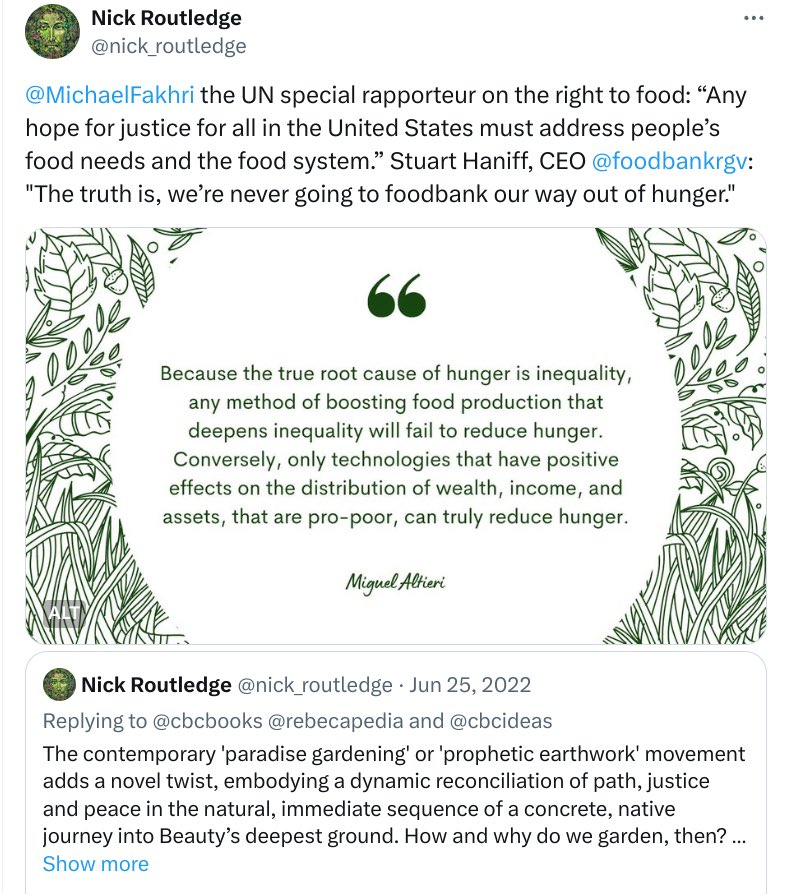
Image description
Original X alt text
Copy of tweet here: the UN special rapporteur on the right to food: “Any hope for justice for all in the United States must address people’s food needs and the food system.” Stuart Haniff, CEO @foodbankrgv: "The truth is, we’re never going to foodbank our way out of hunger." Because the root cause of hunger is inequality, any method of boosting food production that deepens inequality will fail to reduce hunger. Conversely, only technologies that have positive effects on the distribution of wealth, income, and assets, that are pro-poor, can truly reduce hunger. -Miguel Altieri The contemporary 'paradise gardening' or 'prophetic earthwork' movement adds a novel twist, embodying a dynamic reconciliation of path, justice and peace in the natural, immediate sequence of a concrete, native journey into Beauty’s deepest ground. How and why do we garden, then?
Image description
Original X alt text
Copy of the Food Not Lawns original website logo - a 'Celtic' trinity knot made of worms.