
@Naifalbidh Thanks for your response. Further down that thread chain, here's Mahdi Ahouie, the Iranian political scientist and former Research Fellow at the Foundation for Interreligious and Intercultural Research and Dialogue in Geneva, speaking precisely to the substance of your concerns.
@trippfuller As Panikkar clarifies, "For a truly cross-cultural understanding, we need a new revelatory experience." The 'messianic', which is to say 'planetarian' ontology of deep incarnation, then, and the parousial initiation of a unicity in which we include and complete one another. 12/13
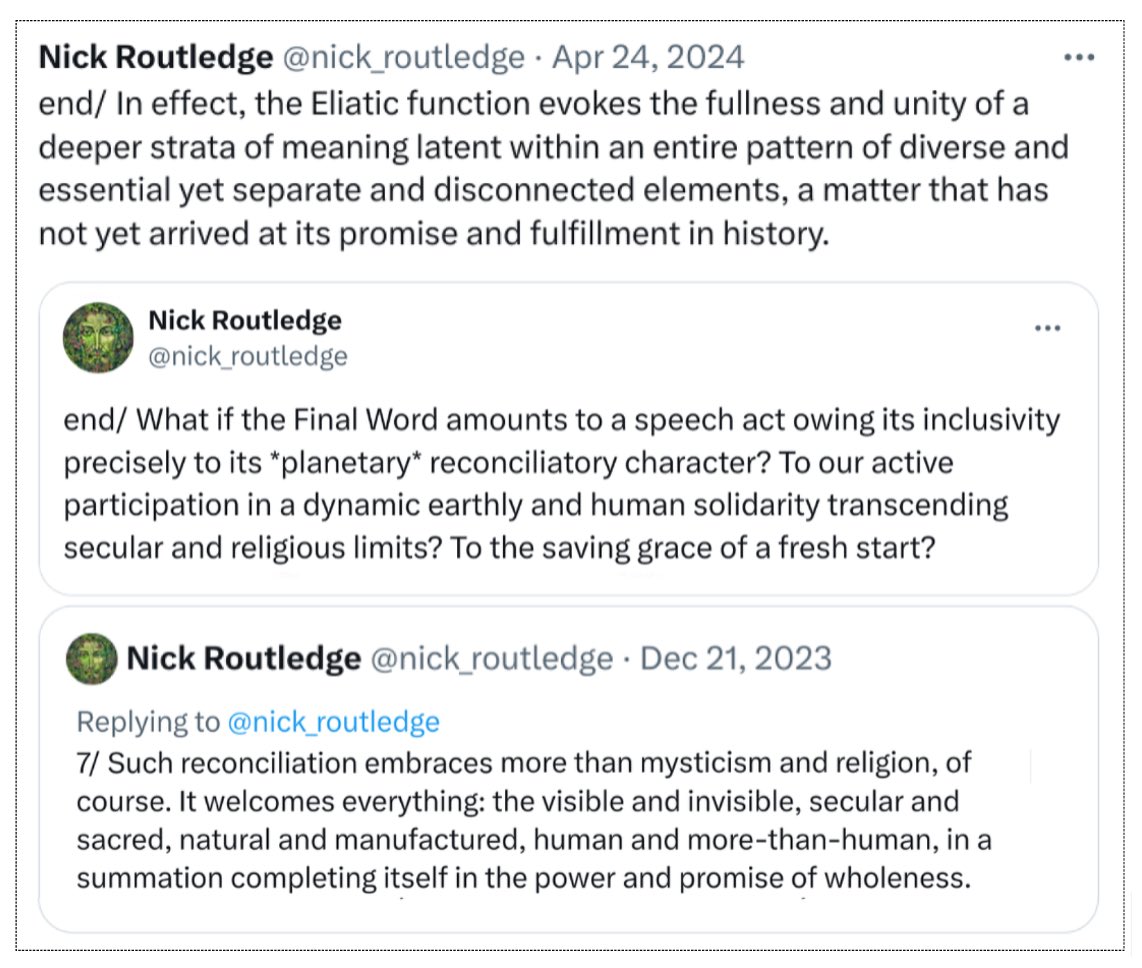
Image description
Original X alt text
Copy of tweet here: and end/ In effect, the Eliatic function evokes the fullness and unity of a deeper strata of meaning latent within an entire pattern of diverse and essential yet separate and disconnected elements, a matter that has not yet arrived at its promise and fulfillment in history. end/ What if the Final Word amounts to a speech act owing its inclusivity precisely to its *planetary* reconciliatory character? To our active participation in a dynamic earthly and human solidarity transcending secular and religious limits? To the saving grace of a fresh start? 7/ Such reconciliation embraces way more than mysticism and religion, of course. It welcomes everything: the visible and invisible, secular and sacred, natural and manufactured, human and more-than-human, in a summation completing itself in the power and promise of wholeness.
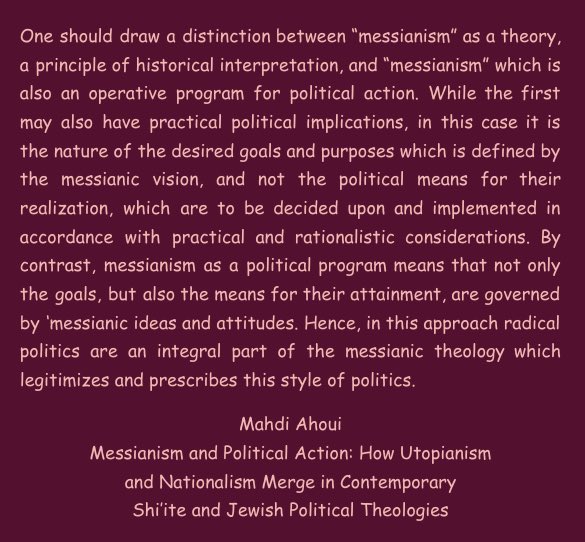
Image description
Original X alt text
One should draw a distinction between “messianism” as a theory, a principle of historical interpretation, and “messianism” which is also an operative program for political action. While the first may also have practical political implications, in this case it is the nature of the desired goals and purposes which is defined by the messianic vision, and not the political means for their realization, which are to be decided upon and implemented in accordance with practical and rationalistic considerations. By contrast, messianism as a political program means that not only the goals, but also the means for their attainment, are governed by ‘messianic ideas and attitudes. Hence, in this approach radical politics are an integral part of the messianic theology which legitimizes and prescribes this style of politics. Mahdi Ahoui Messianism and Political Action: How Utopianism and Nationalism Merge in Contemporary Shi’ite and Jewish Political Theologies
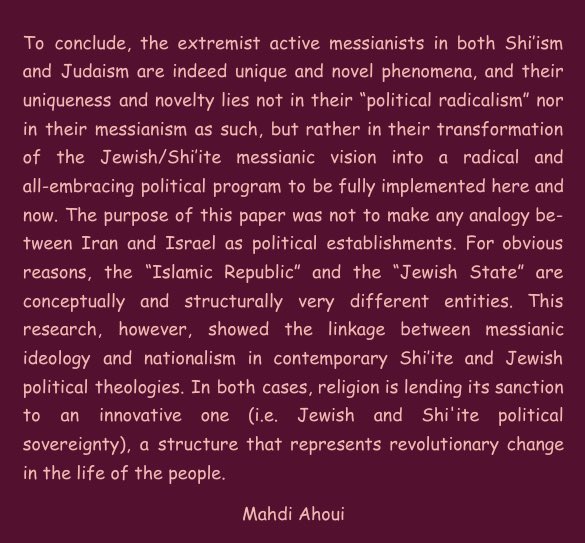
Image description
Original X alt text
To conclude, the extremist active messianists in both Shi’ism and Judaism are indeed unique and novel phenomena, and their uniqueness and novelty lies not in their “political radicalism” nor in their messianism as such, but rather in their transformation of the Jewish/Shi’ite messianic vision into a radical and all-embracing political program to be fully implemented here and now. The purpose of this paper was not to make any analogy be- tween Iran and Israel as political establishments. For obvious reasons, the “Islamic Republic” and the “Jewish State” are conceptually and structurally very different entities. This research, however, showed the linkage between messianic ideology and nationalism in contemporary Shi’ite and Jewish political theologies. In both cases, religion is lending its sanction to an innovative one (i.e. Jewish and Shi'ite political sovereignty), a structure that represents revolutionary change in the life of the people. Mahdi Ahoui
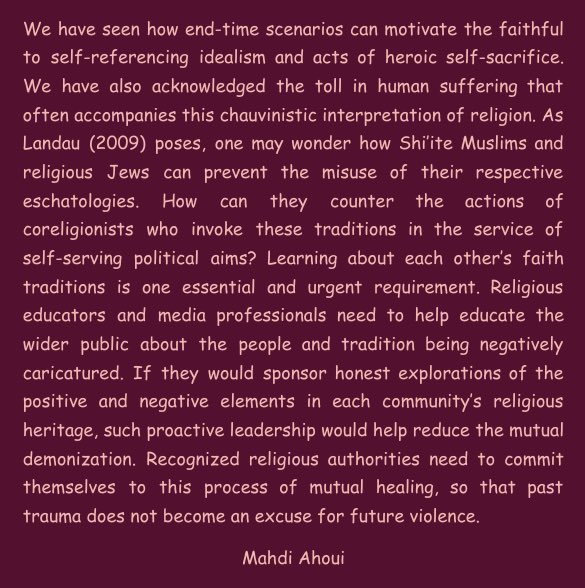
Image description
Original X alt text
End-time scenarios can motivate the faithful to self-referencing idealism and acts of heroic self-sacrifice. We have acknowledged the toll in human suffering that often accompanies this chauvinistic interpretation of religion. One may wonder how Shi’ite Muslims and religious Jews can prevent the misuse of their respective eschatologies countering the actions of coreligionists who invoke these traditions in the service of self-serving political aims Learning about each other’s faith traditions is one essential and urgent requirement. Religious educators and media professionals need to help educate the wider public about the people and tradition being negatively caricatured. If they would sponsor honest explorations of the positive and negative elements in each community’s religious heritage, such proactive leadership would help reduce mutual demonization. Religious authorities need to commit themselves to this process, so that past trauma does not become an excuse for future violence.