
@ncolloff The spur is that the metastasizing aggregate of a planetary Extinction Tyranny has finally secured its flag. As Benjamin noted in 1940, this 'storm' isn't happenstance as much as an ontic inevitability constitutive to the phenomenon of techno-modernity itself. What instead, then?
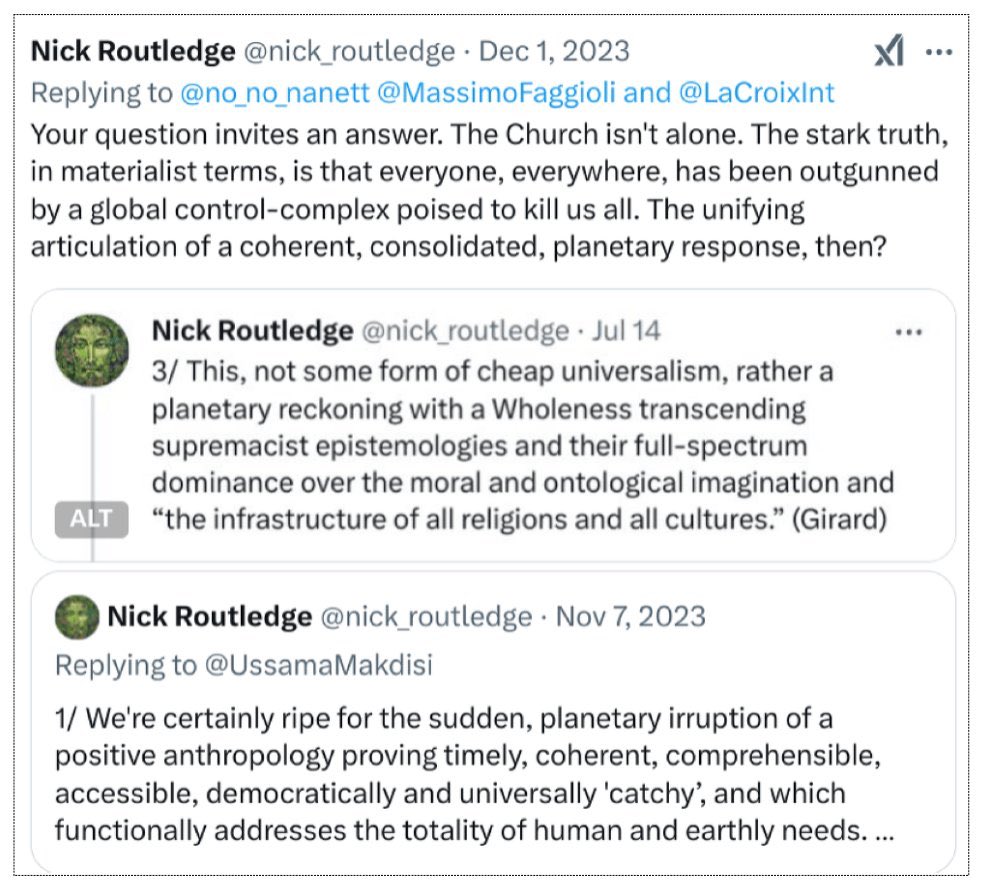
Image description
Original X alt text
Copy of tweet here: Your question invites an answer. The Church isn't alone. The stark truth, in materialist terms, is that everyone, everywhere, has been outgunned by a global control-complex poised to kill us all. The unifying articulation of a coherent, consolidated, planetary response, then? 3/ This, not some form of cheap universalism, rather a planetary reckoning with a Wholeness transcending supremacist epistemologies and their full-spectrum dominance over the moral and ontological imagination and “the infrastructure of all religions and all cultures.” (Girard) 1/ We're certainly ripe for the sudden, planetary irruption of a positive anthropology proving timely, coherent, comprehensible, accessible, democratically and universally 'catchy’, and which functionally addresses the totality of human and earthly needs.
@trippfuller 🧵1/12 'Opening up a revolutionary chance.' A question. Did Benjamin's messianic/revolutionary thesis ultimately succumb to a Franco-Vichy-Nazi storm uncannily paralleling the global, fascist surge of our time? The gas chambers were, of course, but a year ahead. Context, then.
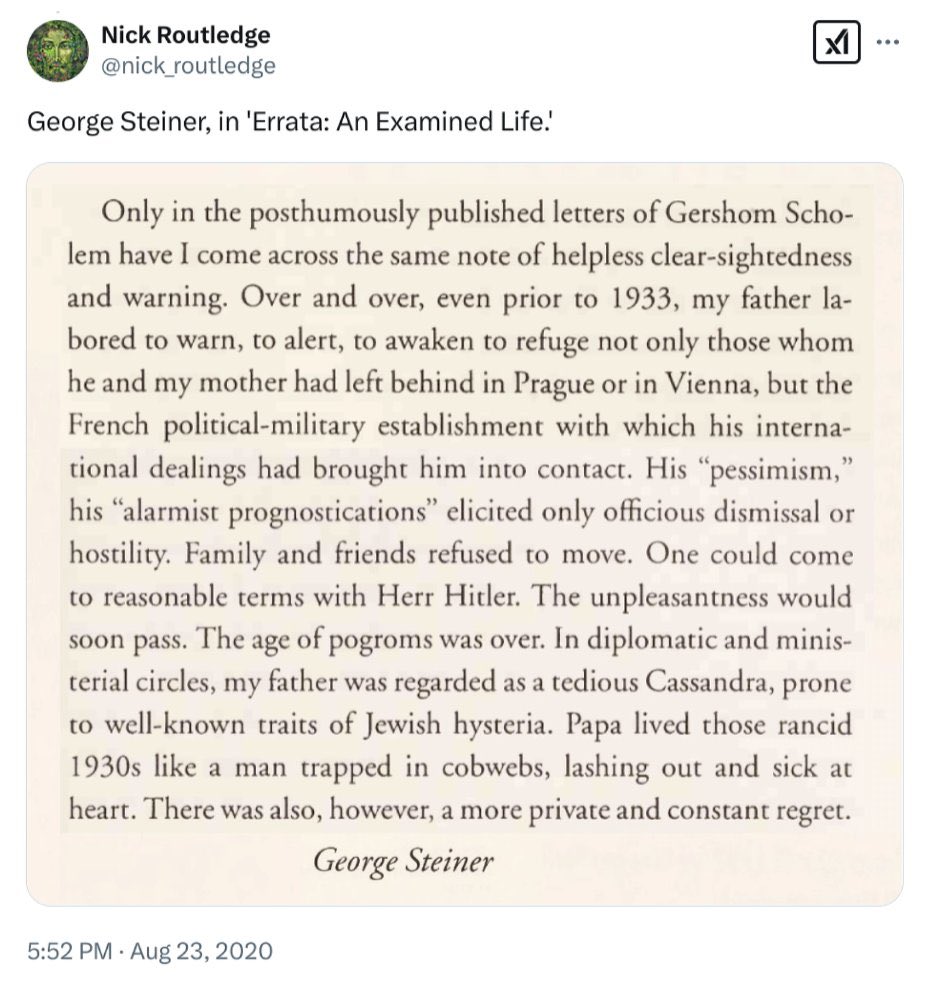
Image description
Original X alt text
Only in the posthumously published letters of Gershom Scholem have I come across the same note of helpless clear-sightedness and warning. Over and over, even prior to 1933, my father labored to warn, to alert, to awaken to refuge not only those whom he and my mother had left behind in Prague or in Vienna, but the French political-military establishment with which his international dealings had brought him into contact. His “pessimism,” his “alarmist prognostications” elicited only officious dismissal or hostility. Family and friends refused to move. One could come to reasonable terms with Herr Hitler. The unpleasantness would soon pass. The age of pogroms was over. In diplomatic and ministerial circles, my father was regarded as a tedious Cassandra, prone to well-known traits of Jewish hysteria. Papa lived those rancid 1930s like a man trapped in cobwebs, lashing out and sick at heart. There was also, however, a more private and constant regret. George Steiner