
@trippfuller 9/ Benjamin may find his closest contemporary counterpart in the Iranian, Ali Shari’ati, who similarly affirms that neither politics nor religion alone suffice to furnish the world a means of liberation and redemption involving the fusion of their respective messianic traditions.
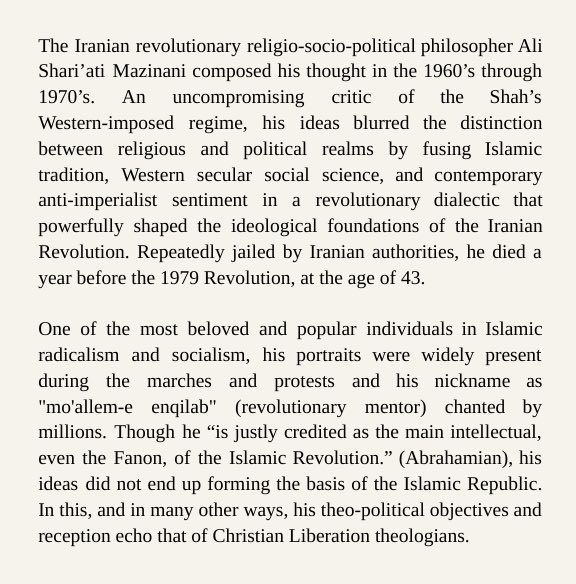
Image description
Original X alt text
The Iranian revolutionary religio-socio-political philosopher Ali Shari’ati Mazinani composed his thought in the 1960’s through 1970’s. An uncompromising critic of the Shah’s regime, his ideas blurred the distinction between religious and political realms by fusing Islamic tradition, Western secular social science, and contemporary anti-imperialist sentiment in a revolutionary dialectic that powerfully shaped the ideological foundations of the Iranian Revolution. Repeatedly jailed by Iranian authorities, he died a year before the 1979 Revolution, at the age of 43. One of the most beloved and popular individuals in Islamic radicalism and socialism, his portraits were widely present during the marches and protests and his nickname as "mo'allem-e enqilab" (revolutionary mentor) chanted by millions. Though he “is justly credited as the main intellectual, even the Fanon, of the Islamic Revolution.” (Abrahamian), his ideas did not end up forming the basis of the Islamic Republic.
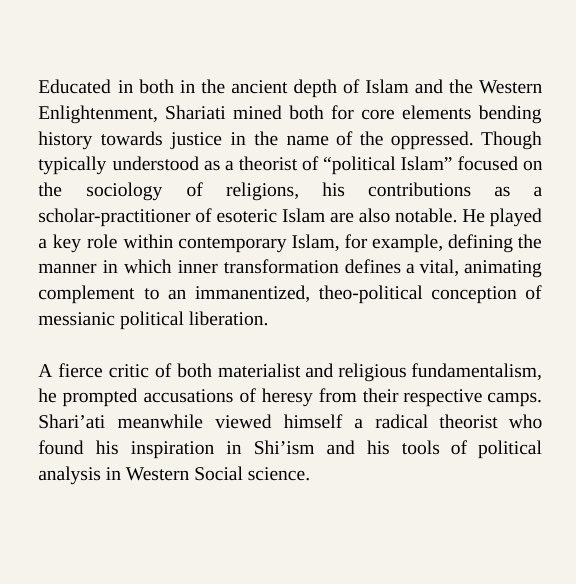
Image description
Original X alt text
In this, and in many other ways, his theo-political objectives and reception echo that of Christian Liberation theologians. Educated in both in the ancient depth of Islam and the Western Enlightenment, Shariati mined both for core elements bending history towards justice in the name of the oppressed. Though typically understood as a theorist of “political Islam” focused on the sociology of religions, his contributions as a scholar-practitioner of esoteric Islam are also notable. He played a key role within contemporary Islam, for example, defining the manner in which inner transformation defines a vital, animating complement to an immanentized, theo-political conception of messianic political liberation. A fierce critic of both materialist and religious fundamentalism, he prompted accusations of heresy from their respective camps. Shari’ati meanwhile viewed himself a radical theorist who found his inspiration in Shi’ism and his tools of political analysis in Western Social science.
@nils_gilman 1/ Yes, Schmitt avers modernity's central political concepts are theological analogs, secularized: Taubes, less famously, the inverse. Alert, then, to a truce already functional as a planetarian ecology of symbiotic consciousness? Well, purblind Islamophobia doesn't exactly help.
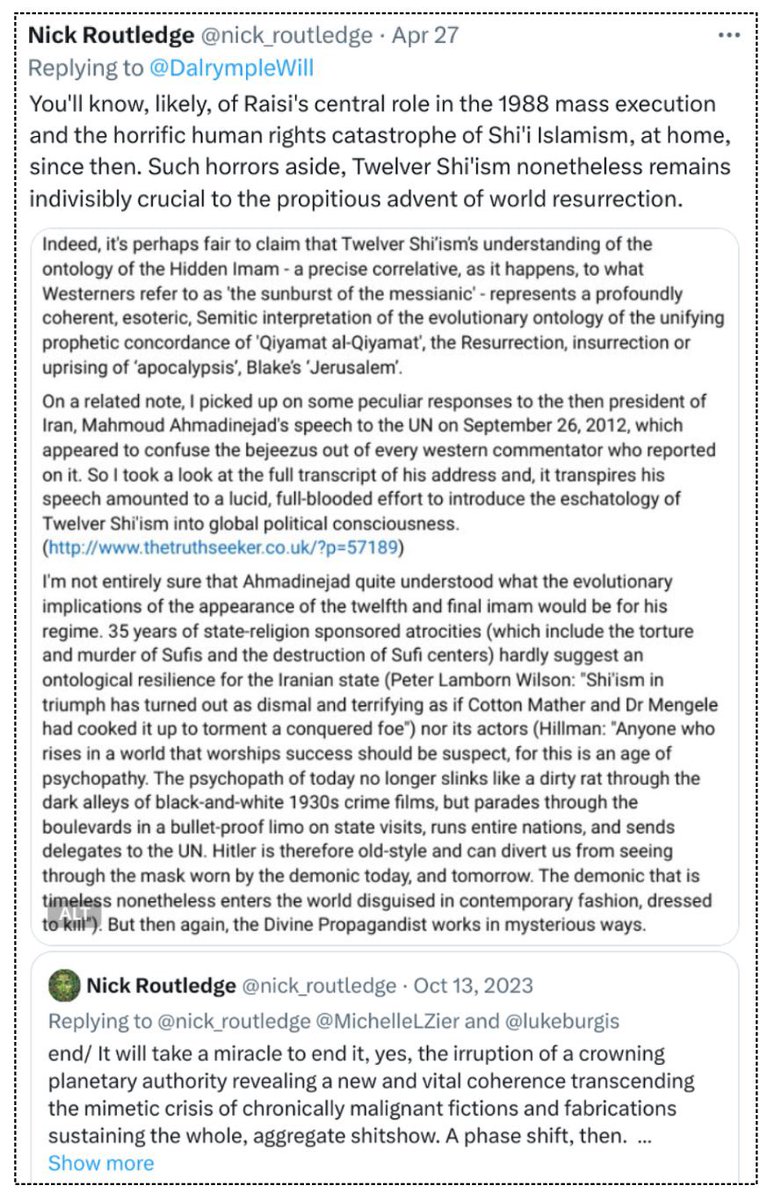
Image description
Original X alt text
Copy of tweet here: Containing excerpt from Facebook post here: And quote tweet here:
Extended description
Pictured speaker / quoted attribution: Nick Routledge quoting Peter Lamborn Wilson and Hillman Saved source record associated with pictured writing; full saved record, not an exact pictured excerpt. Passage boundary: You'll know / Indeed / On a related note / I'm not entirely Source: archive.nickroutledge.org/post/1874277625373614543 Preserve quoted-author distinctions; the containing tweet does not confer authorship. My latest: What Israelis can learn from the nightmares of an Iranian hangman The deeper lesson is how Iran repeatedly scales the death penalty to reconstitute political order from within. While different in magnitude from 1988's mass executions, the 2025 surge held to the same template—eliminating those cast as threats to the regime's theocratic mandate. Quote tweet: You'll know, likely, of Raisi's central role in the 1988 mass execution and the horrific human rights catastrophe of Shi'i Islamism, at home, since then. Such horrors aside, Twelver Shi'ism nonetheless remains indivisibly crucial to the propitious advent of world resurrection. Indeed, it's perhaps fair to claim that Twelver Shi’ism’s understanding of the ontology of the Hidden Imam - a precise correlative, as it happens, to what Westerners refer to as 'the sunburst of the messianic' - represents a profoundly coherent, esoteric, Semitic interpretation of the evolutionary ontology of the unifying prophetic concordance of 'Qiyamat al-Qiyamat', the Resurrection, insurrection or uprising of ‘apocalypsis’, Blake’s ‘Jerusalem’. On a related note, I picked up on some peculiar responses to the then president of Iran, Mahmoud Ahmadinejad's speech to the UN on September 26, 2012, which appeared to confuse the bejeezus out of every western commentator who reported on it. So I took a look at the full transcript of his address and, it transpires his speech amounted to a lucid, full-blooded effort to introduce the eschatology of Twelver Shi'ism into global political consciousness. (thetruthseeker.co.uk/?p=57189) I'm not entirely sure that Ahmadinejad quite understood what the evolutionary implications of the appearance of the twelfth and final imam would be for his regime. 35 years of state-religion sponsored atrocities (which include the torture and murder of Sufis and the destruction of Sufi centers) hardly suggest an ontological resilience for the Iranian state (Peter Lamborn Wilson: "Shi'ism in triumph has turned out as dismal and terrifying as if Cotton Mather and Dr Mengele had cooked it up to torment a conquered foe") nor its actors (Hillman: "Anyone who rises in a world that worships success should be suspect, for this is an age of psychopathy. The psychopath of today no longer slinks like a dirty rat through the dark alleys of black-and-white 1930s crime films, but parades through the boulevards in a bullet-proof limo on state visits, runs entire nations, and sends delegates to the UN. Hitler is therefore old-style and can divert us from seeing through the mask worn by the demonic today, and tomorrow. The demonic that is timeless nonetheless enters the world disguised in contemporary fashion, dressed to kill"). But then again, the Divine Propagandist works in mysterious ways.
Open original documentExtended description
Pictured speaker / quoted attribution: Nick Routledge Saved source record associated with pictured writing; full saved record, not an exact pictured excerpt. Passage boundary: end It will take a miracle Source: Preserve quoted-author distinctions; the containing tweet does not confer authorship. @MichelleLZier @lukeburgis end/ It will take a miracle to end it, yes, the irruption of a crowning planetary authority revealing a new and vital coherence transcending the mimetic crisis of chronically malignant fictions and fabrications sustaining the whole, aggregate shitshow. A phase shift, then. t.co/lHQdAGjsLD
Open original document