
@trippfuller 3/ Adorno rightly defined Benjamin as a thinker ‘standing apart from all tendencies’. Scholem held him as an almost canonical source, noting to Arendt, “just how far [his work] distances itself from every traditional conception of philosophy.” Why was he utterly ‘unclassifiable’?
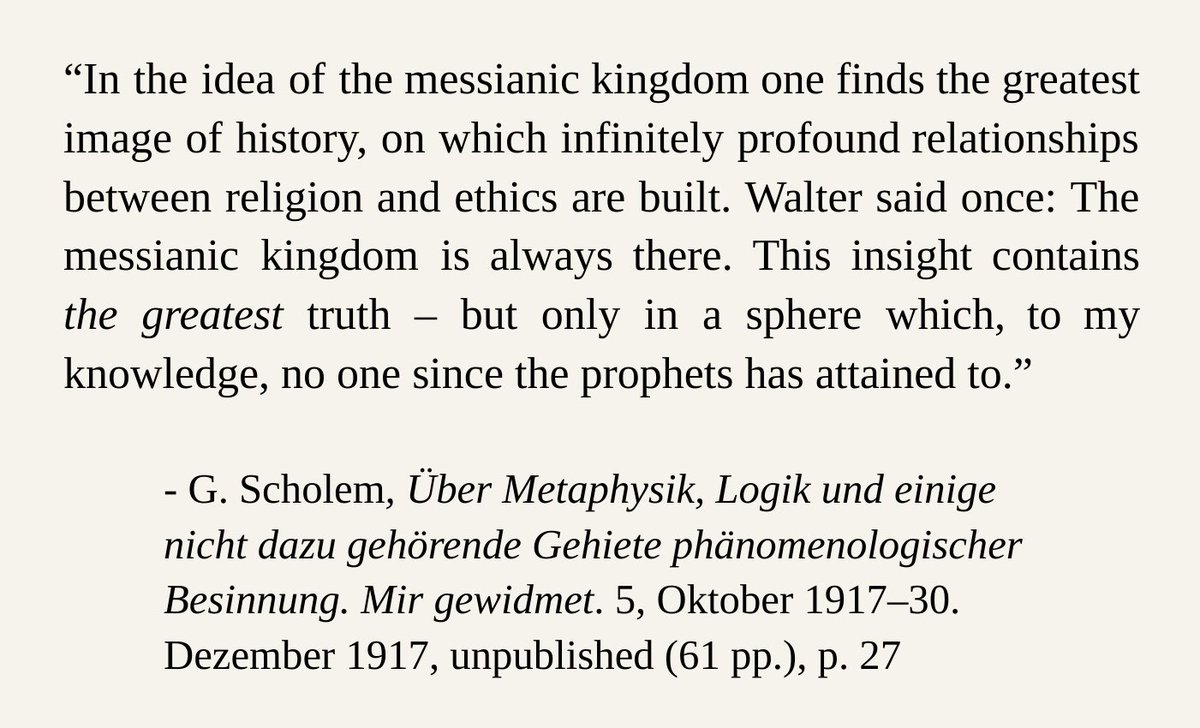
Image description
Original X alt text
“In the idea of the messianic kingdom one finds the greatest image of history, on which infinitely profound relationships between religion and ethics are built. Walter said once: The messianic kingdom is always there. This insight contains the greatest truth – but only in a sphere which, to my knowledge, no one since the prophets has attained to.” - G. Scholem, Über Metaphysik, Logik und einige nicht dazu gehörende Gehiete phänomenologischer Besinnung. Mir gewidmet. 5, Oktober 1917–30. Dezember 1917, unpublished (61 pp.), p. 27
@TGBelt @noonessleep Hello, Thomas! In truth, I sense a worthy answer embraces a semiotic radiance transcending traditional modes of expression. I can, however, approach a greater assimilative space 'hypertextually.' My subtweet above, opens a dimension upon your question. Perhaps a baptismal dip?
View this post’s context →