
RT @nick_routledge: @pauljpastor No joke. The planetary dialectic identifying deeply trustworthy hermaneutics commonly rates sense of humor a universal, vital, reliable indicator. On the cosmic comic circuit, I find the Himalayans fastest to the draw, where "Every Rabbi, a comedian," defines a supreme absolute.
@ncolloff That's very lovely. An aside. I was an impetuous, know-nothing neophyte when, three decades ago, actively scanning a contemplative horizon, 'Govinda' radically altered the compass of my life. A cosmic blessing more inclusive and generous than us both, I now sense. Reality, wise.
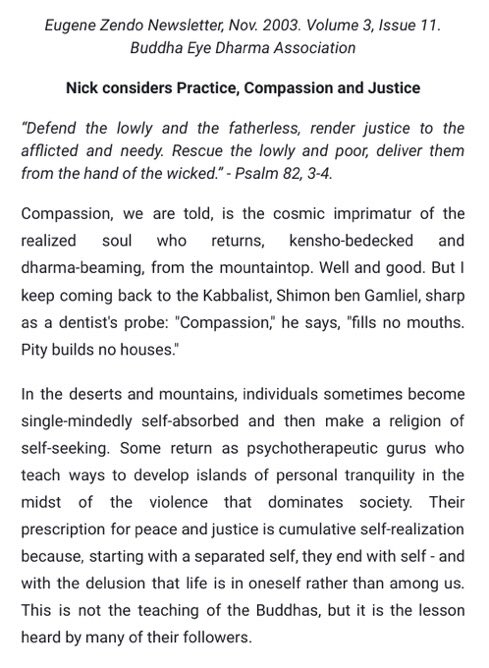
Image description
Original X alt text
Text at the Facebook link here:
Extended description
Pictured speaker / quoted attribution: Nick Routledge, Eugene Zendo newsletter November 2003; separate Psalm 82, Gamliel, Heschel, Corbett and Moyers/Campbell quotations Saved source record associated with pictured writing; full saved record, not an exact pictured excerpt. Passage boundary: Nick considers Practice Compassion Justice; three separate images through Where are the Zen prophets Source: archive.nickroutledge.org/post/1795792496506900860 Preserve quoted-author distinctions; the containing tweet does not confer authorship. Nobody has yet articulated a Buddhist metaphysical grammar fusing eschatological drama and incarnational stakes. I suspect fusion, if it comes, will be born of reality itself evolving—contemplative depth co-constituted through dynamic reciprocity, alive to context and current. 1/ I once asked the Christian master, Cynthia Bourgeault, what she believes distinguishes the contemplative experience in fundamentally ‘prophetic’ dispensations, such as Christianity, from that of ‘non-prophetic’ traditions, such as Buddhism. “I don't know," she humbly offered. Subtweets: The final battle, not one fought. Once again, I'm treasuring the privilege and blessing of sitting in pre-dawn candlelight, incense rising, becoming morning. After a couple of decades away from the daily temple grind, it's lighter now. The Long March polished the step, perhaps. ‘Nick considers Practice, Compassion and Justice.’ Eugene Zendo Newsletter. November, 2003. Vol. 3, Issue 11. Buddha Eye Dharma Association. - Eugene Zendo Newsletter, Nov. 2003. Volume 3, Issue 11. Buddha Eye Dharma Association Nick considers Practice, Compassion and Justice “Defend the lowly and the fatherless, render justice to the afflicted and needy. Rescue the lowly and poor, deliver them from the hand of the wicked.” - Psalm 82, 3-4. Compassion, we are told, is the cosmic imprimatur of the realized soul who returns, kensho-bedecked and dharma-beaming, from the mountaintop. Well and good. But I keep coming back to the Kabbalist, Shimon ben Gamliel, sharp as a dentist's probe: "Compassion," he says, "fills no mouths. Pity builds no houses." In the deserts and mountains, individuals sometimes become single-mindedly self-absorbed and then make a religion of self-seeking. Some return as psychotherapeutic gurus who teach ways to develop islands of personal tranquility in the midst of the violence that dominates society. Their prescription for peace and justice is cumulative self-realization because, starting with a separated self, they end with self - and with the delusion that life is in oneself rather than among us. This is not the teaching of the Buddhas, but it is the lesson heard by many of their followers. Implicit in Shimon ben Gamliel's observation, I sense, is an insistence that leaping beyond the One isn't simply a private affair. This carries us directly to the heart of a concern with justice, world history, and the prophetic imperative. ("The role of the prophet is to interfere with injustice." - Abraham Joshua Heschel.) Now, these are hardly factors that weigh heavily, if at all, in Buddhist notions of the nature of Enlightenment, even as they are are a central concern of other modern faiths, which see covenanting - what the Quaker goatherd and co-founder of the sanctuary movement, Jim Corbett, describes as "the enactment by consensual agreement of societal and other symbiotic harmonies that would reach completion in communion" - as the fundamental adaptive concern of anyone who seeks to become fully human. Some might say we find such a covenant in the free love among individuals; but how can this amount to a covenant? In a society that lives by conquest and possession, individual professions of steadfast love for the Creation's active Presence are make-believe. As Corbett might put it: the radical individuality of a Buddha is fully realized only in the kind of co-association which empowers its members to be co-creators of a social order in which humankind lives in harmony with one another and all that lives. The catholic communion we form is the body of the boundless. The Prophets teach communities a way that Buddhas teach individuals. Admittedly, our Prophets point out a communal way of hallowing that no people has yet completed. Why? I'm reminded of a conversation between Bill Moyers and Joseph Campbell. Moyers: "What if the hero returns from his ordeal and the world doesn't want what he brings back?" Campbell: "That, of course, is a normal experience. It isn't always so much that the world doesn't want the gift, but that it doesn't know how to receive it and how to institutionalize it..." Moyers: "How to keep it, how to renew it." Campbell: "Yes, how to help keep it going." Where are the Zen prophets? - 2/3 Consider Maitreya not as latent but immediate cipher-bridge between Dōgen's being-time and messianic tempieternity—the future Buddha as the pressure of universal compassion, and eschatological consciousness, recognized as different time-grammars of the same, charged now-time. Photograph of Being-Time by Shinshu Robert's, a gift from dearest brother, teacher and friend, Ejo McMullen Roshi.
Open original document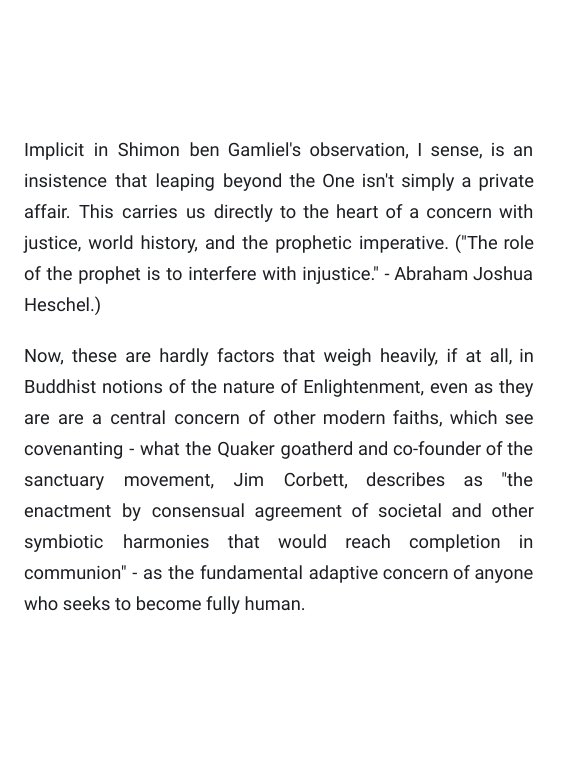
Image description
Original X alt text
Text at the Facebook link here:
Extended description
Pictured speaker / quoted attribution: Nick Routledge, Eugene Zendo newsletter November 2003; separate Psalm 82, Gamliel, Heschel, Corbett and Moyers/Campbell quotations Saved source record associated with pictured writing; full saved record, not an exact pictured excerpt. Passage boundary: Nick considers Practice Compassion Justice; three separate images through Where are the Zen prophets Source: archive.nickroutledge.org/post/1795792496506900860 Preserve quoted-author distinctions; the containing tweet does not confer authorship. Nobody has yet articulated a Buddhist metaphysical grammar fusing eschatological drama and incarnational stakes. I suspect fusion, if it comes, will be born of reality itself evolving—contemplative depth co-constituted through dynamic reciprocity, alive to context and current. 1/ I once asked the Christian master, Cynthia Bourgeault, what she believes distinguishes the contemplative experience in fundamentally ‘prophetic’ dispensations, such as Christianity, from that of ‘non-prophetic’ traditions, such as Buddhism. “I don't know," she humbly offered. Subtweets: The final battle, not one fought. Once again, I'm treasuring the privilege and blessing of sitting in pre-dawn candlelight, incense rising, becoming morning. After a couple of decades away from the daily temple grind, it's lighter now. The Long March polished the step, perhaps. ‘Nick considers Practice, Compassion and Justice.’ Eugene Zendo Newsletter. November, 2003. Vol. 3, Issue 11. Buddha Eye Dharma Association. - Eugene Zendo Newsletter, Nov. 2003. Volume 3, Issue 11. Buddha Eye Dharma Association Nick considers Practice, Compassion and Justice “Defend the lowly and the fatherless, render justice to the afflicted and needy. Rescue the lowly and poor, deliver them from the hand of the wicked.” - Psalm 82, 3-4. Compassion, we are told, is the cosmic imprimatur of the realized soul who returns, kensho-bedecked and dharma-beaming, from the mountaintop. Well and good. But I keep coming back to the Kabbalist, Shimon ben Gamliel, sharp as a dentist's probe: "Compassion," he says, "fills no mouths. Pity builds no houses." In the deserts and mountains, individuals sometimes become single-mindedly self-absorbed and then make a religion of self-seeking. Some return as psychotherapeutic gurus who teach ways to develop islands of personal tranquility in the midst of the violence that dominates society. Their prescription for peace and justice is cumulative self-realization because, starting with a separated self, they end with self - and with the delusion that life is in oneself rather than among us. This is not the teaching of the Buddhas, but it is the lesson heard by many of their followers. Implicit in Shimon ben Gamliel's observation, I sense, is an insistence that leaping beyond the One isn't simply a private affair. This carries us directly to the heart of a concern with justice, world history, and the prophetic imperative. ("The role of the prophet is to interfere with injustice." - Abraham Joshua Heschel.) Now, these are hardly factors that weigh heavily, if at all, in Buddhist notions of the nature of Enlightenment, even as they are are a central concern of other modern faiths, which see covenanting - what the Quaker goatherd and co-founder of the sanctuary movement, Jim Corbett, describes as "the enactment by consensual agreement of societal and other symbiotic harmonies that would reach completion in communion" - as the fundamental adaptive concern of anyone who seeks to become fully human. Some might say we find such a covenant in the free love among individuals; but how can this amount to a covenant? In a society that lives by conquest and possession, individual professions of steadfast love for the Creation's active Presence are make-believe. As Corbett might put it: the radical individuality of a Buddha is fully realized only in the kind of co-association which empowers its members to be co-creators of a social order in which humankind lives in harmony with one another and all that lives. The catholic communion we form is the body of the boundless. The Prophets teach communities a way that Buddhas teach individuals. Admittedly, our Prophets point out a communal way of hallowing that no people has yet completed. Why? I'm reminded of a conversation between Bill Moyers and Joseph Campbell. Moyers: "What if the hero returns from his ordeal and the world doesn't want what he brings back?" Campbell: "That, of course, is a normal experience. It isn't always so much that the world doesn't want the gift, but that it doesn't know how to receive it and how to institutionalize it..." Moyers: "How to keep it, how to renew it." Campbell: "Yes, how to help keep it going." Where are the Zen prophets? - 2/3 Consider Maitreya not as latent but immediate cipher-bridge between Dōgen's being-time and messianic tempieternity—the future Buddha as the pressure of universal compassion, and eschatological consciousness, recognized as different time-grammars of the same, charged now-time. Photograph of Being-Time by Shinshu Robert's, a gift from dearest brother, teacher and friend, Ejo McMullen Roshi.
Open original document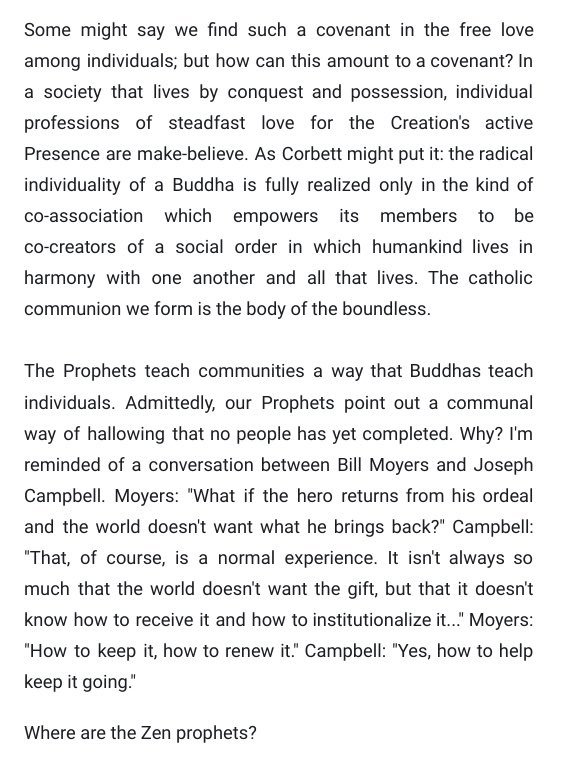
Image description
Original X alt text
Text at the Facebook link here:
Extended description
Pictured speaker / quoted attribution: Nick Routledge, Eugene Zendo newsletter November 2003; separate Psalm 82, Gamliel, Heschel, Corbett and Moyers/Campbell quotations Saved source record associated with pictured writing; full saved record, not an exact pictured excerpt. Passage boundary: Nick considers Practice Compassion Justice; three separate images through Where are the Zen prophets Source: archive.nickroutledge.org/post/1795792496506900860 Preserve quoted-author distinctions; the containing tweet does not confer authorship. Nobody has yet articulated a Buddhist metaphysical grammar fusing eschatological drama and incarnational stakes. I suspect fusion, if it comes, will be born of reality itself evolving—contemplative depth co-constituted through dynamic reciprocity, alive to context and current. 1/ I once asked the Christian master, Cynthia Bourgeault, what she believes distinguishes the contemplative experience in fundamentally ‘prophetic’ dispensations, such as Christianity, from that of ‘non-prophetic’ traditions, such as Buddhism. “I don't know," she humbly offered. Subtweets: The final battle, not one fought. Once again, I'm treasuring the privilege and blessing of sitting in pre-dawn candlelight, incense rising, becoming morning. After a couple of decades away from the daily temple grind, it's lighter now. The Long March polished the step, perhaps. ‘Nick considers Practice, Compassion and Justice.’ Eugene Zendo Newsletter. November, 2003. Vol. 3, Issue 11. Buddha Eye Dharma Association. - Eugene Zendo Newsletter, Nov. 2003. Volume 3, Issue 11. Buddha Eye Dharma Association Nick considers Practice, Compassion and Justice “Defend the lowly and the fatherless, render justice to the afflicted and needy. Rescue the lowly and poor, deliver them from the hand of the wicked.” - Psalm 82, 3-4. Compassion, we are told, is the cosmic imprimatur of the realized soul who returns, kensho-bedecked and dharma-beaming, from the mountaintop. Well and good. But I keep coming back to the Kabbalist, Shimon ben Gamliel, sharp as a dentist's probe: "Compassion," he says, "fills no mouths. Pity builds no houses." In the deserts and mountains, individuals sometimes become single-mindedly self-absorbed and then make a religion of self-seeking. Some return as psychotherapeutic gurus who teach ways to develop islands of personal tranquility in the midst of the violence that dominates society. Their prescription for peace and justice is cumulative self-realization because, starting with a separated self, they end with self - and with the delusion that life is in oneself rather than among us. This is not the teaching of the Buddhas, but it is the lesson heard by many of their followers. Implicit in Shimon ben Gamliel's observation, I sense, is an insistence that leaping beyond the One isn't simply a private affair. This carries us directly to the heart of a concern with justice, world history, and the prophetic imperative. ("The role of the prophet is to interfere with injustice." - Abraham Joshua Heschel.) Now, these are hardly factors that weigh heavily, if at all, in Buddhist notions of the nature of Enlightenment, even as they are are a central concern of other modern faiths, which see covenanting - what the Quaker goatherd and co-founder of the sanctuary movement, Jim Corbett, describes as "the enactment by consensual agreement of societal and other symbiotic harmonies that would reach completion in communion" - as the fundamental adaptive concern of anyone who seeks to become fully human. Some might say we find such a covenant in the free love among individuals; but how can this amount to a covenant? In a society that lives by conquest and possession, individual professions of steadfast love for the Creation's active Presence are make-believe. As Corbett might put it: the radical individuality of a Buddha is fully realized only in the kind of co-association which empowers its members to be co-creators of a social order in which humankind lives in harmony with one another and all that lives. The catholic communion we form is the body of the boundless. The Prophets teach communities a way that Buddhas teach individuals. Admittedly, our Prophets point out a communal way of hallowing that no people has yet completed. Why? I'm reminded of a conversation between Bill Moyers and Joseph Campbell. Moyers: "What if the hero returns from his ordeal and the world doesn't want what he brings back?" Campbell: "That, of course, is a normal experience. It isn't always so much that the world doesn't want the gift, but that it doesn't know how to receive it and how to institutionalize it..." Moyers: "How to keep it, how to renew it." Campbell: "Yes, how to help keep it going." Where are the Zen prophets? - 2/3 Consider Maitreya not as latent but immediate cipher-bridge between Dōgen's being-time and messianic tempieternity—the future Buddha as the pressure of universal compassion, and eschatological consciousness, recognized as different time-grammars of the same, charged now-time. Photograph of Being-Time by Shinshu Robert's, a gift from dearest brother, teacher and friend, Ejo McMullen Roshi.
Open original document