
RT @nick_routledge: @2000_mondo It's bigger than Trump. Bigger than America. It's the whole, global shebang. Purity cults, everywhere. Secular and religious. Right and left. Fundamentalisms and exceptionalisms galore. Patriarchal calculus for the religio-political ego, metastasized. Paul calls it, ‘The Law’.
@ncolloff Paul North: "When he finally arrives, what language will the Messiah speak?" The first made it clear enough. A tyranny of materialist and religious fetishism urges a summons beyond all prior secular and religious imaginaries or containment. A new Wording for a new reality, hear.
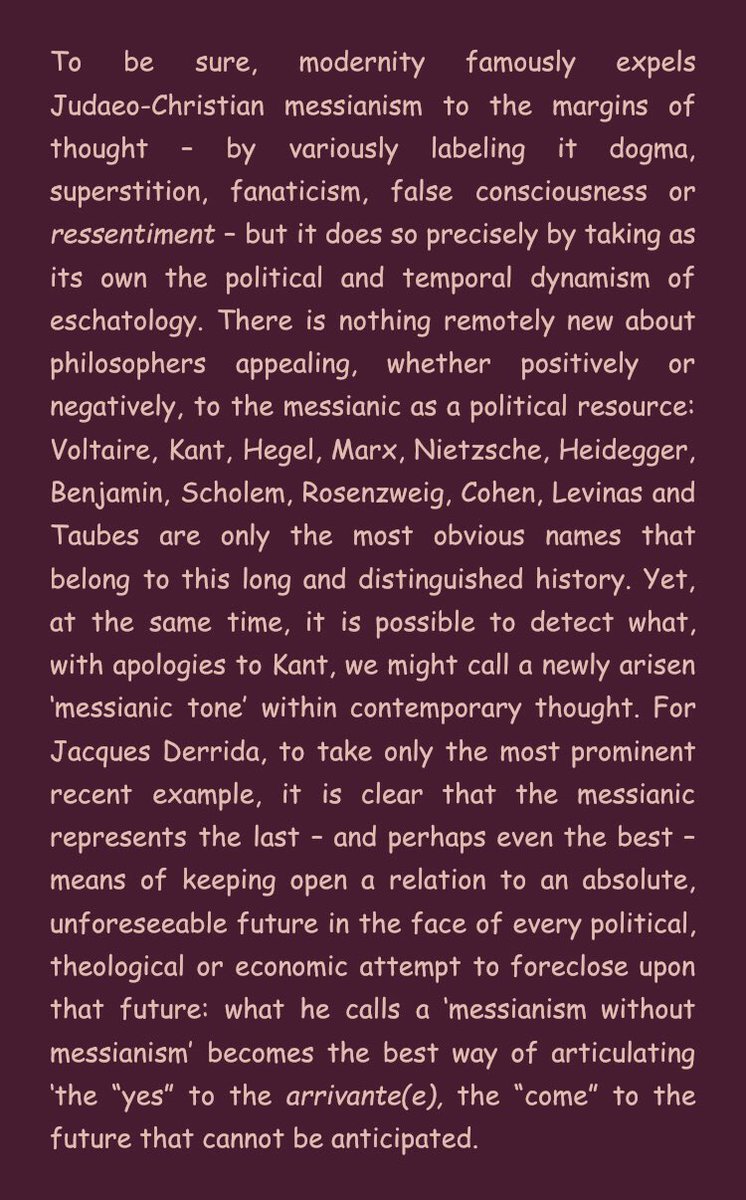
Image description
Original X alt text
To be sure, modernity famously expels Judaeo-Christian messianism to the margins of thought – by variously labeling it dogma, superstition, fanaticism, false consciousness or ressentiment – but it does so precisely by taking as its own the political and temporal dynamism of eschatology... Yet, at the same time, it is possible to detect what, with apologies to Kant, we might call a newly arisen ‘messianic tone’ within contemporary thought. For Jacques Derrida, to take only the most prominent recent example, it is clear that the messianic represents the last – and perhaps even the best – means of keeping open a relation to an absolute, unforeseeable future in the face of every political, theological or economic attempt to foreclose upon that future: what he calls a ‘messianism without messianism’ becomes the best way of articulating ‘the “yes” to the arrivante(e), the “come” to the future that cannot be anticipated.
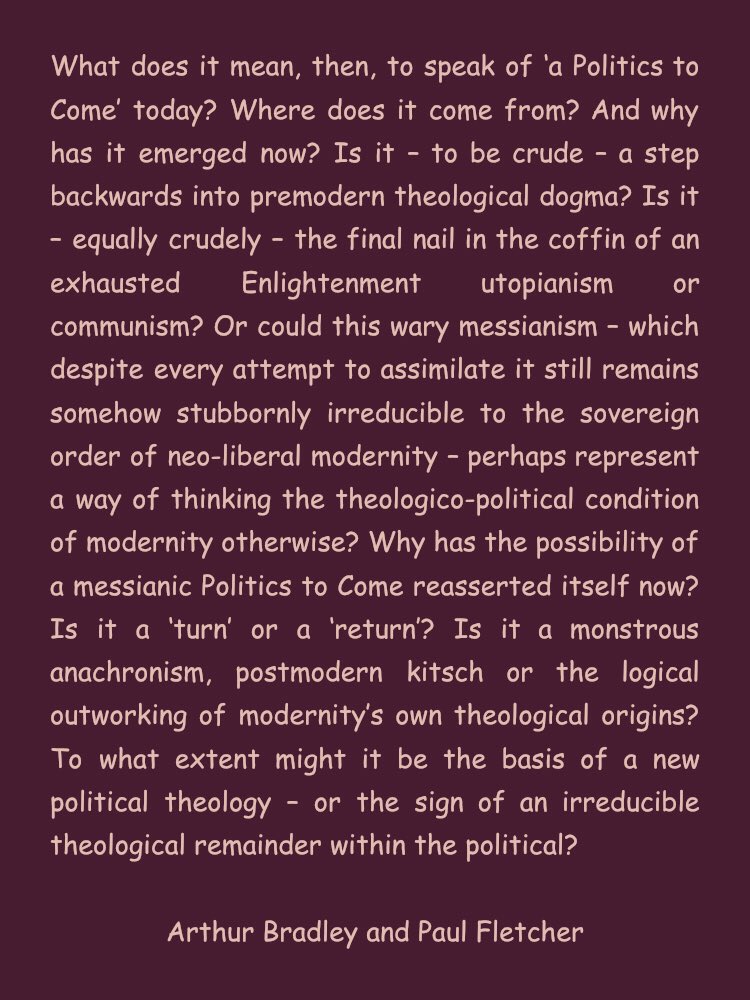
Image description
Original X alt text
What does it mean, then, to speak of ‘a Politics to Come’ today? Where does it come from? And why has it emerged now? Is it – to be crude – a step backwards into premodern theological dogma? Is it – equally crudely – the final nail in the coffin of an exhausted Enlightenment utopianism or communism? Or could this wary messianism – which despite every attempt to assimilate it still remains somehow stubbornly irreducible to the sovereign order of neo-liberal modernity – perhaps represent a way of thinking the theologico-political condition of modernity otherwise? Why has the possibility of a messianic Politics to Come reasserted itself now? Is it a ‘turn’ or a ‘return’? Is it a monstrous anachronism, postmodern kitsch or the logical outworking of modernity’s own theological origins? To what extent might it be the basis of a new political theology – or the sign of an irreducible theological remainder within the political? Arthur Bradley and Paul Fletcher
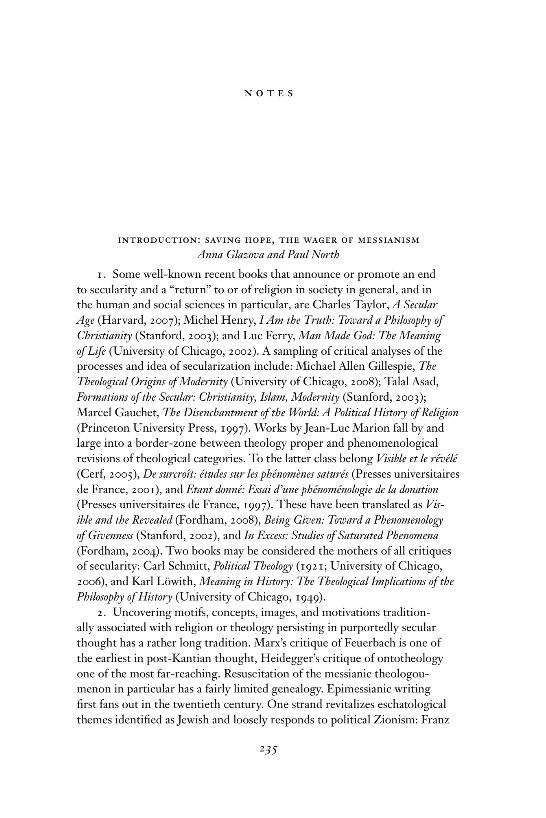
Image description
Original X alt text
Copy of tweet here: showing pages from the Notes on the introduction to 'Messianic Thought: Outside Theology', edited by Anna Glazova and Paul North.
Extended description
Pictured speaker / quoted attribution: Anna Glazova and Paul North Recovered pictured passage; not a claim to the full source. Passage boundary: Source: archive.nickroutledge.org/post/1885333342822031610 Preserve quoted-author distinctions; the containing tweet does not confer authorship. NOTES INTRODUCTION: SAVING HOPE, THE WAGER OF MESSIANISM Anna Glazova and Paul North 1. Some well-known recent books that announce or promote an end to secularity and a “return” to or of religion in society in general, and in the human and social sciences in particular, are Charles Taylor, A Secular Age (Harvard, 2007); Michel Henry, I Am the Truth: Toward a Philosophy of Christianity (Stanford, 2003); and Luc Ferry, Man Made God: The Meaning of Life (University of Chicago, 2002). A sampling of critical analyses of the processes and idea of secularization include: Michael Allen Gillespie, The Theological Origins of Modernity (University of Chicago, 2008); Talal Asad, Formations of the Secular: Christianity, Islam, Modernity (Stanford, 2003); Marcel Gauchet, The Disenchantment of the World: A Political History of Religion (Princeton University Press, 1997). Works by Jean-Luc Marion fall by and large into a border-zone between theology proper and phenomenological revisions of theological categories. To the latter class belong Visible et le révélé (Cerf, 2005), De surcroît: études sur les phénomènes saturés (Presses universitaires de France, 2001), and Étant donné: Essai d’une phénoménologie de la donation (Presses universitaires de France, 1997). These have been translated as Visible and the Revealed (Fordham, 2008), Being Given: Toward a Phenomenology of Givenness (Stanford, 2002), and In Excess: Studies of Saturated Phenomena (Fordham, 2004). Two books may be considered the mothers of all critiques of secularity: Carl Schmitt, Political Theology (1921; University of Chicago, 2006), and Karl Löwith, Meaning in History: The Theological Implications of the Philosophy of History (University of Chicago, 1949). 2. Uncovering motifs, concepts, images, and motivations traditionally associated with religion or theology persisting in purportedly secular thought has a rather long tradition. Marx’s critique of Feuerbach is one of the earliest in post-Kantian thought, Heidegger’s critique of ontotheology one of the most far-reaching. Resuscitation of the messianic theologoumenon in particular has a fairly limited genealogy. Epimessianic writing first fans out in the twentieth century. One strand revitalizes eschatological themes identified as Jewish and loosely responds to political Zionism: Franz 235
Open original document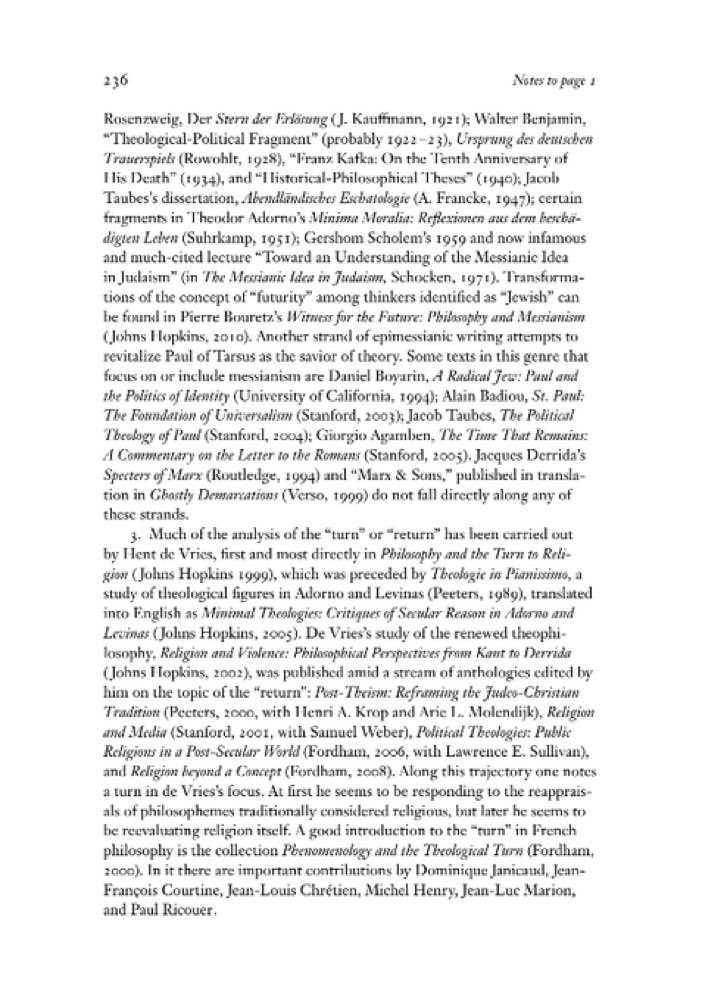
Image description
Original X alt text
Copy of tweet here: showing pages from the Notes on the introduction to 'Messianic Thought: Outside Theology', edited by Anna Glazova and Paul North.
Extended description
Pictured speaker / quoted attribution: Anna Glazova and Paul North Recovered pictured passage; not a claim to the full source. Passage boundary: Source: archive.nickroutledge.org/post/1885333342822031610 Preserve quoted-author distinctions; the containing tweet does not confer authorship. 236 Notes to page 1 Rosenzweig, Der Stern der Erlösung (J. Kauffmann, 1921); Walter Benjamin, “Theological-Political Fragment” (probably 1922–23), Ursprung des deutschen Trauerspiels (Rowohlt, 1928), “Franz Kafka: On the Tenth Anniversary of His Death” (1934), and “Historical-Philosophical Theses” (1940); Jacob Taubes’s dissertation, Abendländisches Eschatologie (A. Francke, 1947); certain fragments in Theodor Adorno’s Minima Moralia: Reflexionen aus dem beschädigten Leben (Suhrkamp, 1951); Gershom Scholem’s 1959 and now infamous and much-cited lecture “Toward an Understanding of the Messianic Idea in Judaism” (in The Messianic Idea in Judaism, Schocken, 1971). Transformations of the concept of “futurity” among thinkers identified as “Jewish” can be found in Pierre Bouretz’s Witness for the Future: Philosophy and Messianism (Johns Hopkins, 2010). Another strand of epimessianic writing attempts to revitalize Paul of Tarsus as the savior of theory. Some texts in this genre that focus on or include messianism are Daniel Boyarin, A Radical Jew: Paul and the Politics of Identity (University of California, 1994); Alain Badiou, St. Paul: The Foundation of Universalism (Stanford, 2003); Jacob Taubes, The Political Theology of Paul (Stanford, 2004); Giorgio Agamben, The Time That Remains: A Commentary on the Letter to the Romans (Stanford, 2005). Jacques Derrida’s Specters of Marx (Routledge, 1994) and “Marx & Sons,” published in translation in Ghostly Demarcations (Verso, 1999) do not fall directly along any of these strands. 3. Much of the analysis of the “turn” or “return” has been carried out by Hent de Vries, first and most directly in Philosophy and the Turn to Religion (Johns Hopkins 1999), which was preceded by Theologie in Pianissimo, a study of theological figures in Adorno and Levinas (Peeters, 1989), translated into English as Minimal Theologies: Critiques of Secular Reason in Adorno and Levinas (Johns Hopkins, 2005). De Vries’s study of the renewed theophilosophy, Religion and Violence: Philosophical Perspectives from Kant to Derrida (Johns Hopkins, 2002), was published amid a stream of anthologies edited by him on the topic of the “return”: Post-Theism: Reframing the Judeo-Christian Tradition (Peeters, 2000, with Henri A. Krop and Arie L. Molendijk), Religion and Media (Stanford, 2001, with Samuel Weber), Political Theologies: Public Religions in a Post-Secular World (Fordham, 2006, with Lawrence E. Sullivan), and Religion beyond a Concept (Fordham, 2008). Along this trajectory one notes a turn in de Vries’s focus. At first he seems to be responding to the reappraisals of philosophemes traditionally considered religious, but later he seems to be reevaluating religion itself. A good introduction to the “turn” in French philosophy is the collection Phenomenology and the Theological Turn (Fordham, 2000). In it there are important contributions by Dominique Janicaud, Jean-François Courtine, Jean-Louis Chrétien, Michel Henry, Jean-Luc Marion, and Paul Ricoeur. Retained uncertainty: [{"passage": "Taubes dissertation title, adjective terminal letter in ‘Abendländisches Eschatologie’", "reason": "Full-resolution page236 is soft and compressed; final letter after ‘Abendländische’ cannot be confidently distinguished. Draft keeps apparent s, not certified spelling. All surrounding reference text recovered."}]
Open original document