
RT @nick_routledge: @leashless 'Severance Day', a classic prophetological motif and echoed, as such, in the characteristically hierophanic guidance of ‘Alī b. Abī Ṭālib – cousin and son-in-law of Mohammed (PBUH), and the first and father of all other imams. "I am the instigator of the second Flood," he said.
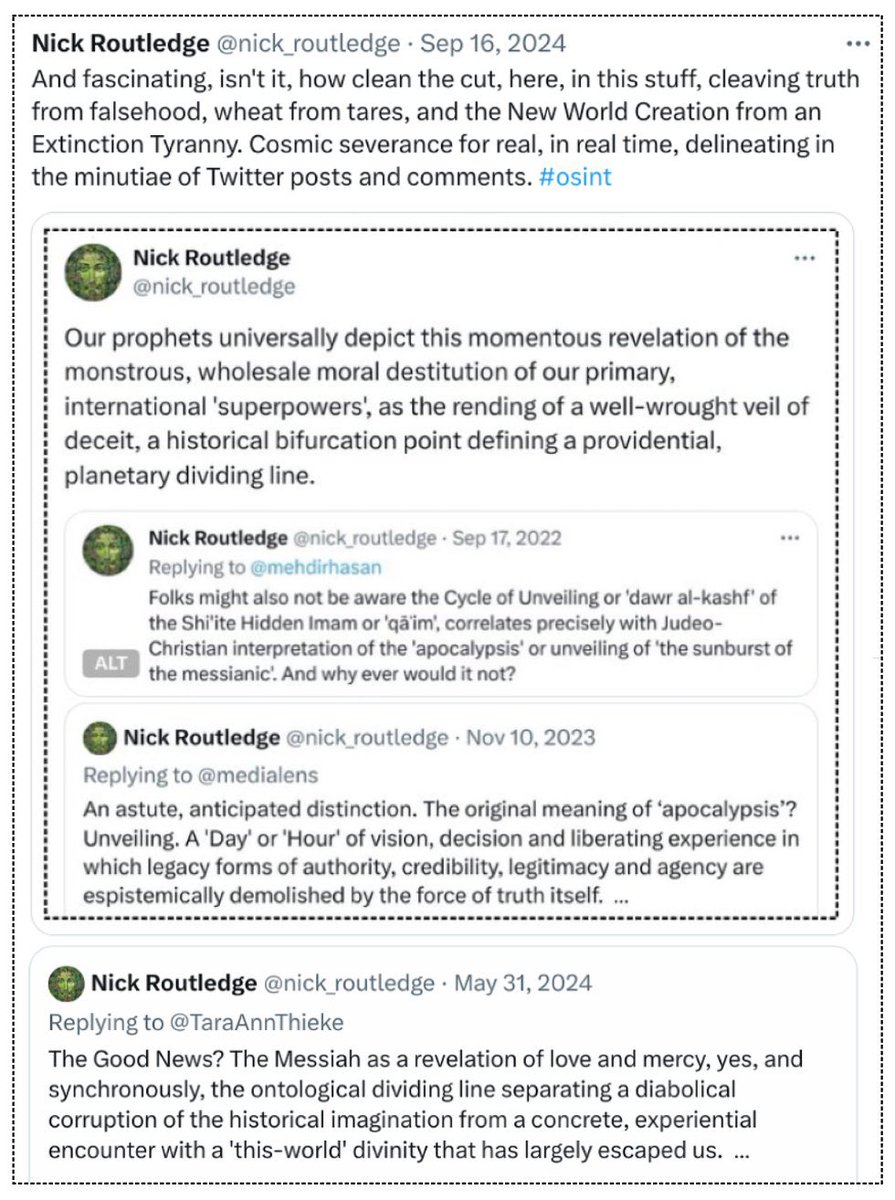
Image description
Original X alt text
Copy of tweet, images and quote tweet here:
@GabrielSaidR Ultimately, whatever our name for it, the 'Hour of Reckoning' or 'Day of the Messiah' isn't delineated by peculiarly Abrahamic or even singularly religious limits. Man-made history is only one of history’s dimensions. 'Planetary Parousia' or 'Qiyamat al-Qiyamat' takes it all in.
Image description
Original X alt text
Christ's parousia is not a dispensable appendage to the history of Christ. It is the goal of that history, for it is its completion. It is the keystone supporting the whole of christology, and this also makes it the key to the understanding of the history of Christ. Christ's parousia therefore does not merely 'unveil' the salvific meaning of Christ's death. It also, and much more, brings the fulfillment of the whole history of Christ, with all that it promises; for it is only with Christ's parousia that 'the kingdom that shall have no end' begins. Christ's messianic mission would remain incomprehensible if we were not to take into account the future 'Day of the Messiah', the future of the Son of Man, the coming 'Day of the Lord' — which is to say Jesus' parousia in the universal glory of God. His parousia is the fulfillment of his resurrection. That is why this future of Christ does not bring the turn of history 'once more'; it brings it 'once and for all'. Jürgen Moltmann