
@commonwealmag @NWirzba So, as an inherently co-evolutionary phenomenon, the Christ Mystery effects and requires a coherence attuned to a deeper flow of destiny - to the irresistible, onward, upward march of Life itself. Greek perfect is static but Hebrew good is dynamic and destinative (1 Cor. 15:51).
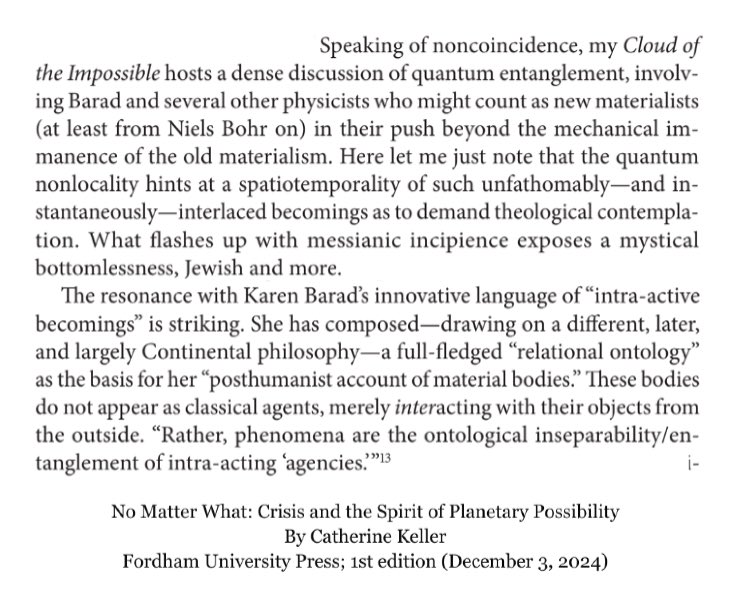
Image description
Original X alt text
Speaking of noncoincidence, my Cloud of the Impossible hosts a dense discussion of quantum entanglement, involving Barad and several other physicists who might count as new materialists in their push beyond the mechanical immanence of the old materialism. Here let me just note that the quantum nonlocality hints at a spatiotemporality of such unfathomably—and instantaneously—interlaced becomings as to demand theological contemplation. What flashes up with messianic incipience exposes a mysticalbottomlessness, Jewish and more. The resonance with Karen Barad’s innovative language of “intra-active becomings” is striking. She has composed—drawing on a later, and largely Continental philosophy—a full-fledged “relational ontology” as the basis for her “posthumanist account of material bodies.” These bodies do not appear as classical agents, merely interacting with their objects from the outside. “Rather, phenomena are the ontological inseparability/entanglement of intra-acting ‘agencies.
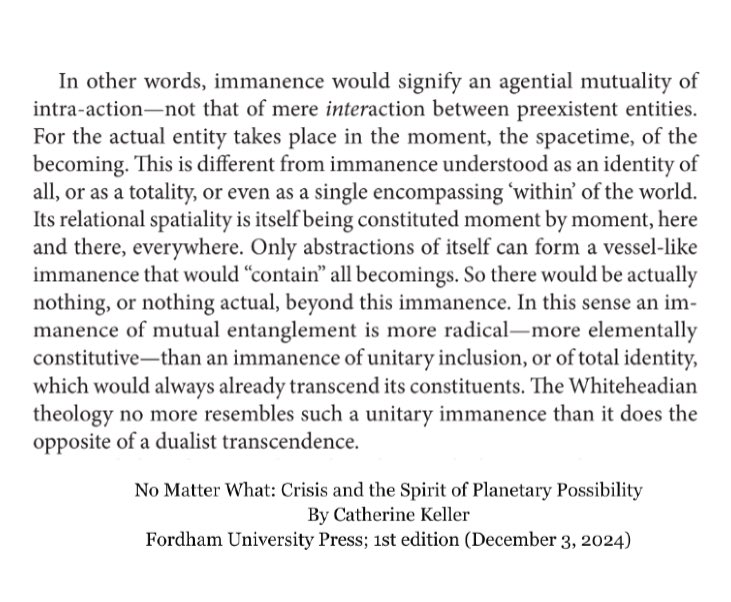
Image description
Original X alt text
In other words, immanence would signify an agential mutuality of intra-action—not that of mere interaction between preexistent entities. For the actual entity takes place in the moment, the spacetime, of the becoming. This is different from immanence understood as an identity of all, or as a totality, or even as a single encompassing ‘within’ of the world. Its relational spatiality is itself being constituted moment by moment, here and there, everywhere. Only abstractions of itself can form a vessel-like immanence that would “contain” all becomings. So there would be actually nothing, or nothing actual, beyond this immanence. In this sense an immanence of mutual entanglement is more radical —more elementally constitutive—than an immanence of unitary inclusion, or of total identity, which would always already transcend its constituents. The Whiteheadian theology no more resembles such a unitary immanence than it does the opposite of a dualist transcendence.
@ThinkingFaith Perhaps "the unthinkable density of truth of the word of the Cross" (Barnhart) eludes sapiential conception because it's revealed complete only in the transcendence of immanence itself radically activated. 'Follow me' means 'Enflesh!' 'Eat this!' Only the Kingdom is Christ alive.
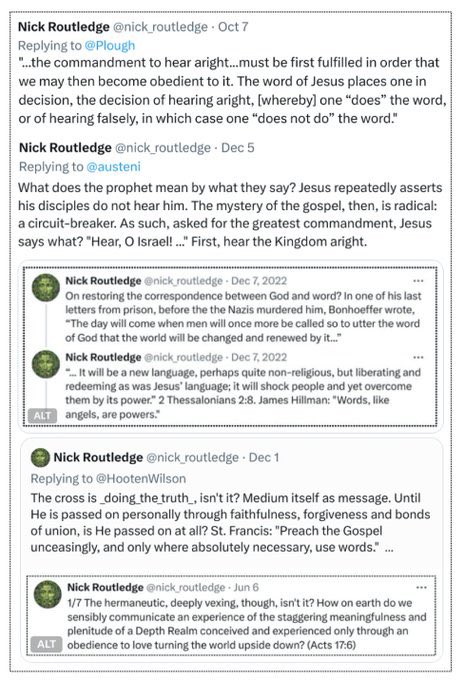
Image description
Original X alt text
Copy of tweet here:
Extended description
Pictured speaker / quoted attribution: Nick Routledge Saved source record associated with pictured writing; full saved record, not an exact pictured excerpt. Passage boundary: commandment to hear aright Source: Preserve quoted-author distinctions; the containing tweet does not confer authorship. @Plough "...the commandment to hear aright...must be first fulfilled in order that we may then become obedient to it. The word of Jesus places one in decision, the decision of hearing aright, [whereby] one “does” the word, or of hearing falsely, in which case one “does not do” the word." t.co/fSTvAFVZA1
Open original documentExtended description
Pictured speaker / quoted attribution: Nick Routledge Saved source record associated with pictured writing; full saved record, not an exact pictured excerpt. Passage boundary: What does the prophet mean Source: Preserve quoted-author distinctions; the containing tweet does not confer authorship. @austeni What does the prophet mean by what they say? Jesus repeatedly asserts his disciples do not hear him. The mystery of the gospel, then, is radical: a circuit-breaker. As such, asked for the greatest commandment, Jesus says what? "Hear, O Israel! ..." First, hear the Kingdom aright. t.co/jWnHCDzM71
Open original documentExtended description
Pictured speaker / quoted attribution: Nick Routledge quoting Bonhoeffer and James Hillman Saved source record associated with pictured writing; full saved record, not an exact pictured excerpt. Passage boundary: On restoring / It will be a new language Source: Preserve quoted-author distinctions; the containing tweet does not confer authorship. Copy of tweets here: On restoring the correspondence between God and word? In one of his last letters from prison, before the the Nazis murdered him, Bonhoeffer wrote, “The day will come when men will once more be called so to utter the word of God that the world will be changed and renewed by it...” “... It will be a new language, perhaps quite non-religious, but liberating and redeeming as was Jesus’ language; it will shock people and yet overcome them by its power.” 2 Thessalonians 2:8. James Hillman: "Words, like angels, are powers."
Open original documentExtended description
Pictured speaker / quoted attribution: Nick Routledge quoting St. Francis Saved source record associated with pictured writing; full saved record, not an exact pictured excerpt. Passage boundary: The cross Source: Preserve quoted-author distinctions; the containing tweet does not confer authorship. @HootenWilson The cross is _doing_the_truth_, isn't it? Medium itself as message. Until He is passed on personally through faithfulness, forgiveness and bonds of union, is He passed on at all? St. Francis: "Preach the Gospel unceasingly, and only where absolutely necessary, use words." t.co/8inujfG7K6
Open original documentExtended description
Pictured speaker / quoted attribution: Nick Routledge Saved source record associated with pictured writing; full saved record, not an exact pictured excerpt. Passage boundary: 1/7 The hermaneutic Source: Preserve quoted-author distinctions; the containing tweet does not confer authorship. Copy of tweet here: nick_routledge 1/7 The hermaneutic, deeply vexing, though, isn't it? How on earth do we sensibly communicate an experience of the staggering meaningfulness and plenitude of a Depth Realm conceived and experienced only through an obedience to love turning the world upside down? (Acts 17:6) We only have the first fruits of the Kingdom in this world, but we experience enough to know that it’s the only thing that will ever satisfy us. Once we have had the truth, half-truths do not satisfy us anymore. In its light, everything else is relative, even our own life. -Rohr Ragaz: "Not only does Jesus not bring a new religion, he does not bring any religion at all. One can't make this fact clear enough. He does not want a new religion, but rather a kingdom, a new creation, a new world." Thus, "We must teach spiritual things spiritually," 1 Cor. 2:13
Open original document