
@Himalayologist 1/3 What a glorious adventure, Vaibhav. I was quite taken by your encounter with the three Rishi Sufi ascetics "whilst roaming the high, icy ridges of the Pir Panjal Mountains." You're likely aware of Rishi Sufism's origins as a distinctively 'self-emergent' lineage or 'silsila'.
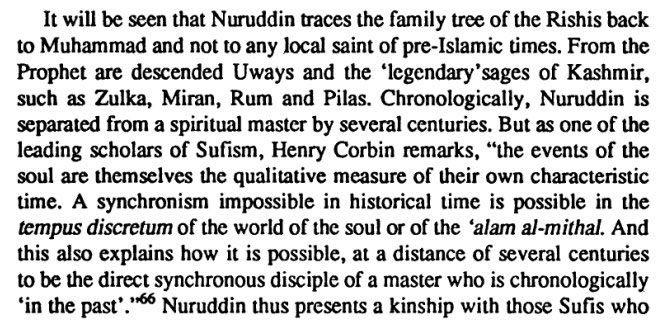
Image description
Original X alt text
It will be seen that Nuruddin traces the family tree of the Rishis back to Muhammad and not to any local saint of pre-Islamic times. From the Prophet are descended Uways and the ‘legendary’ sages of Kashmir, such as Zulka, Miran, Rum and Pilas. Chronologically, Nuruddin is separated from a spiritual master by several centuries. But as one of the leading scholars of Sufism, Henry Corbin remarks, “the events of the soul are themselves the qualitative measure of their own characteristic time. A synchronism impossible in historical time is possible in the tempus discretum of the world of the soul or of the ‘alam al-mithal.’ And this also explains how it is possible, at a distance of several centuries to be the direct synchronous disciple of a master who is chronologically ‘in the past’... Kashmir’s Transition to Islam: The Role of Muslim Rishis (Fifteenth to Eighteenth Century) by Mohammed Ishaq Khan
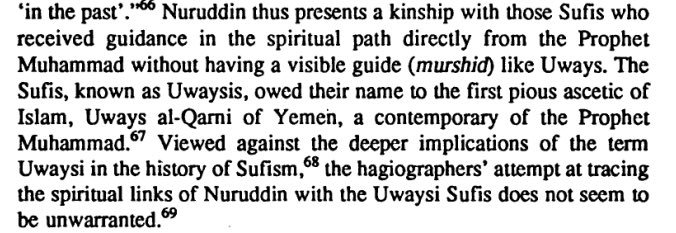
Image description
Original X alt text
Nuruddin thus presents a kinship with those Sufis who received guidance in the spiritual path directly from the Prophet Muhammad without having a visible guide (murshid) like Uways. The Sufis, known as Uwaysis, owed their name to the first pious ascetic of Islam, Uways al-Qami of Yemen, a contemporary of the Prophet Muhammad.®’ Viewed against the deeper implications of the term Uwaysi in the history of Sufism, the hagiographers’ attempt at tracing the spiritual links of Nuruddin with the Uwaysi Sufis does not seem to be unwarranted.” Kashmir’s Transition to Islam: The Role of Muslim Rishis (Fifteenth to Eighteenth Century) by Mohammed Ishaq Khan