
RT @nick_routledge: @riyeff We? Depends who you reckon with. A vast field of study has long been alert to the structure of media ecology (of late, generative AI) changing us even more than its content. Ellul, Ong and McLuhan would, of course, suggest our reconciliation with truth an eschatological matter.
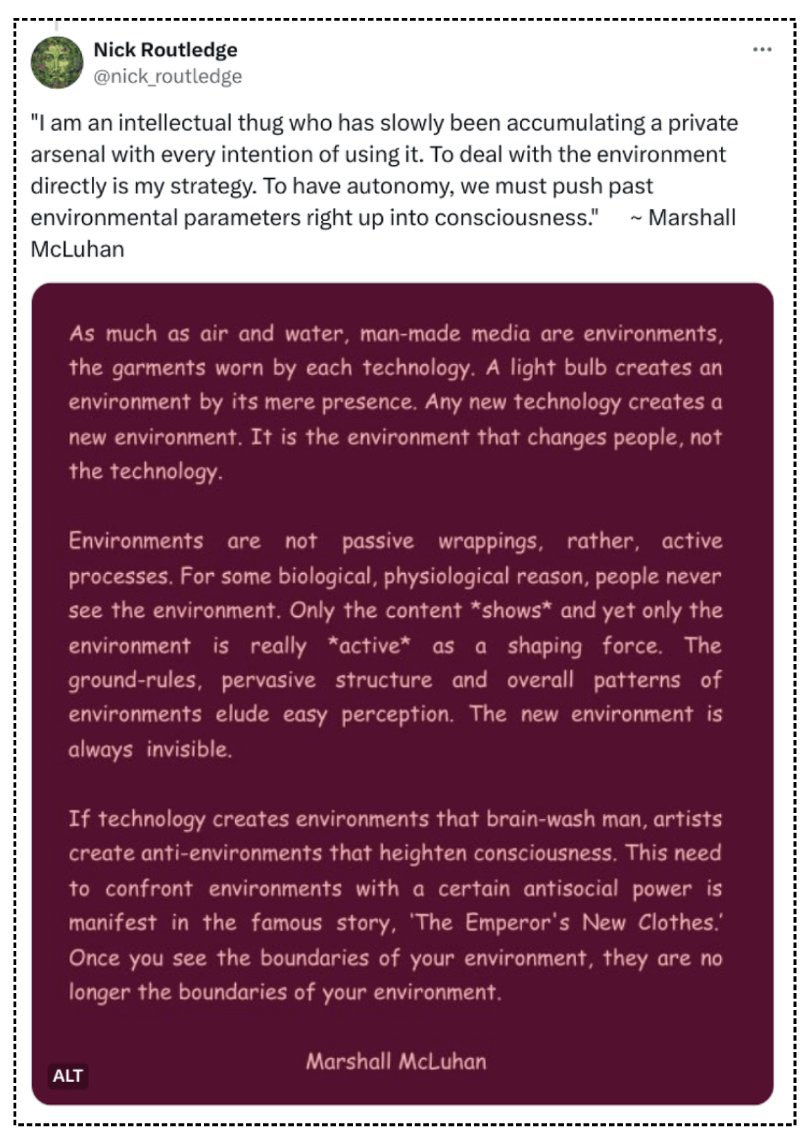
Image description
Original X alt text
Copy of tweet here:
Extended description
Pictured speaker / quoted attribution: Nick Routledge quoting Marshall McLuhan; McLuhan card Saved source record associated with pictured writing; full saved record, not an exact pictured excerpt. Passage boundary: I am an intellectual thug / As much as air and water Source: archive.nickroutledge.org/post/1822500661923303770 Preserve quoted-author distinctions; the containing tweet does not confer authorship. 1/2 So obvious we cannot see it. Our media, McLuhan noted, 'own' us in strangely concealed, "invincibly persuasive" ways. As such, 'apocalypse' (in its original sense of 'unveiling') makes the visible Real, freeing us from an all-enveloping enchantment. And the Cloud's role here? Ellul, Ong and McLuhan, fundamentally Christian media ecologists all, would suggest our reconciliation with truth an eschatological matter. Tweet: "I am an intellectual thug who has slowly been accumulating a private arsenal with every intention of using it. To deal with the environment directly is my strategy. To have autonomy, we must push past environmental parameters right up into consciousness." ~ Marshall McLuhan As much as air and water, man-made media are environments, the garments worn by each technology. A light bulb creates an environment by its mere presence. Any new technology creates a new environment. It is the environment that changes people, not the technology. Environments are not passive wrappings, rather, active processes. For some biological, physiological reason, people never see the environment. Only the content *shows* and yet only the environment is really *active* as a shaping force. The ground-rules, pervasive structure and overall patterns of environments elude easy perception. The new environment is always invisible. If technology creates environments that brain-wash man, art creates anti-environments heightening consciousness. This need to confront environments with a certain antisocial power is manifest in the famous story, The Emperor's New Clothes. Once you see the boundaries of your environment, they are no longer the boundaries of your environment. Marshall McLuhan [Works cited in text and image here:]
Open original documentExtended description
Pictured speaker / quoted attribution: Marshall McLuhan quotation exact wording variant Saved source record associated with pictured writing; full saved record, not an exact pictured excerpt. Passage boundary: artists create anti-environments that heighten consciousness Source: Preserve quoted-author distinctions; the containing tweet does not confer authorship. @jamespoulos McLuhan was clear on that point: "If technology creates environments that brain-wash man, artists create anti-environments that heighten consciousness." - M. McLuhan, review of 'Cyborg: Evolution of the Superman', 1965.
Open original document@johnrobb Don DeLillo: "News is the last addiction before - what?" @x
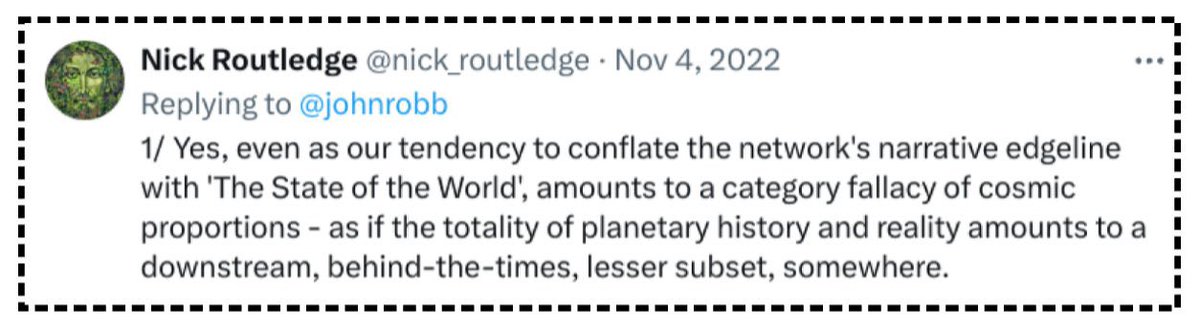
Image description
Original X alt text
Copy of tweet here: 1/ Yes, even as our tendency to conflate the network's narrative edgeline with 'The State of the World', amounts to a category fallacy of cosmic proportions - as if the totality of planetary history and reality amounts to a downstream, behind-the-times, lesser subset, somewhere.