
RT @nick_routledge: @Sophiologist_ Life, full of surprises, eh? Where Gandhi aptly described such religion as, "in practice, a negation of Christ's Christianity", many @x-ians clearly imagine their conduct somehow absolved from, rather than first to, a non-negotiable, algorithmically-supercharged Dividing Line.
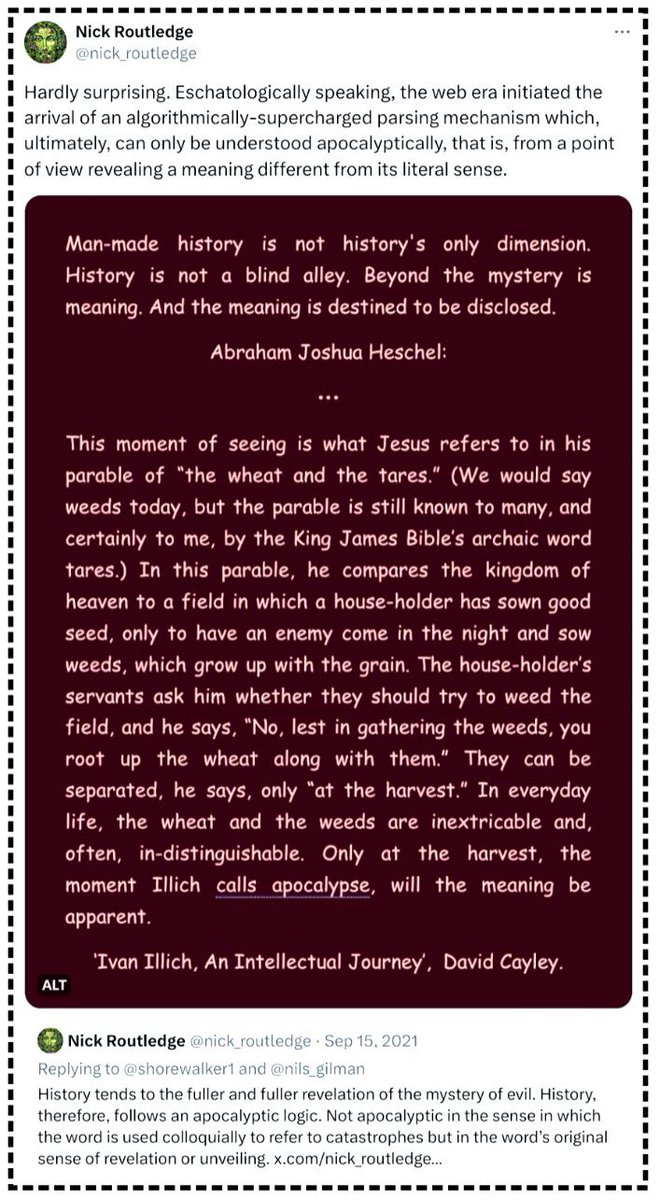
Image description
Original X alt text
Copy of tweet, image and quote tweet here:
Extended description
Pictured speaker / quoted attribution: Nick Routledge Saved source record associated with pictured writing; full saved record, not an exact pictured excerpt. Passage boundary: Hardly surprising Source: Preserve quoted-author distinctions; the containing tweet does not confer authorship. @johnrobb Hardly surprising. Eschatologically speaking, the web era initiated the arrival of an algorithmically-supercharged parsing mechanism which, ultimately, can only be understood apocalyptically, that is, from a point of view revealing a meaning different from its literal sense. t.co/xau7I0DMyP
Open original documentExtended description
Pictured speaker / quoted attribution: Abraham Joshua Heschel; David Cayley Saved source record associated with pictured writing; full saved record, not an exact pictured excerpt. Passage boundary: Man-made history / This moment of seeing / History tends Source: archive.nickroutledge.org/post/1813720906537263107 Preserve quoted-author distinctions; the containing tweet does not confer authorship. Hardly surprising. Eschatologically speaking, the web era initiated the arrival of an algorithmically-supercharged parsing mechanism which, ultimately, can only be understood apocalyptically, that is, from a point of view revealing a meaning different from its literal sense. Man-made history is not history's only dimension. History is not a blind alley. Beyond the mystery is meaning. And the meaning is destined to be disclosed. - Abraham Joshua Heschel This moment of seeing is what Jesus refers to in his parable of “the wheat and the tares.” (We would say weeds today, but the parable is still known to many, and certainly to me, by the King James Bible’s archaic word tares.) In this parable, he compares the kingdom of heaven to a field in which a house-holder has sown good seed, only to have an enemy come in the night and sow weeds, which grow up with the grain. The house-holder’s servants ask him whether they should try to weed the field, and he says, “No, lest in gathering the weeds, you root up the wheat along with them.” They can be separated, he says, only “at the harvest.” In everyday life, the wheat and the weeds are inextricable and, often, in-distinguishable. Only at the harvest, the moment Illich calls apocalypse, will the meaning be apparent. - Ivan Illich, An Intellectual JourneyDavid Cayley. Subtweet: History tends to the fuller and fuller revelation of the mystery of evil. History, therefore, follows an apocalyptic logic. Not apocalyptic in the sense in which the word is used colloquially to refer to catastrophes but in the word’s original sense of revelation or unveiling.
Open original document@BrianZahnd Yes, and from the get go, Jesus explicitly clarified that misrepresentation of the Gospel would reach its fullest, most perverse and mature expression among whom? The Second Advent does not amount to the rubber stamp we perhaps presume.
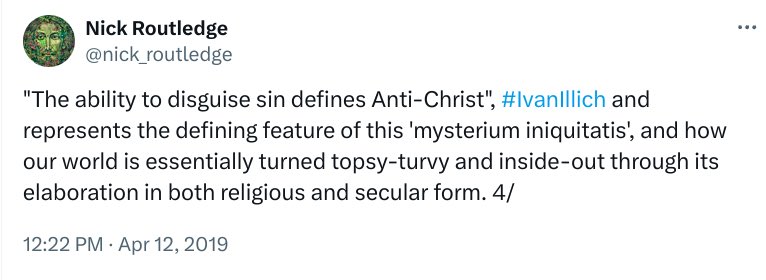
Image description
Original X alt text
Copy of tweet here: "The ability to disguise sin defines Anti-Christ", #IvanIllich and represents the defining feature of this 'mysterium iniquitatis', and how our world is essentially turned topsy-turvy and inside-out through its elaboration in both religious and secular form. 4/ 12:22 PM · Apr 12, 2019