
@BrianZahnd Once the Powers and Church moved _in_, we became Kingdom-blind. We could have an unquestionably authentic religious experience of rebirth yet remain possessed by exactly what Jesus came to end, the "idolatrous spells cast over people" (Wink) by "the demonic complex" (Whiteley).
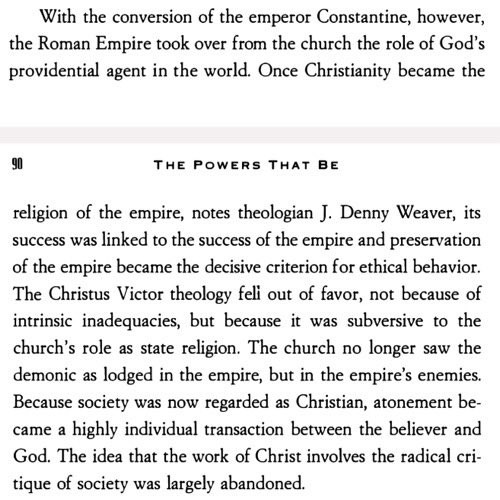
Image description
Original X alt text
With the conversion of the emperor Constantine, however, the Roman Empire took over from the church the role of God's providential agent in the world. Once Christianity became the religion of the empire, notes theologian J. Denny Weaver, its success was linked to the success of the empire and preservation of the empire became the decisive criterion for ethical behavior. The Christus Victor theology feli out of favor, not because of intrinsic inadequacies, but because it was subversive to the church’s role as state religion. The church no longer saw the demonic as lodged in the empire, but in the empire’s enemies. Because society was now regarded as Christian, atonement became a highly individual transaction between the believer and God. The idea that the work of Christ involves the radical critique of society was largely abandoned. - Walter Wink, The Powers That Be: Theology for a New Millennium
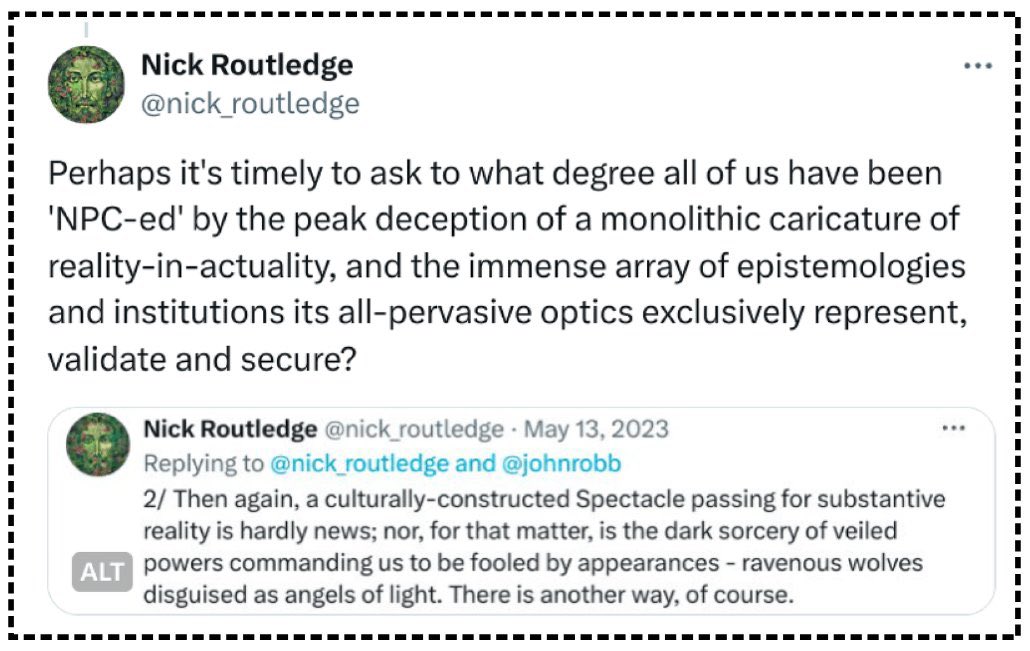
Image description
Original X alt text
Copy of tweet here: Perhaps it's timely to ask to what degree all of us have been 'NPC-ed' by the peak deception of a monolithic caricature of reality-in-actuality, and the immense array of epistemologies and institutions its all-pervasive optics exclusively represent, validate and secure? @nick_routledge and @johnrobb 2/ Then again, a culturally-constructed Spectacle passing for substantive reality is hardly news; nor, for that matter, is the dark sorcery of veiled powers commanding us to be fooled by appearances - ravenous wolves disguised as angels of light. There is another way, of course.
@TaraAnnThieke The Good News? The Messiah as a revelation of love and mercy, yes, and synchronously, the ontological dividing line separating a diabolical corruption of the historical imagination from a concrete, experiential encounter with a 'this-world' divinity that has largely escaped us.
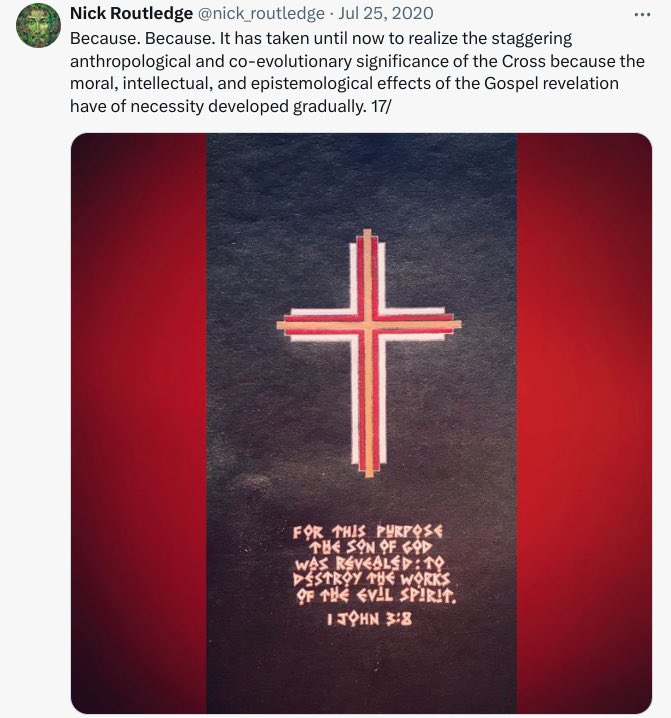
Image description
Original X alt text
Copy of tweet: Because. Because. It has taken until now to realize the staggering anthropological and co-evolutionary significance of the Cross because the moral, intellectual, and epistemological effects of the Gospel revelation have of necessity developed gradually. 17/ With art of cross and calligraphy: For this purpose the Son of God was revealed: to destroy the works of the evil spirit. 1 John 3:8