
@Dan_Bowdoin How could a fully-adapted concern with universal suffering ever end with the skin-bound self? The faithful way of co-suffering love is the narrow road that leads to life and the conscience knows it. Eckhart: “There are plenty to follow our Lord half-way, but not the other half."
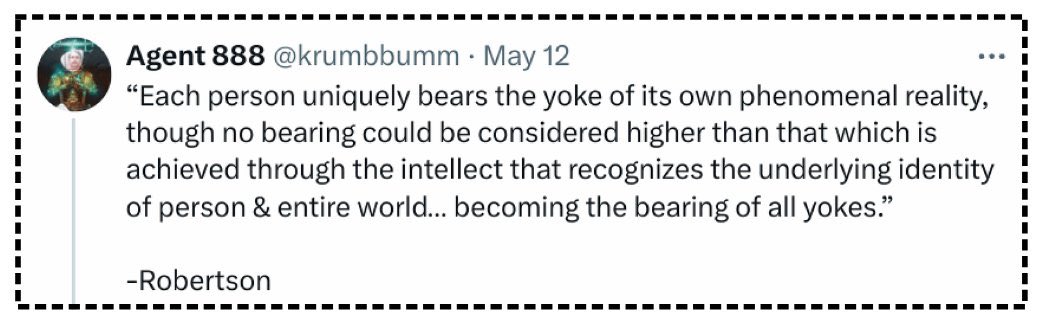
Image description
Original X alt text
Copy of tweet: “Each person uniquely bears the yoke of its own phenomenal reality, though no bearing could be considered higher than that which is achieved through the intellect that recognizes the underlying identity of person & entire world… becoming the bearing of all yokes.” -Robertson
@krumbbumm As such, the interdependent attitude of the Bodhisattva or Jesus enduring the Cross is the most realistic, locating the meaning of life in whole-hearted, personal identification with the perfection, in this world, of human and earthly solidarity, liberation, salvation and peace.
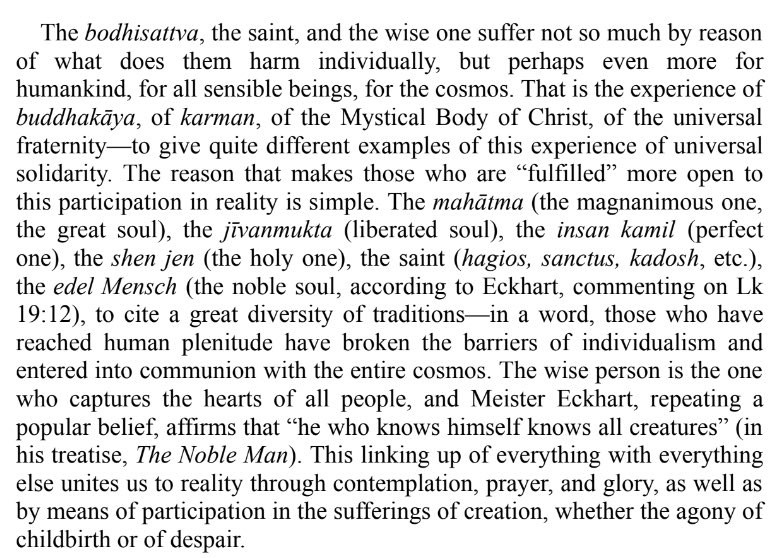
Image description
Original X alt text
The bodhisattva, the saint, and the wise one suffer not so much by reason of what does them harm individually, but perhaps even more for humankind, for all sensible beings, for the cosmos. That is the experience of buddhakaya, of karman, of the Mystical Body of Christ, of the universal fraternity—to give quite different examples of this experience of universal solidarity. The reason that makes those who are “fulfilled” more open to this participation in reality is simple. The mahatma (the magnanimous one, the great soul), the jivanmukta (liberated soul), the insan kamil (perfect one), the shen jen (the holy one), the saint (hagios, sanctus, kadosh, etc.), the edel Mensch (the noble soul, according to Eckhart, commenting on Lk 19:12), to cite a great diversity of traditions—in a word, those who have reached human plenitude have broken the barriers of individualism and entered into communion with the entire cosmos. The wise person is the one who captures the hearts... - Raimon Panikkar