
@DalrympleWill A wonderful photograph! Thank you. How sad that glorying in the beauty, diversity and profundity of world cultures so often perishes to "the barbed wire idiocy of borders" as George Steiner cursed it. We are made for so much more than present day power politics. A turn, in order.
@nils_gilman 1/ Ultimately, nationalism, "the venom of modern history" (Steiner), proves no more substantive than the mimetic aggregate of chronically malignant fictions and fabrications upholding the whole shebang. Like a thief in the night, a deeper, genuine Wholeness subverts it all.
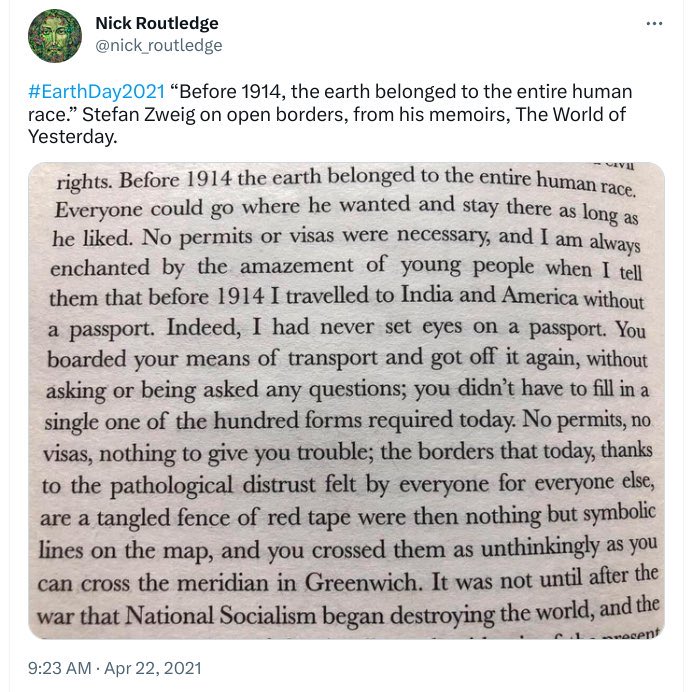
Image description
Original X alt text
Stefan Zweig, from his memoirs, The World of Yesterday: Before 1914 the earth belonged to the entire human race. Everyone could go where he wanted and stay there as long as he liked. No permits or visas were necessary, and I am always enchanted by the amazement of young people when I tell them that before 1914 I travelled to India and America without a passport. Indeed, I had never set eyes on a passport. You boarded your means of transport and got off it again, without asking or being asked any questions; you didn’t have to fill in a single one of the hundred forms required today. No permits, no visas, nothing to give you trouble; the borders that today, thanks to the pathological distrust felt by everyone for everyone else, are a tangled fence of red tape were then nothing but symbolic lines on the map, and you crossed them as unthinkingly as you can cross the meridian in Greenwich. It was not until after the war that National Socialism began destroying the world, and…
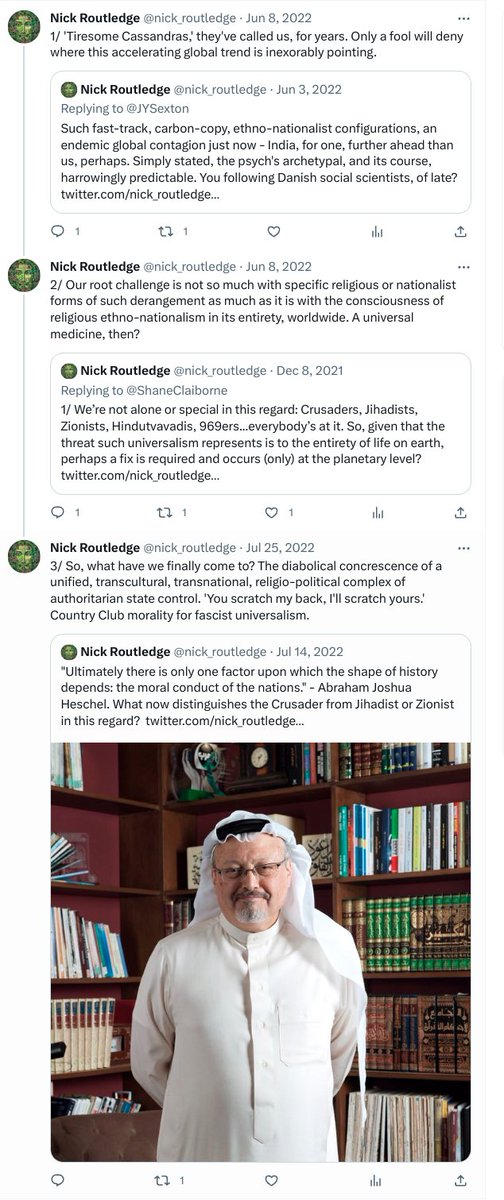
Image description
Original X alt text
Copy of tweet thread beginning here:
Extended description
Pictured speaker / quoted attribution: Nick Routledge Saved source record associated with pictured writing; full saved record, not an exact pictured excerpt. Passage boundary: 1 Tiresome Source: Preserve quoted-author distinctions; the containing tweet does not confer authorship. @RNS @omarsuleiman504 1/ 'Tiresome Cassandras,' they've called us, for years. Only a fool will deny where this accelerating global trend is inexorably pointing.
Open original documentExtended description
Pictured speaker / quoted attribution: Nick Routledge Saved source record associated with pictured writing; full saved record, not an exact pictured excerpt. Passage boundary: Such fast-track Source: Preserve quoted-author distinctions; the containing tweet does not confer authorship. @JYSexton Such fast-track, carbon-copy, ethno-nationalist configurations, an endemic global contagion just now - India, for one, further ahead than us, perhaps. Simply stated, the psych's archetypal, and its course, harrowingly predictable. You following Danish social scientists, of late?
Open original documentExtended description
Pictured speaker / quoted attribution: Nick Routledge Saved source record associated with pictured writing; full saved record, not an exact pictured excerpt. Passage boundary: 2 Our root Source: Preserve quoted-author distinctions; the containing tweet does not confer authorship. @RNS @omarsuleiman504 2/ Our root challenge is not so much with specific religious or nationalist forms of such derangement as much as it is with the consciousness of religious ethno-nationalism in its entirety, worldwide. A universal medicine, then?
Open original documentExtended description
Pictured speaker / quoted attribution: Nick Routledge Saved source record associated with pictured writing; full saved record, not an exact pictured excerpt. Passage boundary: 1 We're not Source: Preserve quoted-author distinctions; the containing tweet does not confer authorship. @ShaneClaiborne 1/ We’re not alone or special in this regard: Crusaders, Jihadists, Zionists, Hindutvavadis, 969ers...everybody’s at it. So, given that the threat such universalism represents is to the entirety of life on earth, perhaps a fix is required and occurs (only) at the planetary level?
Open original documentExtended description
Pictured speaker / quoted attribution: Nick Routledge with Heschel quotation Saved source record associated with pictured writing; full saved record, not an exact pictured excerpt. Passage boundary: 3 So / Ultimately one factor Source: Preserve quoted-author distinctions; the containing tweet does not confer authorship. Copy of tweet and quote tweet here: 3/ So, what have we finally come to? The diabolical concrescence of a unified, transcultural, transnational, religio-political complex of authoritarian state control. 'You scratch my back, I'll scratch yours.' Country Club morality for fascist universalism. Quote tweet "Ultimately there is only one factor upon which the shape of history depends: the moral conduct of the nations." - Abraham Joshua Heschel. What now distinguishes the Crusader from Jihadist or Zionist in this regard? twitter.com/nick_routledge… Image of Jamal Khashoggi, smiling, facing the camera.
Open original document