
RT @nick_routledge: @AlanWattsQuot @RichardRohrOFM Generally speaking, Eastern cultures have always maintained 'silencing' or 'centering down' as a root spiritual practice, whereas modern Christian contemplatives have had to 'recover' the discipline. Text from 'Just This: Prompts and Practices For Contemplation' @RichardRohrOFM
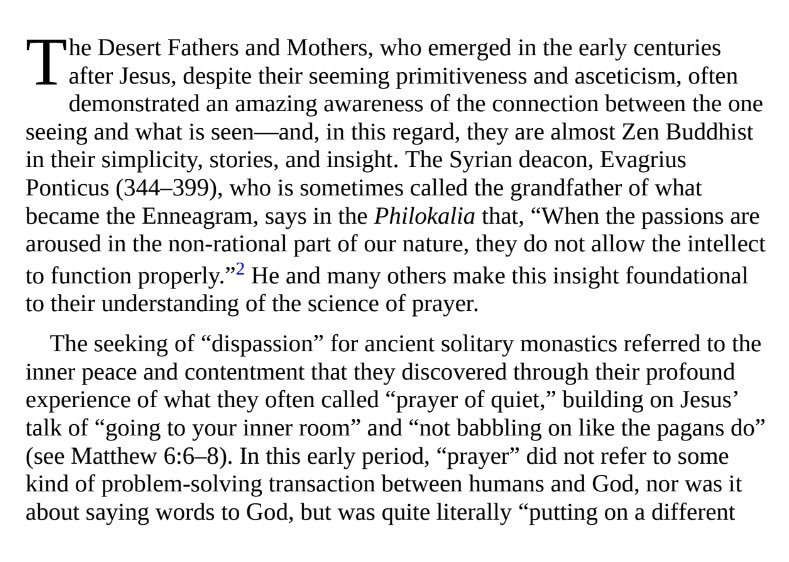
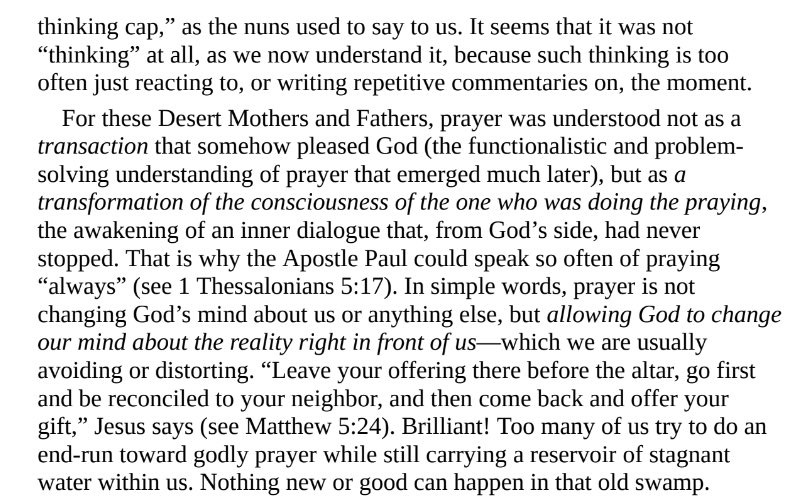
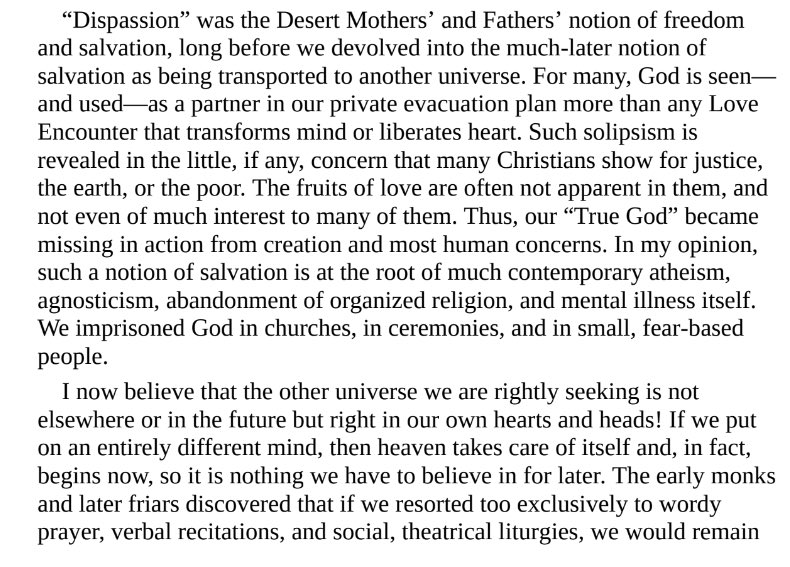
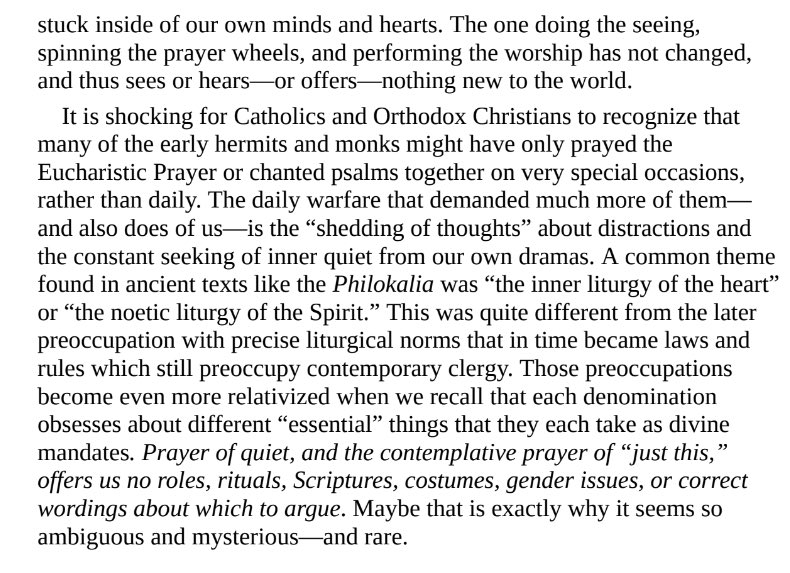
@SophiaCycles 3/ It’s fair to say that a great, global chorus of contemplative voices insist upon 'quietening down' as an essential constitutive requirement of access to such orders of reality. Here, modern, theistic, Christian perspectives, for example. world3.scribble.com/world3/meme1/space3/Silence_say_the_Sages.html
Image description
Original X alt text
"The reason why mystics and contemplatives are so insistent on intentional silence as a spiritual practice is that we know that our words and thoughts always get in the way of the inaudible presence of le point vierge. Carl McColman We now recognize only too deeply the limitations of mere thinking. In a word, “thinking freezes being.” Real silence is not repression of the word and incapacity to think, but absence of the word and transcending of thought. Raimon Panikkar …All such spiritual sleepwalking bypasses that crucial first step, that moment when the heart has to find its way not through external conditioning but through a raw immediacy of presence. Only there—in “the cave of the heart,” as the mystics are fond of calling it—does a person come in contact with his or her own direct knowingness. And only out of this direct knowingness is sovereignty born, one’s own inner authority." Cynthia Bourgeault
Image description
Original X alt text
…Mothers of the fourth Century interpreted this wisdom saying of Jesus as referring to the movement from ordinary psychological awareness to the interior silence of the spiritual level of our being and beyond that, to the secrecy of union with the Divine Indwelling. This tradition was handed on by the Hesychasts of the Eastern Orthodox tradition, and in particular by the sixth-century Syrian monk known as Pseudo-Dionysius; Meister Eckhardt, John Ruysbroeck, and the Rhineland mystics in the Middle Ages;the anonymous author of The Cloud of Unknowing in the fourteenth century; later by the Carmelite tradition exemplified by Teresa of Avila, John of the Cross, Thérèse of Lisieux, and Elizabeth of the Trinity; and in the last century by Thomas Merton.This tradition became known as apophatic contemplation. It is not in opposition to so-called kataphatic contemplation, which draws on the exercise of our rational faculties to access divine union. Thomas Keating
Image description
Original X alt text
“Nothing in the universe resembles God so much as silence.” - Meister Eckhart “Silence, more than anything else within us, is the doorway to the presence of God.” - Carl McColman The root of prayer is interior silence. We may think of prayer as thoughts or feelings expressed in words...but this is only one of its forms. “Prayer,” according to Evagrius, “is the laying aside of thoughts.” Centering prayer is not so much the absence of thoughts as detachment from them. It is the opening of mind and heart, body and emotions—our whole being—to God, the Ultimate Mystery, beyond words, thoughts, and emotions—beyond, in other words, the psychological content of the present moment. Regular periods of silence and solitude quiet the psyche, foster interior silence and initiate the dynamic of self-knowledge. Silence is God’s first language; everything else is a poor translation. Thomas Keating