
RT @nick_routledge: @SophiaCycles I keep returning to O'Donohue's "persistent courage to be at ease with what is unfinished", echoing the Tibetan adage that projecting the perspective through and beyond the death experience is essential. Bringing the Eternal tangibly home, the Easter message incarnate, isn't it?
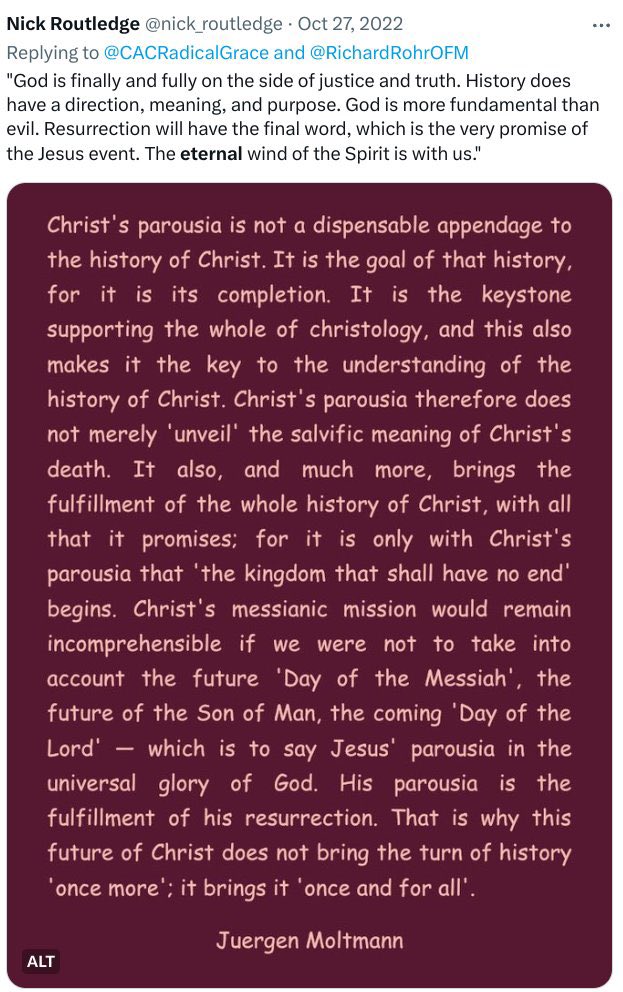
Image description
Original X alt text
Copy of tweet here:
@AimeTim Panikkar’s “tempiternal explosion of the adventure of Being,” this, the sunburst of the messianic, the transition from a conception of time that is not empty and mechanical, but that is full, intensive, and redemptive. The temporal-eternal cleft, bridged.
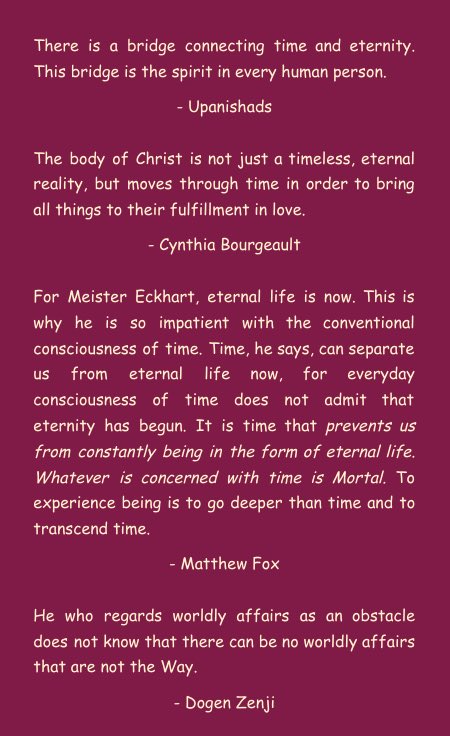
Image description
Original X alt text
There is a bridge connecting time and eternity. This bridge is the spirit in every human person. - Upanishads The body of Christ is not just a timeless, eternal reality, but moves through time in order to bring all things to their fulfillment in love. - Cynthia Bourgeault For Meister Eckhart, eternal life is now. This is why he is so impatient with the conventional consciousness of time. Time, he says, can separate us from eternal life now, for everyday consciousness of time does not admit that eternity has begun. It is time that prevents us from constantly being in the form of eternal life. Whatever is concerned with time is Mortal. To experience being is to go deeper than time and to transcend time. - Matthew Fox He who regards worldly affairs as an obstacle does not know that there can be no worldly affairs that are not the Way. - Dogen Zenji
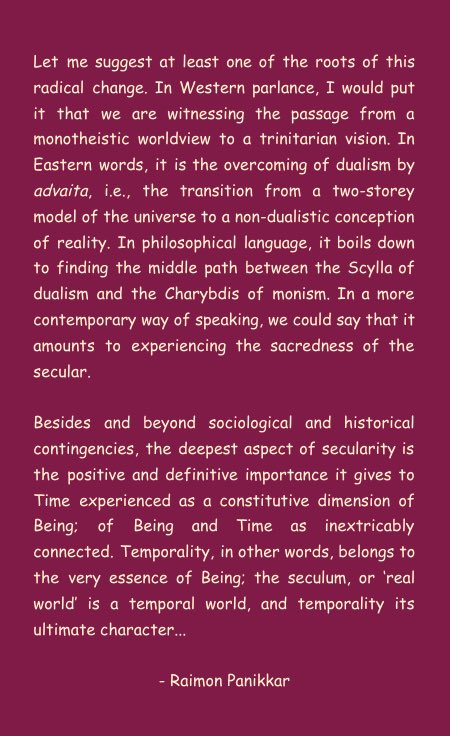
Image description
Original X alt text
Let me suggest at least one of the roots of this radical change. In Western parlance, we are witnessing the passage from a monotheistic worldview to a trinitarian vision. In Eastern words, it is the overcoming of dualism by advaita, i.e., the transition from a two-storey model of the universe to a non-dualistic conception of reality. In philosophical language, it boils down to finding the middle path between the Scylla of dualism and the Charybdis of monism. In a more contemporary way of speaking, we could say that it amounts to experiencing the sacredness of the secular. Besides and beyond sociological and historical contingencies, the deepest aspect of secularity is the positive and definitive importance it gives to Time experienced as a constitutive dimension of Being; of Being and Time as inextricably connected. Temporality, in other words, belongs to the very essence of Being; the seculum, or ‘real world’ is a temporal world, and temporality its ultimate character.
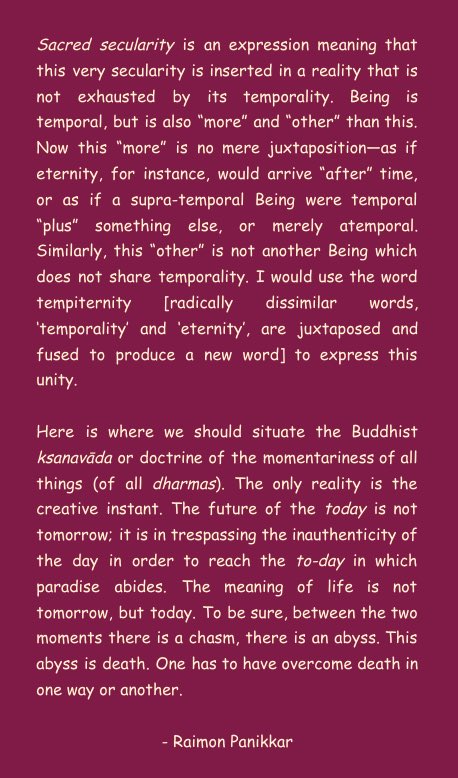
Image description
Original X alt text
Sacred secularity is an expression meaning that this very secularity is inserted in a reality that is not exhausted by its temporality. Being is temporal, but is also “more” and “other” than this. Now this “more” is no mere juxtaposition—as if eternity, for instance, would arrive “after” time, or as if a supra-temporal Being were temporal “plus” something else, or merely atemporal. Similarly, this “other” is not another Being which does not share temporality. I would use the word tempiternity [radically dissimilar words, ‘temporality’ and ‘eternity’, are juxtaposed and fused to produce a new word] to express this unity. Here is where we should situate the Buddhist ksanavāda or doctrine of the momentariness of all things (of all dharmas). The only reality is the creative instant. The future of the today is not tomorrow; it is in trespassing the inauthenticity of the day in order to reach the to-day in which paradise abides. The meaning of life is not tomorrow, but today. Panikkar
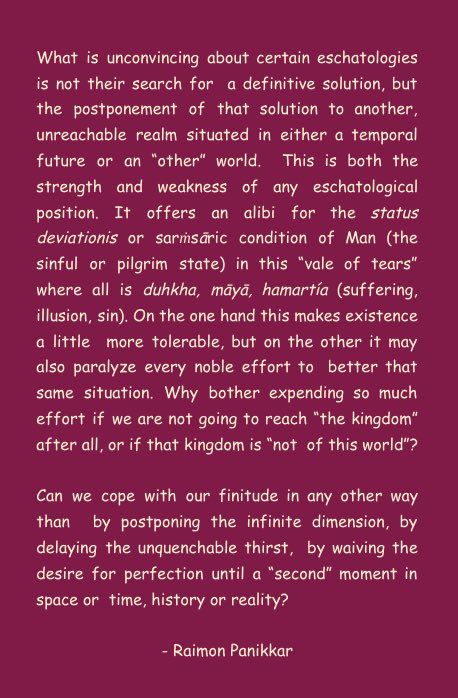
Image description
Original X alt text
What is unconvincing about certain eschatologies is not their search for a solution, but the postponement of that solution to another, unreachable realm situated in either a temporal future or an “other” world. This is both the strength and weakness of any eschatological position. It offers an alibi for the status deviationis or sarṁsāric condition of Man (the sinful or pilgrim state) in this “vale of tears” where all is duhkha, māyā, hamartía (suffering, illusion, sin). On the one hand this makes existence a little more tolerable, but on the other it may also paralyze every noble effort to better that same situation. Why bother expending so much effort if we are not going to reach “the kingdom” after all, or if that kingdom is “not of this world”? Can we cope with our finitude in any other way than by postponing the infinite dimension, by delaying the unquenchable thirst, by waiving the desire for perfection until a “second” moment in space or time, history or reality?