
The art of authentic belonging - settling in well to the genius of a particularized habitat - calls for an endless, co-creative adventure. Today, shucking field corn and, in the same breath, selecting kernels for further adaptation. Which traits and combinations beautifully fit?
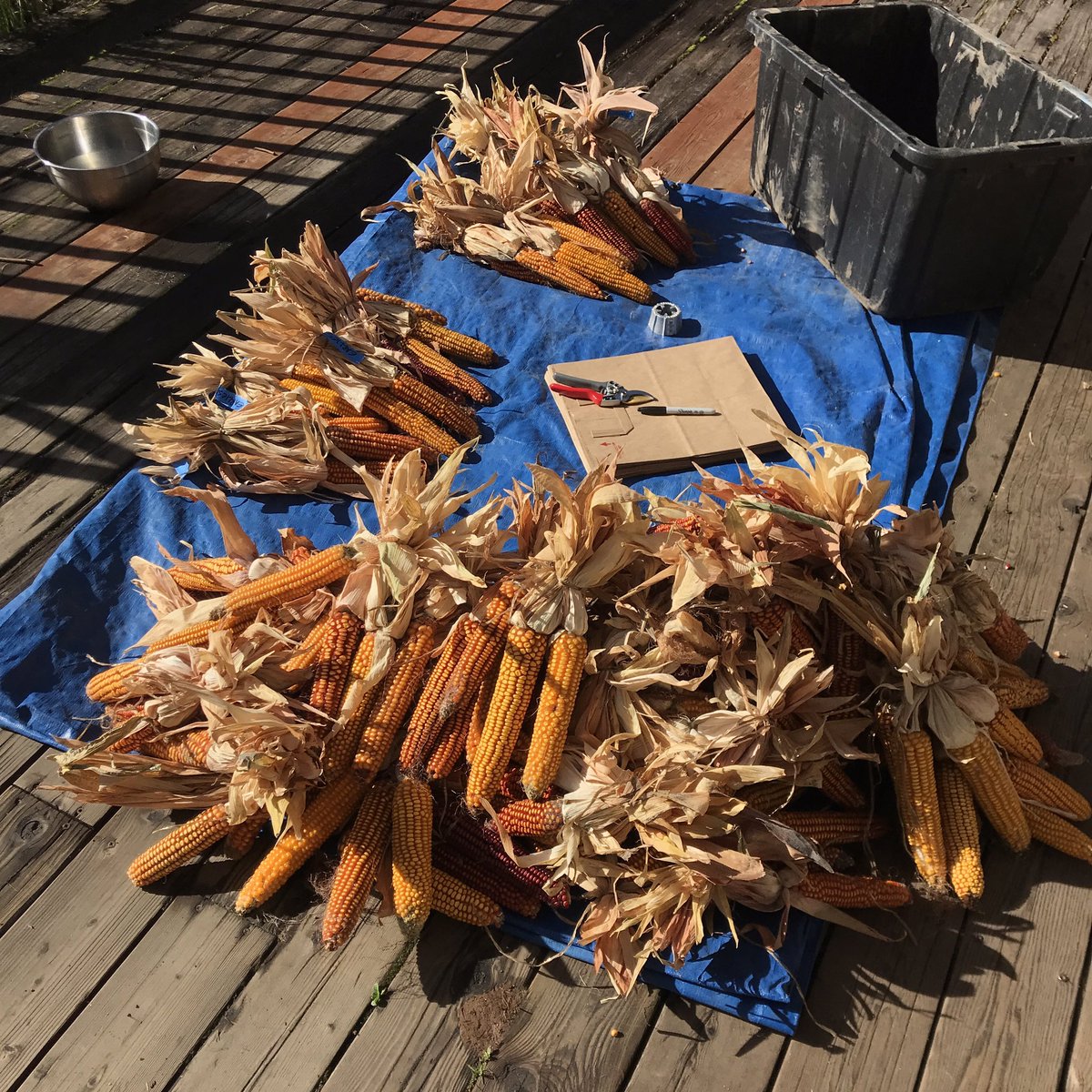
Image description
Original X alt text
Here, in the Willamette Valley, field corn isn’t a commercial crop because it can’t be combined. (A combine is a machine that removes the kernels from the ears and plants in the field.) Corn can’t be combined here because the ears don’t dry down well enough in the field. Corn can be combined in eastern Oregon. The Willamette Valley pioneers hand-picked their ears and let them finish drying inside, just like we do, today. Even in regions where combining is possible, these specialty or ‘Indian corns’ often don’t combine well. Corn can be readily shucked by hands wearing gloves. Simple tools can quicken the process. Here, an inexpensive shucker and a tote suffice.
As a strongly outcrossing, double-fertilizing angiosperm, corn (Zea mays) responds very rapidly to selective breeding approaches. Here, ASN's Chris Homanics describes what he looks for when selecting for positive traits in a modern PNW composite field corn.youtu.be/nNfyBalBYzw
View this post’s context →