
@SherPoint Taking a Zarathustran motif further, Redemption does not therefore destroy the terrestrial world (the Zoroastrian Mazdean ‘getik’) but re-couples or re-originates it with its celestial reality (‘menok’) restoring it to its luminous state, its archetypal dimension. Here, Moltmann:
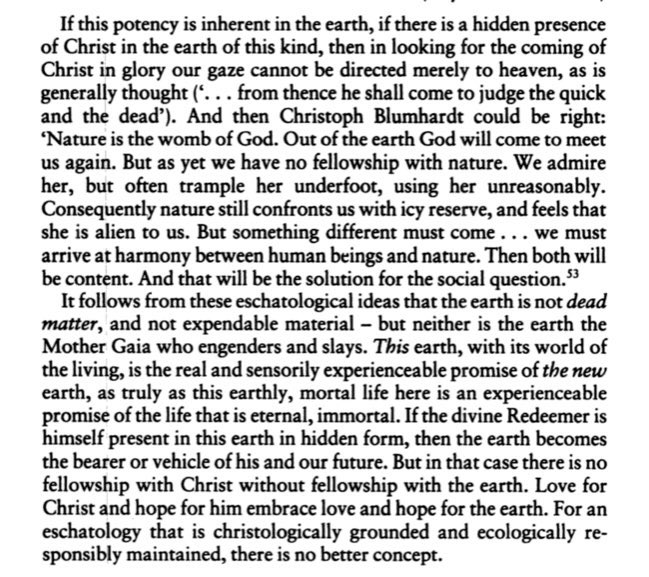
Image description
Original X alt text
Edited down by 640 characters... If this potency is inherent in the earth, if there is a hidden presence ofChrist in the earth of this kind, then in looking for the coming of Christ in glory our gaze cannot be directed merely to heaven, as is generally thought And then Christoph Blumhardt could be right: 'Nature is the womb of God. Out of the earth God will come to meet us again....we must arrive at harmony between human beings and nature. Then both will be content. And that will be the solution for the social question. It follows from these eschatological ideas that the earth is not dead matter, and not expendable material...lf the divine Redeemer is himself present in this earth in hidden form, then the earth becomes the bearer or vehicle of his and our future. But in that case there is no fellowship with Christ without fellowship with the earth. Love for Christ and hope for him embrace love and hope for the earth.
@AimeTim 5/ Ultimately, a dynamic complex of mutual adaptation, co-evolution, synergy and companionship restores the ontological communion of path and peace in the natural sequence of a concrete journey into the fullness of authentic homecoming. Paradise Regained, locally made.
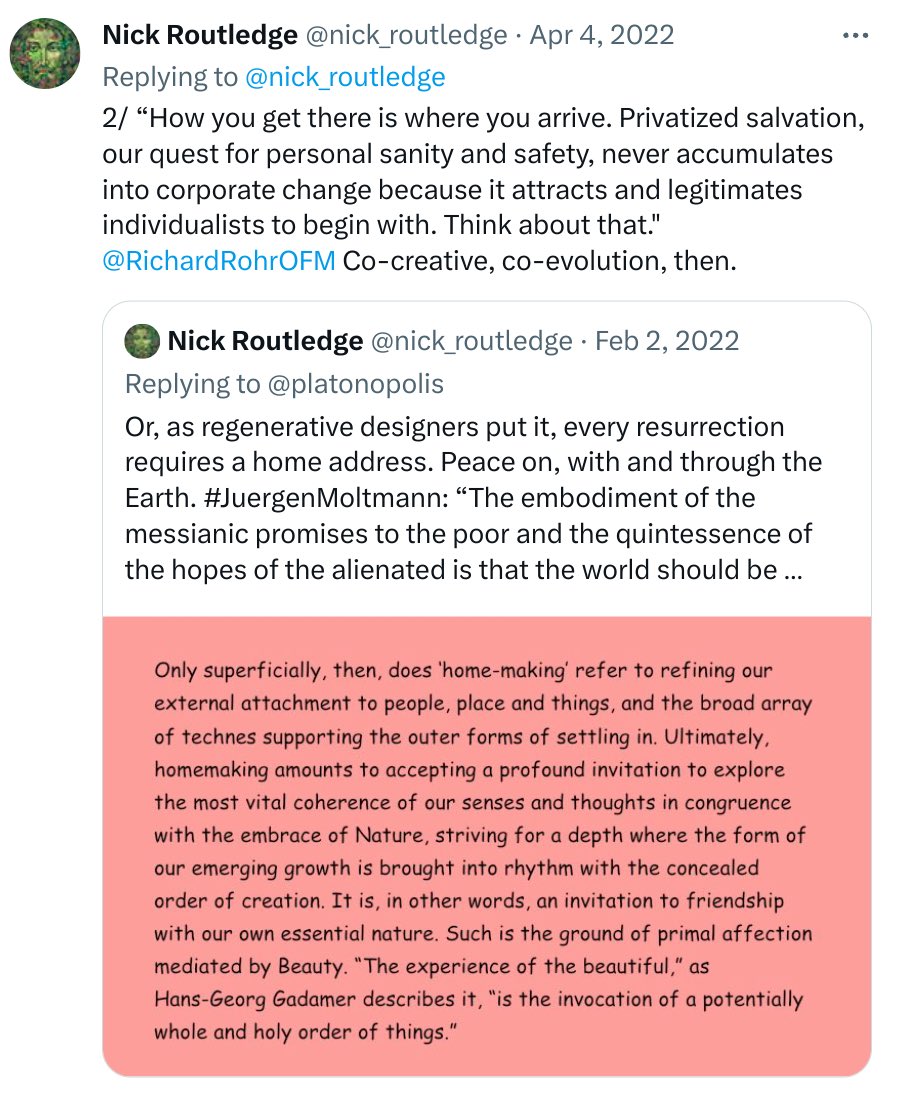
Image description
Original X alt text
Copy of tweet and quote tweet here: Including image reading: Only superficially, then, does 'home-making' refer to refining our external attachment to people, place and things, and the broad array of technes supporting the outer forms of settling in. Ultimately, homemaking amounts to accepting a profound invitation to explore the most vital coherence of our senses and thoughts in congruence with the embrace of Nature, striving for a depth where the form of our emerging growth is brought into rhythm with the concealed order of creation. It is, in other words, an invitation to friendship with our own essential nature. Such is the ground of primal affection mediated by Beauty. "The experience of the beautiful,” as Hans-Georg Gadamer describes it, “is the invocation of a potentially whole and holy order of things.”