
@MassimoFaggioli 2/ Hardly surprising that Western interpreters, wired fast relative to the world, were first to get to theological grips with the the root, ontological substrate of the WWW. As early as the mid-90's, our sages intuited its arrival as an evolutionary turn of parousiacal potential.
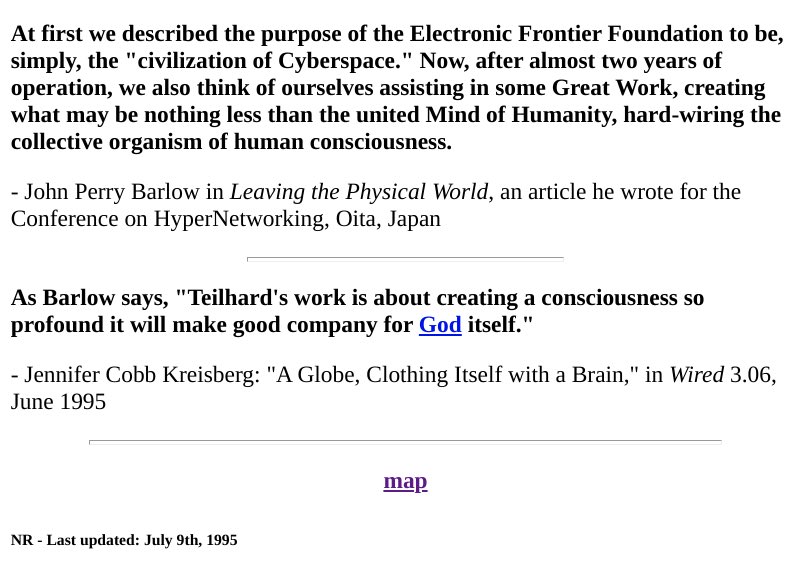
Image description
Original X alt text
Copy of text here: At first we described the purpose of the Electronic Frontier Foundation to be, simply, the "civilization of Cyberspace." Now, after almost two years of operation, we also think of ourselves assisting in some Great Work, creating what may be nothing less than the united Mind of Humanity, hard-wiring the collective organism of human consciousness. - John Perry Barlow in Leaving the Physical World, an article he wrote for the Conference on Hype - rNetworking, Oita, Japan As Barlow says, "Teilhard's work is about creating a consciousness so profound it will make good company for God itself." - Jennifer Cobb Kreisberg: "A Globe, Clothing Itself with a Brain," in Wired 3.06, June 1995 - map NR - Last updated: July 9th, 1995
@bearspeaks Depends what you're about. Even if its positive evolutionary significance remains largely unrecognized, no other platform weds to the peculiar ontological promise of internetworked hypertext as does Twitter. Some get it. Most don't. ?s=20
View this post’s context →