
@alastairmci @davidwhetham @acsc_j 1/ "Peace like Being is neither static nor dynamic...it is Rhythm...the non-dualistic integration of movement and quiet, of striving towards the goal and enjoying it. Rhythm is the deepest nature of Reality." Hazrat Inayat Khan: "Time is the rhythm that is in the whole universe."
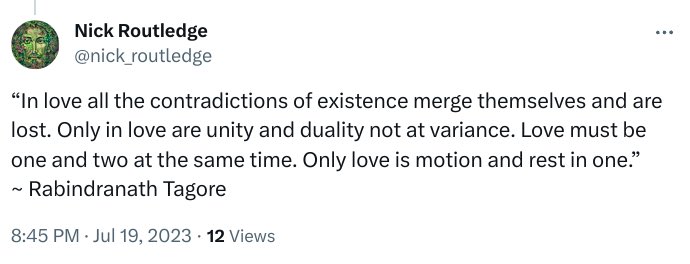
Image description
Original X alt text
Copy of tweet: “In love all the contradictions of existence merge themselves and are lost. Only in love are unity and duality not at variance. Love must be one and two at the same time. Only love is motion and rest in one.” ~ Rabindranath Tagore
@jesuits_ireland @Pontifex 6/ "Illich says relatively little about messianic time in his writings, but I have found some clarification in the writings of Giorgio Agamben: “[There is] nothing in the scope of our present knowledge,” he writes, “that was not profoundly renewed by [Illich's] vision.” ~ Cayley
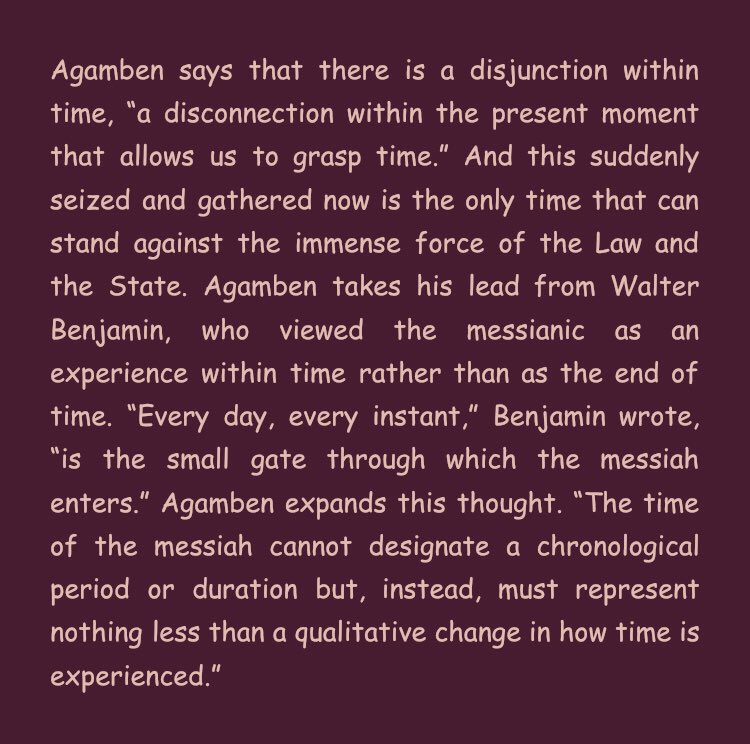
Image description
Original X alt text
Agamben says that there is a disjunction within time, “a disconnection within the present moment that allows us to grasp time.” And this suddenly seized and gathered now is the only time that can stand against the immense force of the Law and the State. Agamben takes his lead from Walter Benjamin, who viewed the messianic as an experience within time rather than as the end of time. “Every day, every instant,” Benjamin wrote, “is the small gate through which the messiah enters.” Agamben expands this thought. “The time of the messiah cannot designate a chronological period or duration but, instead, must represent nothing less than a qualitative change in how time is experienced.”
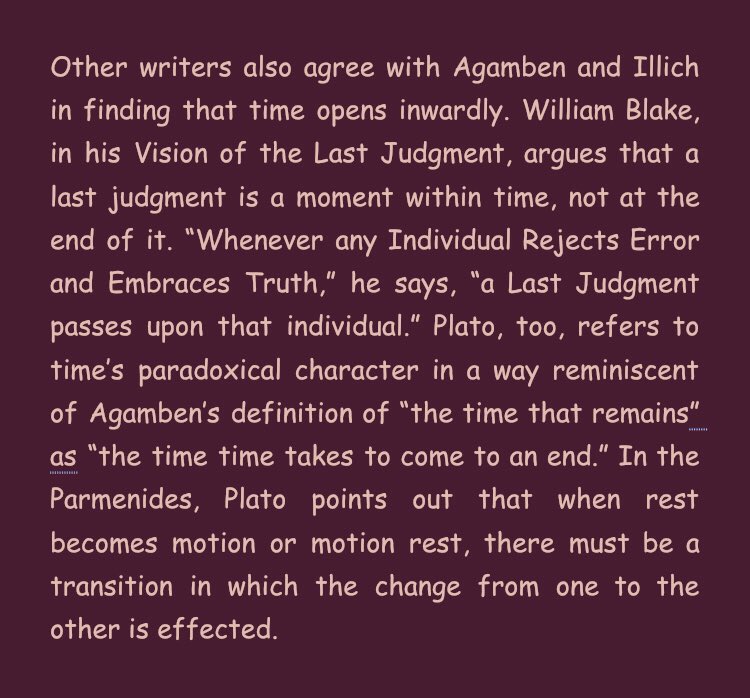
Image description
Original X alt text
Other writers also agree with Agamben and Illich in finding that time opens inwardly. William Blake, in his Vision of the Last Judgment, argues that a last judgment is a moment within time, not at the end of it. “Whenever any Individual Rejects Error and Embraces Truth,” he says, “a Last Judgment passes upon that individual.” Plato, too, refers to time’s paradoxical character in a way reminiscent of Agamben’s definition of “the time that remains” as “the time time takes to come to an end.” In the Parmenides, Plato points out that when rest becomes motion or motion rest, there must be a transition in which the change from one to the other is effected.
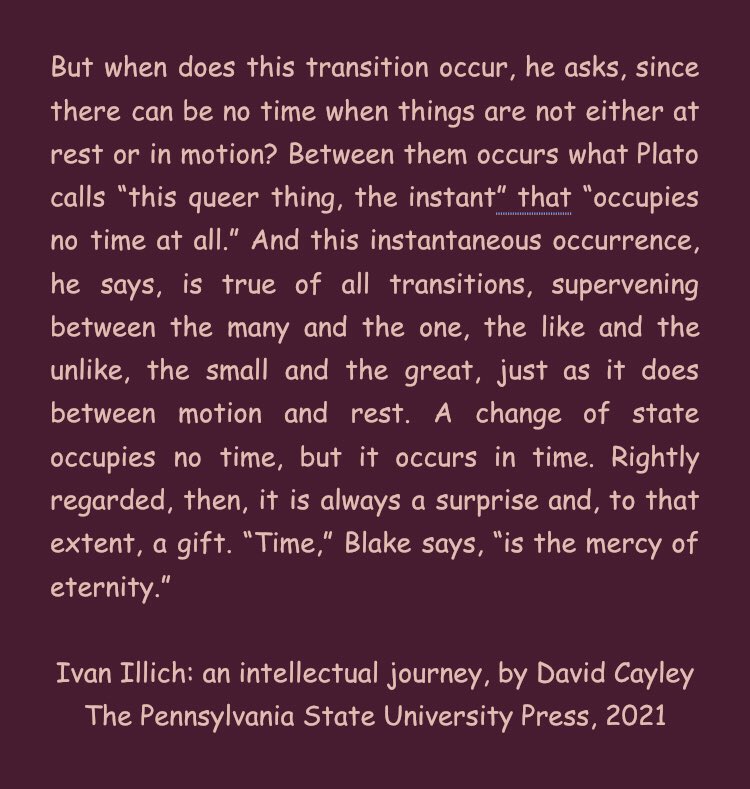
Image description
Original X alt text
But when does this transition occur, he asks, since there can be no time when things are not either at rest or in motion? Between them occurs what Plato calls “this queer thing, the instant” that “occupies no time at all.” And this instantaneous occurrence, he says, is true of all transitions, supervening between the many and the one, the like and the unlike, the small and the great, just as it does between motion and rest. A change of state occupies no time, but it occurs in time. Rightly regarded, then, it is always a surprise and, to that extent, a gift. “Time,” Blake says, “is the mercy of eternity.” Ivan Illich: an intellectual journey, by David Cayley The Pennsylvania State University Press, 2021
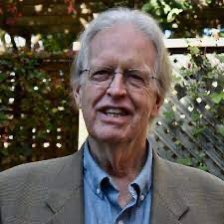
Image description
Original X alt text
Portrait of David Cayley.